
Person-Centered Therapy Practice Test
$69.00
- Buy to unlock unlimited access to all Quiz questions and Answers in this Quiz.
- After purchase you can print a PDF of the whole quiz at any point. The PDF will contain the questions and the correct answers.
About this Exam
Person-Centered Therapy Practice Exam is a comprehensive and highly effective tool designed to empower individuals preparing for certification or licensure in the field of humanistic counseling. Person-Centered Therapy, pioneered by Carl Rogers, is a revolutionary approach that places the client at the center of the therapeutic process, emphasizing their inherent capacity for self-healing and growth.
This practice exam is crafted for aspiring counselors, psychotherapists, psychologists, social workers, and mental health professionals who are studying to demonstrate proficiency in this cornerstone modality. By utilizing this resource, you can confidently prepare to validate your understanding of key humanistic principles, therapeutic relationship building, and clinical application required for a successful career in counseling.
Ready to test your knowledge?
Buy Now to Access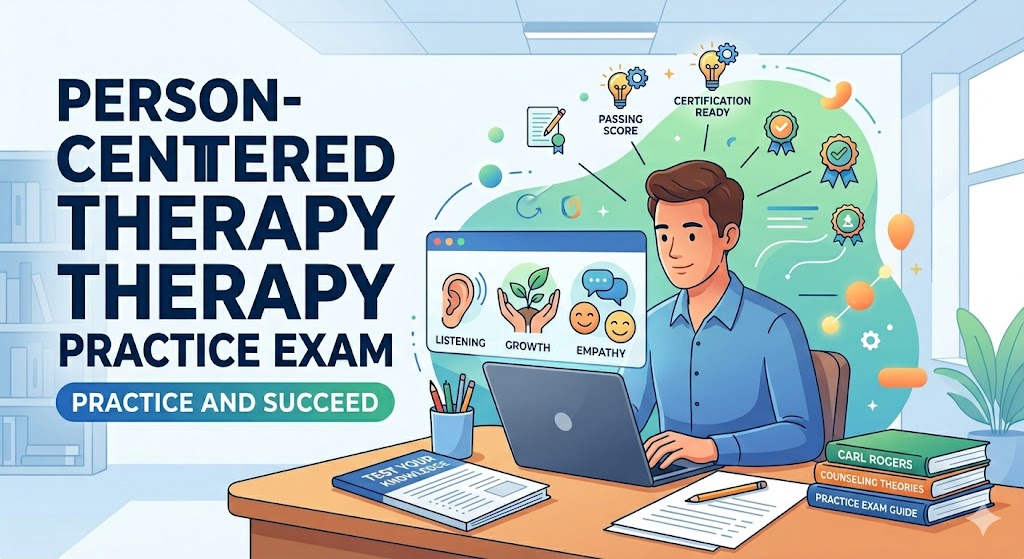
Additional Information
What the Course Entails and Exam Details
The Person-Centered Therapy Practice Exam evaluates deep understanding and clinical application of key humanistic concepts. While tailored specifically for Person-Centered assessments, it addresses foundational topics often covered in comprehensive counseling coursework and licensure exams.
Key Topics and Content Areas Covered:
Philosophical Underpinnings: The humanistic perspective and Carl Rogers’ core beliefs about human nature.
The Three Core Conditions:
Empathy: The therapist's ability to understand the client's experience from their internal frame of reference.
Unconditional Positive Regard (UPR): Accepting and respecting the client as a unique individual, free from judgment.
Congruence (Genuineness): The therapist being authentic, transparent, and integrated within the therapeutic relationship.
Rogers’ Theory of Self and Personality: Concepts of self-actualization, conditions of worth, and the organismic valuing process.
The Therapeutic Relationship as the Catalyst for Change: Understanding how the core conditions, rather than techniques, facilitate healing and growth.
Clinical Process and Techniques (Minimalist Approach): Focusing on active listening, reflection, and non-directive communication.
Application across Diverse Populations and Clinical Settings: Adapting principles for varying needs while maintaining the core philosophy.
Contemporary Developments and Criticisms of Person-Centered Therapy: Understanding its evolution and limitations.
What to Expect in the Final Exam
While the exact structure and delivery can vary significantly depending on the specific state board, certifying organization, or academic program administering the final exam, most examinations assessing competence in Person-Centered Therapy and general counseling principles will include several common elements.
Typically, you can expect:
Format: The predominant format is multiple-choice questions designed to test knowledge retrieval and case application. Some exams may also include true/false, matching, short answer, or case study responses.
Types of Questions: Anticipate questions focusing on definitions of key terms, differentiating between core conditions, identifying appropriate therapeutic responses in specific client scenarios, and applying ethical guidelines to decision-making.
Question Count: A comprehensive final exam often consists of 100 to 150 questions.
Time Limit: Generally ranges from 2 to 3 hours, requiring strong time management skills.
Passing Score: Often set between 70% and 80%, indicating a solid grasp of the subject matter.
General Rules: The majority of licensing and certification exams are closed-book, demanding a robust recall of information and concepts.
Practicing with resources like this exam helps you acclimate to these varied challenges.
How to Study and Exam Centers
Effective preparation for any specialized counseling examination, particularly one centered on Person-Centered principles, requires a dedicated and multifaceted approach that emphasizes deep conceptual understanding over simple memorization.
Highly Actionable Study Strategies:
Engage with Core Texts: Prioritize reading Carl Rogers' foundational works, such as "On Becoming a Person" and "Client-Centered Therapy," and supplement them with a modern, comprehensive counseling textbook that covers humanistic theories in depth.
Master the Core Conditions: Focus intensely on understanding empathy, congruence, and unconditional positive regard. Practice identifying their absence or presence in therapeutic scenarios.
Utilize Active Recall: Create detailed flashcards for key terms, theories, and Rogers’ theoretical framework to test your recall.
Employ Practice Exams: Actively use comprehensive practice tests like this one to identify weak points, familiarize yourself with different question formats, and practice your time management under realistic conditions. Critically review correct answers and explanations.
Form Study Groups and Discuss: Regularly meet with peers to discuss complex concepts, review difficult questions, and share study strategies. Explain concepts to each other to reinforce understanding.
Seek Application in Supervision/Role-Play: If possible, participate in role-playing exercises or observe therapy sessions (within ethical guidelines) focusing on embodying the core conditions.
Finding Exam Centers:
The majority of formal counseling licensing and certification examinations are administered through established, secure testing centers to ensure integrity. Common providers and options include:
Pearson VUE: A global leader in computer-based testing, offering a vast network of secure test centers. Many national and state licensing bodies use this platform.
Prometric: Another major provider offering professional licensing and certification exams through its extensive network of testing centers.
State-Specific Centers: Some state licensing boards may administer exams directly or through specific authorized academic institutions.
Remote Proctoring: Increasingly, secure online proctoring options are available, allowing you to take exams from controlled remote environments.
Contact your specific licensing board, the National Board for Certified Counselors (NBCC), or your program administrator for precise information regarding authorized test centers and scheduling procedures in your region.
Job Opportunities from the Course
A deep understanding and ability to practice Person-Centered Therapy is highly valued across numerous mental health and human service professions. Demonstrating proficiency through certification often makes you a more competitive and versatile candidate in the field.
Common Career Paths and Job Titles:
Licensed Professional Counselor (LPC) / Licensed Mental Health Counselor (LMHC): Providing psychotherapy to individuals, couples, families, and groups in private practice, community clinics, or hospitals.
Psychotherapist: Working independently or within a clinical team to treat mental health disorders and emotional challenges, often specializing in humanistic modalities.
Clinical Social Worker (LCSW): Employing Person-Centered principles to address complex psychosocial issues within diverse settings.
Substance Abuse Counselor: Utilizing the non-judgmental and empathic nature of Person-Centered approaches to support clients in addiction recovery.
School Counselor: Applying Rogers’ principles to create a supportive and understanding environment for students’ personal and academic development.
Rehabilitation Counselor: Helping individuals with disabilities to achieve personal, social, and vocational goals through empowerment and unconditional positive regard.
Case Manager: Using active listening and empathy to assess client needs and connect them with appropriate support services.
Human Resources Specialist / Employee Assistance Program (EAP) Counselor: Applying humanistic communication skills to support employee well-being, resolve conflicts, and promote positive workplace dynamics.
Life Coach / Personal Development Coach: Guiding individuals toward achieving their personal aspirations using principles of growth and self-actualization.
A foundation in Person-Centered values is invaluable in any role that requires building trusting, supportive relationships and facilitating client growth.
Frequently Asked Questions
Reviews
5.0
Based on 0 reviews
Leave a Review
No reviews yet. Be the first to review!