
Personal Financial Literacy Module 4 DBA Practice Test
$69.00
- Buy to unlock unlimited access to all Quiz questions and Answers in this Quiz.
- After purchase you can print a PDF of the whole quiz at any point. The PDF will contain the questions and the correct answers.
About this Exam
The Personal Financial Literacy Module 4 DBA (Discussion-Based Assessment) is a critical evaluation designed for students, typically in high school or early college, who are completing a course in personal finance. This specific assessment focuses on essential long-term financial planning concepts and acts as a one-on-one conversation between the student and the instructor. It is designed to ensure students don't just memorize terms but genuinely understand how to apply financial principles to their future lives, covering crucial areas that impact their long-term financial well-being.
Ready to test your knowledge?
Buy Now to Access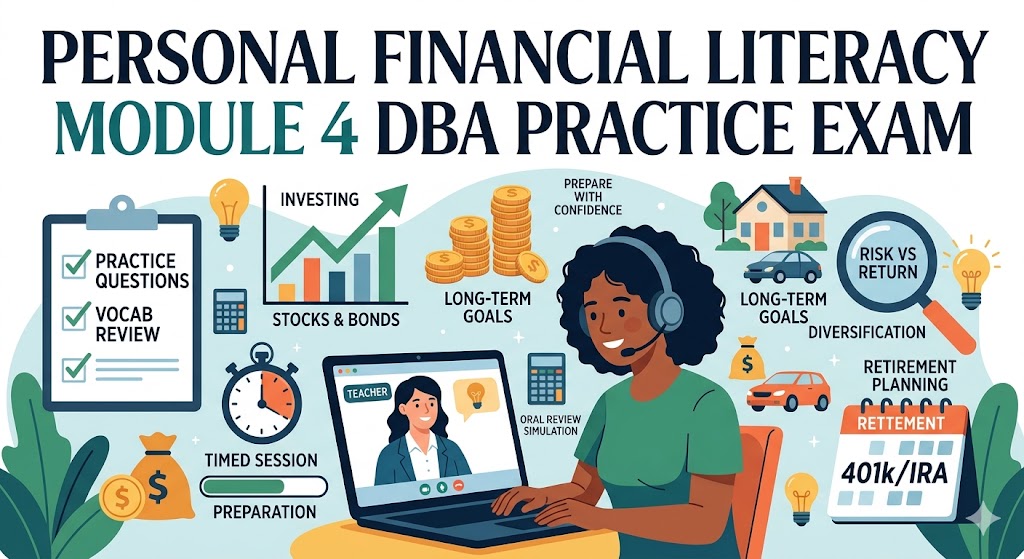
Additional Information
What the Course Entails and Exam Details
This module delves into complex yet vital aspects of personal financial management. The core topics generally include investing strategies, understanding different types of investment vehicles (such as stocks, bonds, and mutual funds), risk management, and diversification. Students also explore retirement planning, analyzing different retirement accounts (like 401(k)s and IRAs), and understanding the impact of inflation and the time value of money on long-term savings. The discussion may also touch upon estate planning basics or insurance needs for long-term security. The assessment is not a written test but a dynamic conversation, where students must explain these concepts clearly and sometimes apply them to hypothetical scenarios provided by the teacher.
What to Expect in the Final Exam
The DBA is an oral assessment, typically conducted via video conference or phone call, lasting anywhere from 10 to 20 minutes. There are no multiple-choice questions; instead, your instructor will ask open-ended questions based on the module's material. You should expect to be asked to define key terms, compare different financial strategies, explain the rationale behind certain financial decisions (like why diversification is important), or solve simple verbal problems. The grading is based on your ability to articulate your understanding, demonstrate critical thinking, and confidently discuss the topics. While there isn't a "passing score" in the traditional sense, a successful DBA shows mastery, and your teacher will provide feedback and a grade based on your performance.
How to Study and Exam Centers
Preparation for an oral exam requires a different approach than studying for a written one. Start by thoroughly reviewing all course materials, notes, and vocabulary for Module 4. Create flashcards for key terms and concepts. However, the most crucial study strategy is to practice explaining the concepts out loud. Role-play the DBA with a friend, family member, or classmate, having them ask you questions about investing, retirement, and risk. Form study groups to discuss topics and clarify any confusion. Practice answering questions clearly and concisely. For the actual assessment, there are no physical "exam centers" in the traditional sense; DBAs are typically scheduled directly with your instructor and conducted online through your course platform (like Canvas, Blackboard, or FLVS’s system) or via a scheduled phone call. Ensure you have a quiet environment and a reliable connection for the scheduled time.
Job Opportunities from the Course
While this module is primarily focused on personal financial health, the knowledge gained is foundational for many careers in the financial services sector. Understanding these concepts can open doors to various entry-level positions and career paths.
Financial Clerk
Loan Processor
Investment Assistant
Entry-level Accountant (often requires further education)
Financial Aid Advisor
Wealth Management Coordinator
Customer Service Representative in Finance
Payroll Clerk
Frequently Asked Questions
Reviews
5.0
Based on 0 reviews
Leave a Review
No reviews yet. Be the first to review!