
Personal Jurisdiction Practice Test
$69.00
- Buy to unlock unlimited access to all Quiz questions and Answers in this Quiz.
- After purchase you can print a PDF of the whole quiz at any point. The PDF will contain the questions and the correct answers.
About this Exam
The Personal Jurisdiction Practice Exam is an essential tool for law students, paralegals, and legal professionals aiming to master one of the fundamental concepts of civil procedure. This exam is designed to test your understanding of a court's authority over a specific defendant. It is critical for anyone preparing for the Multistate Bar Examination (MBE), law school finals, or any legal certification requiring a deep dive into jurisdictional rules and principles in the United States.
Ready to test your knowledge?
Buy Now to Access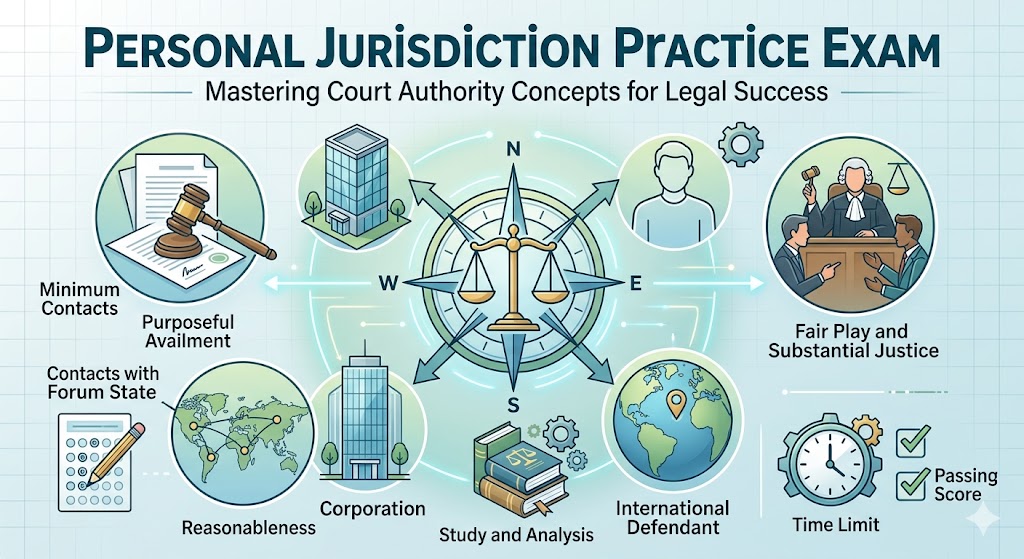
Additional Information
What the Course Entails and Exam Details
This practice exam covers the full spectrum of Personal Jurisdiction doctrine. Candidates must demonstrate proficiency in analyzing whether a court has the power to hear a case involving a particular party, whether that party is a person, corporation, or other entity. The core topics included are:
The constitutional basis for Personal Jurisdiction: Due Process clauses of the Fifth and Fourteenth Amendments.
Traditional bases: Presence, domicile, consent, and waiver.
Modern concepts: Minimum contacts analysis, purposeful availment, and relatedness (specific vs. general jurisdiction).
The "Fair Play and Substantial Justice" test and reasonableness factors.
The impact of state long-arm statutes.
Specific application of jurisdiction rules to modern technology, internet activity, and stream of commerce scenarios.
Procedural aspects: Challenging personal jurisdiction (e.g., special appearances, Rule 12(b)(2) motions) and waiver.
What to Expect in the Final Exam
The final practice exam is a rigorous simulation of the type of assessment you will encounter in high-stakes legal testing environments. It consists of multiple-choice questions, which may vary in number depending on the specific practice platform (often ranging from 30 to 100 questions).
The exam is typically timed to mimic realistic test conditions, providing an experience that helps you manage time effectively during your actual exam. A passing score is generally considered a strong percentile ranking or a set percentage (e.g., 70% or higher), demonstrating competency across all tested subtopics. The interface will often highlight incorrect answers and provide detailed explanations to reinforce learning.
How to Study and Exam Centers
Effective preparation requires a combination of rote learning and practical application. Study strategies include:
Case Law Review: Actively review landmark Supreme Court cases, including International Shoe Co. v. Washington, Burger King Corp. v. Rudzewicz, World-Wide Volkswagen Corp. v. Woodson, and Daimler AG v. Bauman. Focus on the facts, legal reasoning, and the precise holding of each case.
Active Recall and Hypos: Solve numerous "hypos" (hypothetical legal scenarios) that test your ability to apply the law to new facts.
Practice Tests: Utilize practice exams extensively. These can be found on online legal education platforms, Bar review courses (like Barbri or Themis), and often provided by law school professors.
Flashcards: Use digital or physical flashcards for definitions of key terms and rules (e.g., "Purposeful Availment," "General Jurisdiction").
Regarding Exam Centers: As a practice test, this is primarily accessed through online learning portals or downloadable materials. However, candidates should be aware that the actual exams this material prepares you for (like the Bar Exam) are administered in physical testing centers by state boards of law examiners or through professional testing services like Pearson VUE for specific certifications.
Job Opportunities from the Course
A strong grasp of Civil Procedure, particularly Personal Jurisdiction, is a foundational skill for a wide range of legal careers. Mastery of this subject is essential for:
Litigation Attorney: Required for analyzing the initial complaint, determining the correct forum, and successfully challenging or establishing jurisdiction.
Paralegal: Crucial for drafting motions to dismiss, conducting jurisdictional discovery, and preparing case strategy.
Law Clerk: Essential for researching complex jurisdictional issues and advising judges on legal standards.
Compliance Officer: Needed for advising businesses on the jurisdictional implications of their interstate and international operations.
Legal Consultant: Often consulted for expertise on forum selection clauses and minimizing jurisdictional risk in corporate contracts.
Frequently Asked Questions
Reviews
5.0
Based on 0 reviews
Leave a Review
No reviews yet. Be the first to review!