
Pest Control Adviser (PCA) Plant Pathogens Practice Exam
$69.00
- Buy to unlock unlimited access to all Quiz questions and Answers in this Quiz.
- After purchase you can print a PDF of the whole quiz at any point. The PDF will contain the questions and the correct answers.
About this Exam
The Pest Control Adviser (PCA) certification is a prestigious credential for agricultural professionals who provide written recommendations to growers on any pest control matter. To obtain this license, applicants must demonstrate proficiency across several categories, with Plant Pathogens being one of the most critical. This specific category is designed for individuals who intend to specialize in the identification, biology, and management of plant diseases caused by fungi, bacteria, viruses, and other microorganisms. A licensed PCA in Plant Pathogens is an essential partner for farmers, helping them protect crop yields, optimize resource use, and implement sustainable Integrated Pest Management (IPM) programs. This practice exam is an invaluable tool for candidates preparing to demonstrate their expertise and advance their careers in agricultural consultation.
Ready to test your knowledge?
Buy Now to Access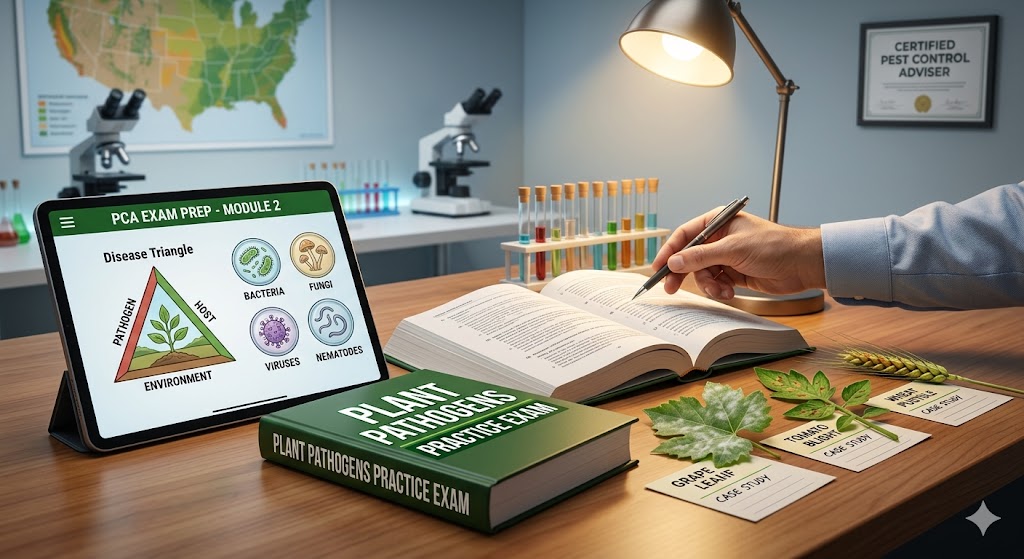
Additional Information
What the Course Entails and Exam Details
Preparing for the PCA Plant Pathogens exam requires a deep understanding of plant pathology and its practical application in the field. The corresponding coursework or self-study materials cover a vast range of topics including:
Fundamentals of Plant Pathology: Definitions of pathogen, disease, signs, and symptoms; the "Disease Triangle" (host, pathogen, environment); and Koch's Postulates for proof of pathogenicity.
Pathogen Identification and Biology: Detailed study of major pathogen groups—fungi, bacteria, viruses, and nematodes. You will learn their characteristics, methods of reproduction, survival mechanisms, and methods of dispersal.
Abiotic vs. Biotic Factors: Distinguishing between non-living causes of plant stress (nutrient deficiencies, weather damage, toxicity) and living pathogens.
Disease Cycles and Epidemiology: Understanding how diseases develop, spread through a crop, and create epidemics, including the concept of primary and secondary inoculum.
Principles of Disease Management: Developing integrated strategies using cultural controls (rotation, sanitation), host resistance, biological controls, and chemical methods (fungicides, bactericides, nematicides).
The examination process is rigorous and state-specific. For example, in California, the Department of Pesticide Regulation (DPR) oversees licensing. Candidates must pass a "Laws, Regulations, and Basic Principles" exam, plus at least one category exam like Plant Pathogens.
What to Expect in the Final Exam
The final PCA Plant Pathogens exam is designed to test not only theoretical knowledge but also your ability to apply that knowledge to real-world agricultural scenarios.
Format: The exam typically consists of multiple-choice questions. It is a closed-book test.
Question Types: While some questions may require recall of specific pathogen names or life cycle stages, many will be scenario-based. You might be presented with a description of symptoms on a specific crop and environment, and be asked to diagnose the most likely pathogen and recommend an effective, IPM-compliant course of action.
Passing Score: The required passing score varies by jurisdiction but is generally around 70%.
Time Limit: You will have a specific time allotment to complete the exam, which will be detailed in your candidate handbook.
Specific Rules: Expect standard professional testing protocols. No electronic devices, notebooks, or outside resources are permitted during the examination. It is essential to arrive early with required identification.
How to Study and Exam Centers
Effective preparation is the key to passing this challenging exam. Here are actionable study strategies:
Master the Core Material: Use the official study guides provided by your state licensing agency. In California, this includes the University of California IPM manuals. These are the primary resource for exam content.
Use Practice Exams: Take advantage of practice exams, like this one, to familiarize yourself with the question format, identify areas of weakness, and build confidence.
Focus on Integrated Pest Management (IPM): The modern PCA exam heavily emphasizes IPM. Your recommendations should always consider prevention, monitoring, and non-chemical controls before pesticide use.
Create Visual Aids: Draw disease cycles, make flashcards for specific pathogens and their symptoms, and create comparison tables for different types of fungicides.
Regarding exam centers, PCA licensing exams are typically administered through a third-party testing vendor or directly by the state's agricultural department. Locations often include:
Pearson VUE and Similar Centers: Many states utilize computer-based testing networks with numerous physical locations.
State-Authorized Locations: In some cases, specific county agricultural commissioner offices or authorized educational institutions may serve as testing sites.
Upon registering with your state's Department of Agriculture (e.g., California's DPR), you will receive specific instructions on how to schedule your exam at a convenient authorized center.
Job Opportunities from the Course
A Pest Control Adviser license with a specialization in Plant Pathogens unlocks a variety of impactful career paths in agricultural consultation and management. Here is a list of job titles and opportunities this certification can provide:
Integrated Pest Management (IPM) Specialist: Developing and implementing comprehensive, sustainable pest and disease management plans for growers and large agricultural operations.
Independent Agricultural Consultant: Providing fee-for-service advice to a diverse client base of farmers, helping them make informed decisions on crop protection and soil health.
Crop Advisor / Field Scout: Working for agricultural supply companies or cooperatives, scouting fields to identify pathogen threats and making timely written recommendations for product applications.
Technical Service Representative: Working for manufacturers of pesticides, biocontrols, or seed companies, providing technical expertise and support to PCA and growers.
Government Agricultural Inspector: Working at the county or state level to enforce pesticide laws, conduct pest detection programs, and manage invasive species.
Farm Manager with Specialization: Overseeing farm operations with a focused expertise in minimizing yield losses from plant diseases.
Research Assistant / Associate: Working in plant pathology labs or field trial stations, contributing to the development of new disease-resistant crop varieties or control methods.
Golf Course Superintendent / Landscape Manager: Managing high-value turf and ornamental plants, where precise diagnosis and treatment of diseases are critical for visual appeal and playability.
Frequently Asked Questions
Reviews
5.0
Based on 0 reviews
Leave a Review
No reviews yet. Be the first to review!