
Pesticide Commercial Dispenser Practice Test
$69.00
- Buy to unlock unlimited access to all Quiz questions and Answers in this Quiz.
- After purchase you can print a PDF of the whole quiz at any point. The PDF will contain the questions and the correct answers.
About this Exam
The Pesticide Commercial Dispenser Certification is a crucial professional credential designed for individuals who apply, sell, or supervise the use of restricted-use pesticides for hire. This comprehensive certification ensures that operators understand the legal, safety, and environmental responsibilities associated with modern pest management. The course and subsequent exam are designed for professionals working in varied fields such as landscaping, structural pest control, agricultural service provision, and industrial weed control. Achieving this license demonstrates a commitment to public safety and environmental stewardship, while legally authorizing you to conduct specialized pesticide applications that non-certified individuals cannot.
Ready to test your knowledge?
Buy Now to Access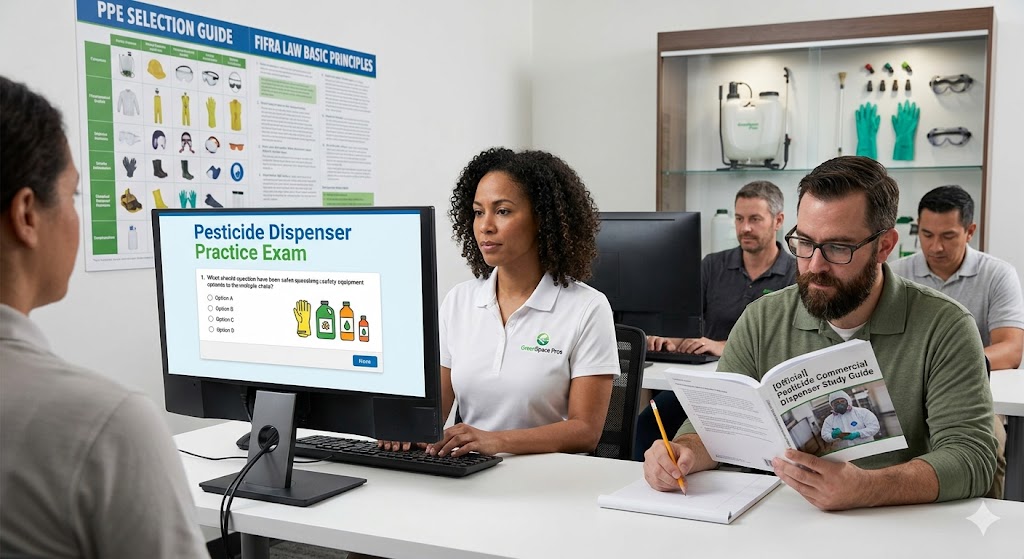
Additional Information
What the Course Entails and Exam Details
To prepare for the exam, candidates typically engage in a combination of self-study and authorized training courses that cover an extensive syllabus. The core components of the course focus on foundational knowledge required for all dispensers, including federal and local pesticide laws and regulations, comprehensive label comprehension, and the categorization of different pesticide types. You will study personal protective equipment (PPE) selection and use, advanced calculation methods for equipment calibration, and critical strategies for minimizing environmental impacts like drift and groundwater contamination. A major focus is Integrated Pest Management (IPM), which teaches techniques for monitoring pests and choosing the least toxic control methods. Depending on your career path, you may also need to study specialized material for specific "categories," such as Structural Pest Control, Turf and Ornamental Management, Aquatic Pest Control, or Right-of-Way application, which detail the specific pests and techniques relevant to those environments.
What to Expect in the Final Exam
The final certification exam is a formal, proctored test designed to rigorously evaluate your competency in safe pesticide management. It usually consists of a standard Core Exam, which covers the general principles applicable to all operators, and at least one category-specific exam relevant to your field of work. The format is typically multiple-choice questions administered either on a computer or as a traditional paper-and-pencil test. The exams are timed, demanding both accuracy and efficiency, with common time limits ranging from 90 minutes to three hours per section. A passing score is frequently set at 70% or higher, and candidates are required to present valid government-issued photo identification upon arrival. Strict rules are in place, often prohibiting the use of personal calculators or unauthorized study aids during the examination to ensure fairness and integrity.
How to Study and Exam Centers
Effective preparation is key to success on this challenging exam, and it is recommended that you develop a comprehensive study plan. Your first step should be to obtain the official study manuals and core guides from your jurisdiction’s leading agricultural or environmental department. Many candidates find that enrolling in in-person or online preparatory courses offered by university extension programs or authorized industrial groups dramatically improves their understanding and pass rates. You can also utilize official online portals for practice tests that simulate the real exam’s format and timing, which will build both your knowledge and your confidence. When you are ready, the actual exam can be taken at specific, authorized physical testing centers, which may include state government offices, university testing labs, or third-party proctoring locations like Pearson VUE centers. You should check your state or provincial department of agriculture's website for a complete list of authorized locations and online booking portals.
Job Opportunities from the Course
A Pesticide Commercial Dispenser license opens doors to a diverse array of professional career paths and often leads to higher earning potential. It is an essential requirement for many roles in both the public and private sectors, including the following:
Commercial Pesticide Applicator
Pest Control Technician (Structural)
Turf and Ornamental Manager (e.g., Golf Course Superintendent, Landscaper)
Agricultural Service Provider (e.g., Custom Applicator, Crop Consultant)
Utility Right-of-Way Manager
Urban Forestry Applicator
Industrial or Municipal Weed Control Specialist
Pesticide Sales Representative and Technical Advisor
Frequently Asked Questions
Reviews
5.0
Based on 0 reviews
Leave a Review
No reviews yet. Be the first to review!