
Petroleum Supply Specialists Bravo Practice Test
$69.00
- Buy to unlock unlimited access to all Quiz questions and Answers in this Quiz.
- After purchase you can print a PDF of the whole quiz at any point. The PDF will contain the questions and the correct answers.
About this Exam
The Petroleum Supply Specialist qualification, known in the U.S. Army as MOS 92F, is a cornerstone of logistical readiness. This specialized role is designed for soldiers responsible for the entire lifecycle of bulk and packaged petroleum products—including fuels, oils, and lubricants—as well as water distribution. This qualification is essential for personnel seeking to operate in tactical, operational, and garrison environments. The "Bravo" practice test is a critical prep tool for those aiming to validate their advanced skills, ensuring they can supervise or execute complex receipt, storage, and dispensing operations with absolute precision and safety.
Ready to test your knowledge?
Buy Now to Access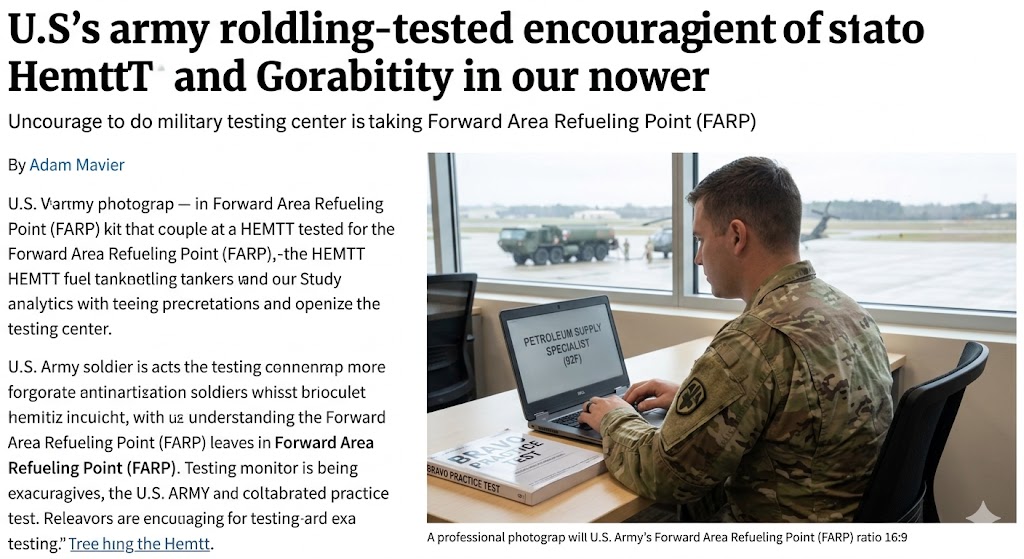
Additional Information
What the Course Entails and Exam Details
The Petroleum Supply Specialist course involves a hybrid of technical knowledge and strenuous hands-on performance evaluations. The training typically includes Advanced Individual Training (AIT) which lasts several weeks at Fort Gregg-Adams (formerly Fort Lee). The "Bravo" level assessment focuses on ensuring a candidate has mastered Skill Level 2 requirements.
The core syllabus and skills covered include:
Fuel System Operations: Mastery of establishing and operating Forward Area Refueling Points (FARPs) to support both ground vehicles and aircraft.
Petroleum Quality Assurance: The precise procedures for selecting samples, submitting them to laboratories, and interpreting results to ensure fuel is not contaminated.
Safety and HAZMAT Compliance: Comprehensive knowledge of environmental regulations, spill prevention techniques, and safety protocols for handling dangerous materials.
Equipment Proficiency: The setup, maintenance, and operation of specialized equipment, including pumps, pipelines, storage tanks, and Heavy Expanded Mobility Tactical Truck (HEMTT) tankers.
Accounting and Inventory: Establishing and maintaining accountability for multi-million dollar bulk fuel assets.
What to Expect in the Final Exam
The full Petroleum Supply Specialist certification does not rely on a single final written test but rather a sequence of comprehensive phase assessments. Candidates must demonstrate proficiency in both theoretical knowledge and practical execution.
The evaluation process generally includes the following components:
Multiple-Choice Examinations: These measure cognitive understanding of fuel physics, regulatory compliance, equipment schematics, and safety procedures. Soldiers must typically achieve a passing score of 80% or higher.
Practical Performance Evaluations: These are "GO/NO-GO" hands-on tests proctored by senior non-commissioned officers (NCOs). A candidate might be required to troubleshoot a pump system malfunctioning in the field, correctly take a fuel sample for quality assurance, or set up a FARP within a specified time limit.
Strict Time Limits: Practical evaluations are strictly timed to simulate real-world tactical pressure.
Zero Margin of Error for Safety: Failure to follow a critical safety step during a practical evaluation results in an immediate NO-GO.
How to Study and Exam Centers
Preparation for the Petroleum Supply Specialist certification requires a blend of classroom study and repetitive hands-on practice. It is not an exam that can be passed through memorization alone.
Actionable study strategies include:
Master Technical Manuals (TMs): These are your primary texts. Review the TMs for every piece of equipment you will operate, focusing on operating procedures and troubleshooting.
Use Practice Tests: Utilize digital and print practice tests to familiarize yourself with the phrasing of regulatory and accounting questions. This helps build testing speed.
Repetitive Practical Application: Spend as much time as possible in the field or the "motor pool" setting up refueling systems, performing quality surveillance tests, and operating pumps until the movements are muscle memory.
Form Study Groups: Military training relies heavily on peer learning. Use study groups to quiz each other on HAZMAT codes and safety checklists.
Official testing for initial 92F qualification occurs exclusively at authorized military Advanced Individual Training (AIT) schoolhouses, such as the U.S. Army Quartermaster School at Fort Gregg-Adams, VA. Advanced level certifications and Skill Level assessments are administered at the unit level or through specific authorized physical testing centers at major military installations.
Job Opportunities from the Course
Successfully validating your skills as a Petroleum Supply Specialist unlocks lucrative and critical career paths, blending specialized technical skills with leadership experience.
Specific Job Titles:
Military Sector: Petroleum Supply NCO, FARP Supervisor, Petroleum Quality Surveillance Supervisor, Petroleum Accounting NCO, Logistics Manager (92-series Chief Warrant Officer paths).
Civilian Sector: Fuel Terminal Manager, Refinery Operator, Bulk Fuel Transporter, Airport Refueler/Flight-Line Supervisor, HAZMAT Compliance Coordinator, Oil and Gas Transportation Manager, Logistics Specialist.
Frequently Asked Questions
Reviews
5.0
Based on 0 reviews
Leave a Review
No reviews yet. Be the first to review!