
Petty Officer of the Watch (POOW) Practice Test
$69.00
- Buy to unlock unlimited access to all Quiz questions and Answers in this Quiz.
- After purchase you can print a PDF of the whole quiz at any point. The PDF will contain the questions and the correct answers.
About this Exam
The Petty Officer of the Watch (POOW) is a critical in-port watchstanding position within the United States Navy, typically assigned to a Petty Officer Second or First Class. This role is essential for the security, safety, and efficient operation of a naval vessel while it is moored or anchored. The POOW acts as the primary assistant to the Officer of the Deck (OOD) and is responsible for managing the Quarterdeck, which serves as the ship's front door and nerve center in port. This exam is designed for enlisted sailors who are preparing to qualify for this significant responsibility, a mandatory milestone for advancement and demonstrating leadership capability.
Ready to test your knowledge?
Buy Now to Access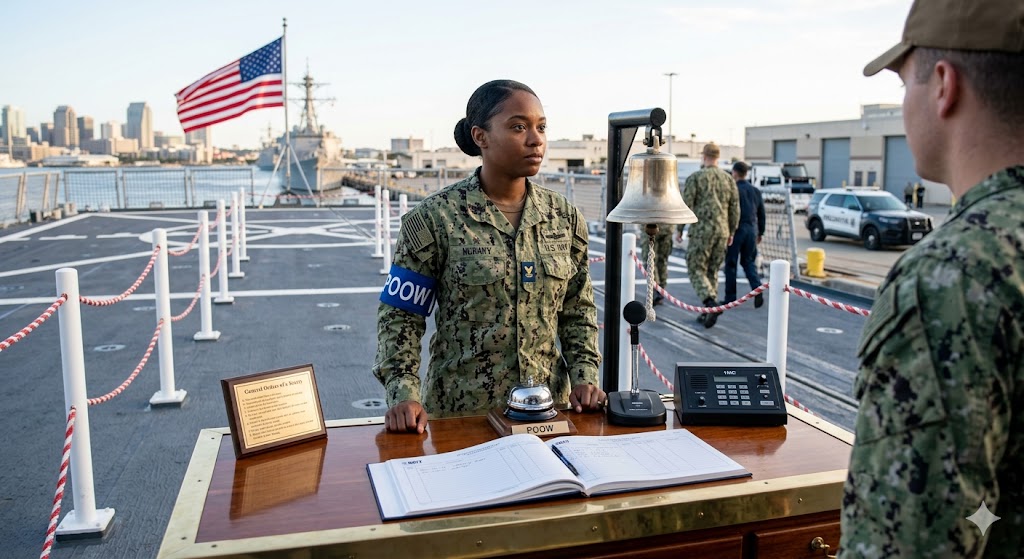
Additional Information
What the Course Entails and Exam Details
The Petty Officer of the Watch qualification course, often part of the Personnel Qualification Standard (PQS) system, covers a broad spectrum of shipboard knowledge, legal authority, and emergency procedures. Students must master the following core competencies:
Quarterdeck Procedures and Protocol: Mastering the "smartness" of the Quarterdeck, maintaining the ship's log, controlling access of personnel, visitors, and vendors, and executing morning and evening colors.
1MC (All-Hands) Announcements: Learning and flawlessly executing the correct verbiage for all standard and emergency shipboard announcements, including piping for officers, muster reports, and alarms.
Honors and Ceremonies: Identifying flags, pennants, and understanding the protocol for rendering honors to arriving and departing high-ranking officers, dignitaries, and passing vessels.
Force Protection and Security: Understanding the ship's Force Protection (FP) plan, Rules of Engagement (ROE), and the Use of Force Continuum. Sailors must know how to respond to various threats, including Security Alerts, a Person Overboard, or unauthorized access.
Emergency Response: Knowing the precise duties of the POOW and the proper initial actions and announcements for every standard shipboard emergency, such as Fire, Flooding, Collision, and medical emergencies.
Weapons Conditions: Demonstrating a thorough knowledge of safety and conditions for the M9 Service Pistol and other relevant weapons carried by the security force.
What to Expect in the Final Exam
The final assessment for the Petty Officer of the Watch qualification is rarely a standard multiple-choice test taken at a computer center. Instead, it is a culmination of a PQS "sign-off" process and a final oral board.
PQS Completion: Before taking any final exam, the sailor must have a PQS booklet complete with verified signatures from qualified personnel, showing they have hands-on understanding of each topic.
Written Exam: Many commands require a comprehensive written exam to test foundational knowledge of standard phrases, alarm colors, and specific rules.
Oral Board: The most crucial element is the final oral examination board, typically composed of the Chief of the Watch, another POOW, and the ship's Senior Enlisted Advisor or a commissioned officer.
Format: The board is an intensive, face-to-face question-and-answer session. The panel will ask theoretical "what-if" scenarios, request standard announcements, and test the sailor's poise and confidence.
Passing Score: There is no numerical passing score for the oral board; the sailor passes based on the unanimous consent of the board that they are fully ready to assume the watch.
How to Study and Exam Centers
Preparation for the POOW qualification is a blend of intense memorization and practical experience.
Master the PQS: Make your Personnel Qualification Standard booklet your primary study guide. Go beyond just getting signatures; ensure you truly understand the practical application of every line item.
1MC Script Practice: Create flashcards with standard announcements and practice saying them, aloud and in the correct order, until they are second nature.
Scenario-Based Training: Use the practice tests and "what-if" scenarios found in command study guides to walk through your required actions during emergencies.
Observation: Spend extra time on the Quarterdeck observing qualified POOWs. Listen to their 1MC announcements, how they manage the flow of traffic, and how they interact with the OOD.
Mock Boards: Form study groups and conduct realistic mock oral boards. This is the most effective way to build the confidence needed for the actual board.
Exam Centers: The final examination does not occur at a civilian facility like Pearson VUE. It is administered directly on board your ship or at your shore command by qualified members of the unit, under the authority of the Commanding Officer.
Job Opportunities from the Course
Qualifying as a Petty Officer of the Watch is an essential professional development step within a military career. It signifies leadership, trust, and advanced seamanship. It unlocks specific military career paths and is often a prerequisite for key duties, but does not directly translate to a civilian job title without further transition planning.
Qualified Petty Officer of the Watch (In-Port): Immediately authorizes you to stand the actual watch.
Qualification for Officer of the Deck (OOD) (In-Port): For Petty Officers First Class, qualifying as POOW is typically the primary step towards qualifying as OOD in port.
Prerequisite for Higher-Level Watches: Qualification is often required before a sailor can begin the process for complex watches like Section Leader.
Improved Advancement Opportunity: Achieving significant watch qualifications, particularly this leadership-focused one, is a key component of a sailor's performance evaluation and directly influences their competitiveness for promotion.
Leadership Development: This role provides hands-on experience in delegating, making decisions under pressure, and acting as the official representative of the command, all highly transferable skills.
Frequently Asked Questions
Reviews
5.0
Based on 0 reviews
Leave a Review
No reviews yet. Be the first to review!