
PGA Level 2 Merchandising/Inventory Practice Exam
$69.00
- Buy to unlock unlimited access to all Quiz questions and Answers in this Quiz.
- After purchase you can print a PDF of the whole quiz at any point. The PDF will contain the questions and the correct answers.
About this Exam
The PGA PGM Level 2 Merchandising and Inventory course represents a critical milestone in the journey toward PGA Class A Membership.
This specific curriculum is designed for PGA Associates and students enrolled in PGA Golf Management university programs who are aspiring to master the business side of the golf industry.
This course bridges the gap between general retail theory and the practical application required to operate a profitable golf facility.
Completing this section ensures that aspiring professionals understand how to curating a merchandise mix that meets customer demands while protecting the facility's bottom line.
Ready to test your knowledge?
Buy Now to Access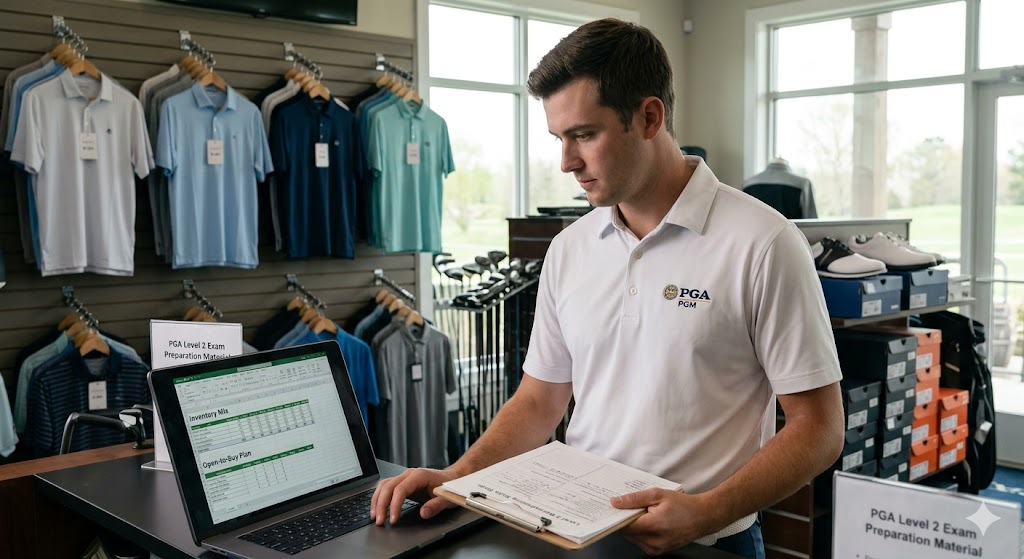
Additional Information
What the Course Entails and Exam Details
This comprehensive course delves into the intricate details of planning, acquiring, and managing the retail operations within a golf environment.
Students must demonstrate a mastery of several key operational functions vital to retail success.
The curriculum covers effective buying strategies, understanding vendor relationships, and implementing profitable pricing models tailored to different customer segments.
A significant portion of the course focus is placed on the Open-to-Buy plan, teaching students how to forecast sales and manage cash flow effectively by purchasing the right amount of inventory at the right time.
Furthermore, the course addresses visual merchandising techniques, layout optimization, and promotional strategies to drive sales velocity.
Crucially, it also covers rigid inventory control measures, including tracking methods, stockturn analysis, and strategies to minimize shrinkage and manage markdown strategies effectively.
What to Expect in the Final Exam
The final examination for the PGA Level 2 Merchandising and Inventory module is a rigorous test administered as part of the broader Level 2 knowledge tests.
The exam typically follows a multiple-choice format, designed to assess both the recall of specific retail terminology and the practical application of business scenarios.
Students can expect a significant emphasis on mathematical calculations related to retail, such as calculating cost of goods sold (COGS), gross margin, markdown percentages, and turnover rates.
There is often a substantial component focused on interpreting and building an Open-to-Buy plan based on hypothetical sales data.
The exact time limit varies but is generally aligned with standard PGA knowledge testing sessions, which require focused efficiency.
A passing score (typically 70% or higher, though this is subject to PGA regulation changes) is required to advance to the next level of the PGM program.
How to Study and Exam Centers
Effective preparation requires a combination of reviewing the official PGA PGM Level 2 curriculum manuals and practical application of the concepts.
We highly recommend working through real-world examples, particularly regarding the calculations for Open-to-Buy plans and retail metrics, as these are frequent stumbling blocks.
Utilizing practice exams that mimic the format and difficulty of the actual test is an invaluable strategy for building confidence and identifying knowledge gaps.
Engaging with a mentor or a Class A PGA Professional who manages a shop can provide context that strengthens your understanding of the materials.
The actual knowledge tests are usually administered at authorized testing centers, often facilitated through third-party services like PSI or Pearson VUE, depending on current PGA partnerships.
These tests can also be taken during designated seminars at the PGA Education Center or approved PGA Golf Management university facilities.
Job Opportunities from the Course
Mastery of merchandising and inventory management is a differentiator in the golf industry, opening doors to diverse and financially rewarding career paths.
Completing this certification demonstrates a strong business acumen required for leadership roles within any golf facility.
Successful students are well-prepared for the following specific job titles and career paths:
Assistant Golf Professional: Managing daily shop operations, visual merchandising, and inventory control.
Head Golf Professional: Overseeing the entire retail operation and financial performance of the golf shop.
Director of Golf: Managing the broader retail strategy across large properties or multi-course facilities.
Golf Retail Manager: Focused specifically on optimizing the profitability and operations of the retail space within a resort or large private club.
Merchandising Coordinator: Working within large management companies to oversee retail standards across multiple properties.
Tournament Director: Utilizing merchandising knowledge for corporate events and outing gifts (SWAG) procurement.
Vendor Sales Representative: Using retail knowledge to sell equipment or apparel to golf facilities more effectively.
Frequently Asked Questions
Reviews
5.0
Based on 0 reviews
Leave a Review
No reviews yet. Be the first to review!