
PGA PGM 3.0 Level 3 Advanced Teaching and Coaching practice Test
$69.00
- Buy to unlock unlimited access to all Quiz questions and Answers in this Quiz.
- After purchase you can print a PDF of the whole quiz at any point. The PDF will contain the questions and the correct answers.
About this Exam
The PGA PGM 3.0 Level 3 Advanced Teaching and Coaching practice test is the final and most critical step on the pathway to becoming a Class A PGA Member. This comprehensive program is the culmination of years of study, designed for PGA Associates who have completed all requirements of Levels 1 and 2 and chosen the Teaching and Coaching Career Path. This certification does not just signify a high level of golf knowledge; it marks a professional's readiness to lead instruction at elite facilities, develop complex player development programs, and apply a sophisticated, data-driven approach to coaching players of all skill levels. If you are preparing for this final assessment, you are at the threshold of the highest professional distinction in golf management.
Ready to test your knowledge?
Buy Now to Access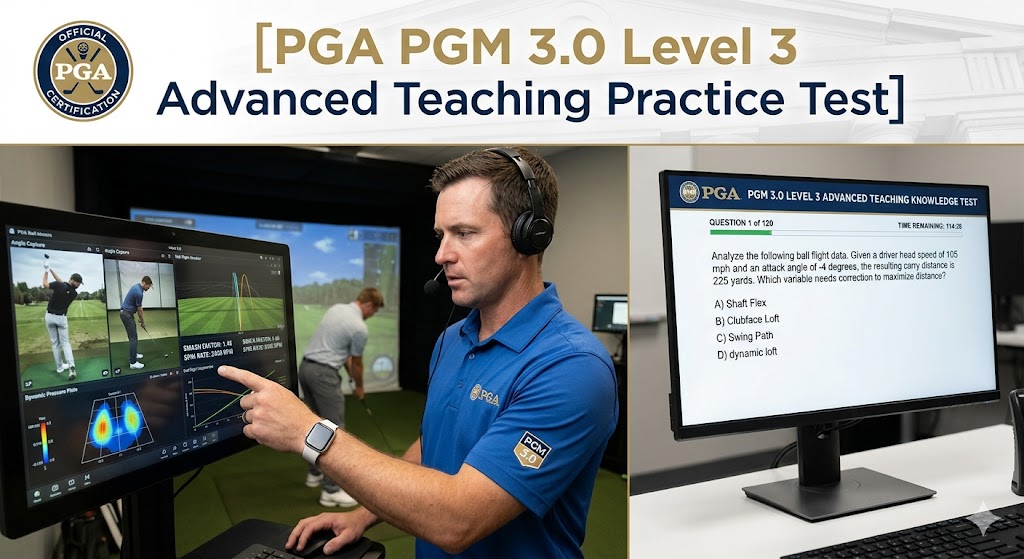
Additional Information
What the Course Entails and Exam Details
The PGA PGM 3.0 Level 3 curriculum for the Teaching and Coaching path moves beyond the fundamentals of full swing analysis. It dives deep into the sciences of biomechanics, motor learning, and psychological player development, combined with the business logic of running an effective instruction vertical. Candidates will integrate their understanding of these components to solve real-world coaching challenges.
The course syllabus includes comprehensive modules such as:
Teaching & Coaching 3: Advanced video and launch monitor data interpretation (e.g., specific ball flight laws and equipment-related data like dynamic loft, attack angle, and spin rate).
Specialized Fitting: The application of fitting variables, specifically how changes in shaft, weight, and head design interact dynamically with a player’s unique swing mechanics.
Player Development: Designing, implementing, and analyzing the business success of comprehensive player development programs, including budgeting and marketing strategies.
Motor Learning & Development: Understanding the cognitive stages of learning and utilizing practice methodologies to accelerate skill acquisition and retention.
Biomechanical Application: Using advanced motion capture data to improve swing efficiency and reduce injury risk for competitive golfers.
The Level 3 exam process is a multi-component evaluation. While the primary, quantifiable component is the standardized Knowledge Test, it is often paired with a review of a candidate's final Work Experience Portfolio and sometimes simulation-based applications conducted during an official PGA Checkpoint seminar.
What to Expect in the Final Exam
The main component that determines your conceptual mastery is the PGA PGM 3.0 Level 3 Knowledge Test. To succeed, candidates must be thoroughly prepared for the following exam format and regulations.
Exam Format and Structure
The final exam is a standardized, computer-based test consisting of a significant number of validated, multiple-choice questions. It is not an assessment of opinion, but of the direct application of the PGM 3.0 course materials. The questions will ask you to:
Analyze data: Given a launch monitor data set (e.g., specific club speed, attack angle, and smash factor), determine the appropriate equipment or swing change.
Apply scenarios: Read a detailed case study of a player's physical limitations and long-term goals and select the most efficient coaching strategy.
Evaluate business plans: Given an instruction program's P&L statement, identify key areas for operational or marketing improvement.
Passing Requirements
To pass the PGA PGM 3.0 Level 3 Knowledge Test, candidates must achieve a minimum score of 70%. Failure to meet this standard requires a retake of the examination, which may be scheduled after a specific waiting period.
Time Limit and Specific Rules
The exam is proctored and adheres to strict professional standards. It is a timed test, and candidates must complete it within the allotted window, which is usually generous but finite (e.g., 90 to 120 minutes, depending on the test batch).
No external resources are allowed. You must use only the pencils, forms, and basic calculators provided by the test administrator. No books, notes, cell phones, or electronic devices of any kind are permitted. Candidates are often allowed a clean, unmarked copy of the Official Rules of Golf for references related to rule questions.
How to Study and Exam Centers
Preparation for the final Level 3 exam must be systematic and rigorous. This is not a test designed for last-minute cramming, as it requires genuine synthesis of advanced concepts.
Proven Study Strategies
Utilize the Education Portal: Your primary study resource is the official PGA Education Portal. Re-read all final course manuals, specifically focusing on the teaching models and the complex flowcharts for problem diagnosis.
Master Practice Tests: The most effective study tool is a high-quality practice exam. Utilize practice tests like this one to familiarize yourself with the question logic, identify your weak areas, and manage your pacing. Look for detailed answer explanations.
Mentor Engagement: Connect with an existing Class A PGA Member, especially one with a strong teaching background. Ask them to present you with challenging lessons and have them evaluate your step-by-step diagnostic process.
Teach and Record Yourself: The highest form of learning is teaching. Practice advanced video analysis. Record a lesson, then critique your communication, the technology you used, and the direct impact of your feedback.
Portfolio Review: Review your accepted Work Experience Portfolio. The act of documenting and submitting real-life projects reinforces the practical application of Level 3 principles.
Official Exam Centers
The PGA PGM exams are administered through official third-party test delivery partners to ensure security and standardization.
When you are ready to register, you will typically schedule your test through the PGA Education Portal or via a designated vendor, such as Pearson VUE or PSI Exams. These partners have thousands of computerized testing centers located nationwide.
Some exam components, particularly simulations or comprehensive portfolio reviews, may also be conducted during mandatory, physical PGA Level 3 Checkpoint seminars held at official PGA Education facilities. You will receive precise directions on how and where to register upon completing the necessary course modules and work experience requirements.
Job Opportunities from the Course
Earning your PGA PGM 3.0 Level 3 certification, particularly on the Advanced Teaching and Coaching Path, unlocks some of the most sought-after and respected positions in the golf industry. This credential, combined with your practical work experience, signals to premier facilities that you are a expert instructor and a capable business manager.
The potential job titles and career paths available to a graduate include:
PGA Director of Instruction
Head Teaching Professional at a Premier Golf Club or Resort
Golf Academy Director
PGA Director of Player Development
High-Performance Golf Coach (NCAA, Professional Tours)
Lead Custom Club Fitter and Dynamic Analysis Specialist
Teaching and Coaching Consultant for National Golf Programs
Golf Retail and Merchandising Manager (focusing on complex custom fitting vertically)
Frequently Asked Questions
Reviews
5.0
Based on 0 reviews
Leave a Review
No reviews yet. Be the first to review!