
Pharmacology and the Nursing Process by Linda Lane Lilley: Practice Exam
$69.00
- Buy to unlock unlimited access to all Quiz questions and Answers in this Quiz.
- After purchase you can print a PDF of the whole quiz at any point. The PDF will contain the questions and the correct answers.
About this Exam
This comprehensive practice resource is your vital guide to conquering the world of pharmacology within the nursing context. Designed primarily for nursing students, aspiring healthcare professionals, and practicing nurses seeking a robust review, this material is centered on the foundational concepts found in Linda Lane Lilley's acclaimed textbook. It focuses heavily on integrating pharmacological principles directly into the critical steps of the nursing process: Assessment, Diagnosis, Planning, Implementation, and Evaluation (ADPIE). Successfully navigating these practice exams demonstrates a student's readiness to apply complex medication knowledge to real-world patient care scenarios, a critical skill for safety and efficacy. Think of this not just as a test, but as a crucial milestone in your journey to becoming a proficient and confident nurse.
Ready to test your knowledge?
Buy Now to Access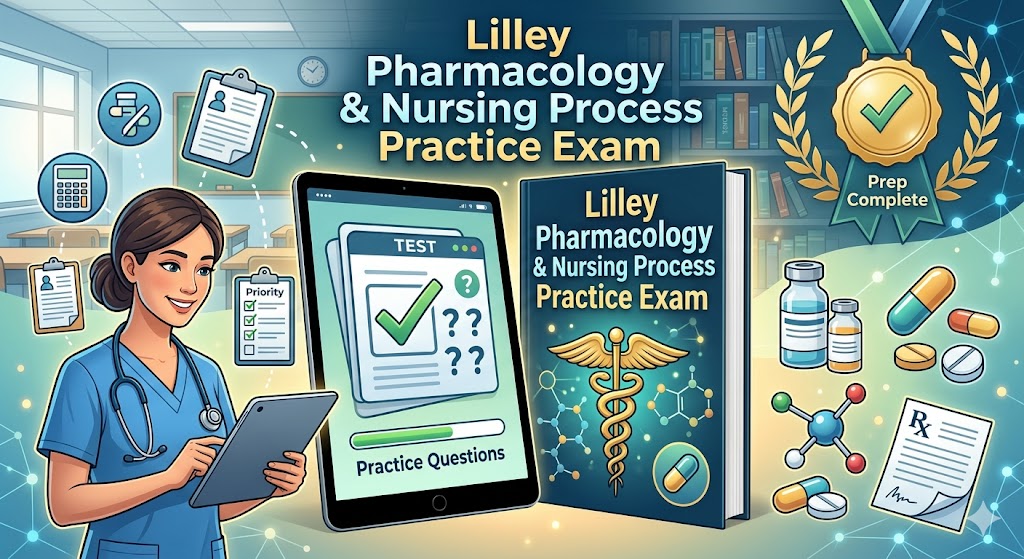
Additional Information
What the Course Entails and Exam Details
This body of knowledge, supported by Lilley’s work, covers a broad spectrum of pharmacology relevant to the nurse’s role. Students should expect the content to deep dive into various drug classifications, including those affecting the cardiovascular, central nervous, autonomic nervous, and immune systems. You will master pharmacokinetics (what the body does to the drug) and pharmacodynamics (what the drug does to the body). The comprehensive curriculum details: Specific drug mechanisms of action and indications. Common and serious adverse effects and contraindications. Crucial nursing implications, assessments, and patient education required for each drug. Correct medication administration techniques and routes. Key drugs and therapeutic concepts for various patient populations across the lifespan. Preventing medication errors and ensuring overall patient safety.
The actual "practice exam" is a powerful tool to measure understanding, consolidate knowledge, and simulate the rigorous testing environment of professional qualifications. Consistency in studying these detailed topics and practicing applying them within the nursing framework is key to mastery.
What to Expect in the Final Exam
While "practice exams" can vary in length and specific structure, they are generally designed to reflect the challenge of nursing school pharmacology exams and the licensure NCLEX. You should expect: A variety of multiple-choice questions, ranging from knowledge recall to complex clinical scenarios. Case study questions and questions that require priority-setting and critical thinking based on the nursing process. Possible inclusions of drug calculation problems, drag-and-drop, or select-all-that-apply questions. Though typical practice materials don't have a singular "passing score" or strict time limit, you should treat them with seriousness, aiming for high percentages (e.g., above 75-80%) and simulating a realistic time constraint to build speed and confidence. Practice materials might come with answer rationales to further enhance learning from mistakes. Specific rules and configurations are dependent on the provider of the practice resources or your educational institution.
How to Study and Exam Centers
Preparation should be an active and engaging process. Key strategies include: Regular, spaced repetition: dedicate time daily to review. Concept mapping and drug grouping: create connections. Flashcards for active recall of key drugs and classes. Working through numerous practice questions with detailed rationales. Understanding, not just memorizing: focus on "why" things happen in the body. Integrating ADPIE into every study session: how would a nurse assess, plan, and evaluate for this drug?
These practice exams are not usually administered in a physical testing center but are accessed through various online learning portals, as supplemental materials to the textbook (like Evolve resources), or provided by your nursing program. You take them in the comfort of your chosen study space! The true "exam centers" for the final qualifications would be either your specific school's testing environment for course exams, or a formal center such as a Pearson VUE facility for the NCLEX. Accessing and utilizing online and digital platforms associated with this textbook is a key way to engage with these powerful study tools.
Job Opportunities from the Course
A strong command of pharmacology and the nursing process, fortified by materials like these, unlocks diverse and rewarding nursing career paths. This knowledge is not just about passing a test; it is fundamental to safe and effective practice in every nurse’s role. Consider these dynamic positions that are highly dependent on this critical knowledge: Registered Nurse (RN) – in hospitals, clinics, and more. Licensed Practical Nurse (LPN) / Licensed Vocational Nurse (LVN). Nurse Educator – in nursing schools or clinical settings. Clinical Nurse Specialist (CNS). Research Nurse. Clinical Research Associate (CRA). Pharmaceutical Sales Representative (focusing on medical context). Case Manager Nurse.
Frequently Asked Questions
Reviews
5.0
Based on 0 reviews
Leave a Review
No reviews yet. Be the first to review!