
Pharmacology Assessment A & B Practice Exam
$69.00
- Buy to unlock unlimited access to all Quiz questions and Answers in this Quiz.
- After purchase you can print a PDF of the whole quiz at any point. The PDF will contain the questions and the correct answers.
About this Exam
The Pharmacology Assessment A & B exams are critical benchmarks often used within nursing and healthcare education programs. These proctored assessments are designed to evaluate a student's comprehensive understanding of foundational pharmacological principles, safe medication administration, and the therapeutic use of various drug classifications. Successfully passing these assessments demonstrates readiness for clinical practice and licensure exams, ensuring that future healthcare professionals can provide safe and effective patient care.
Ready to test your knowledge?
Buy Now to Access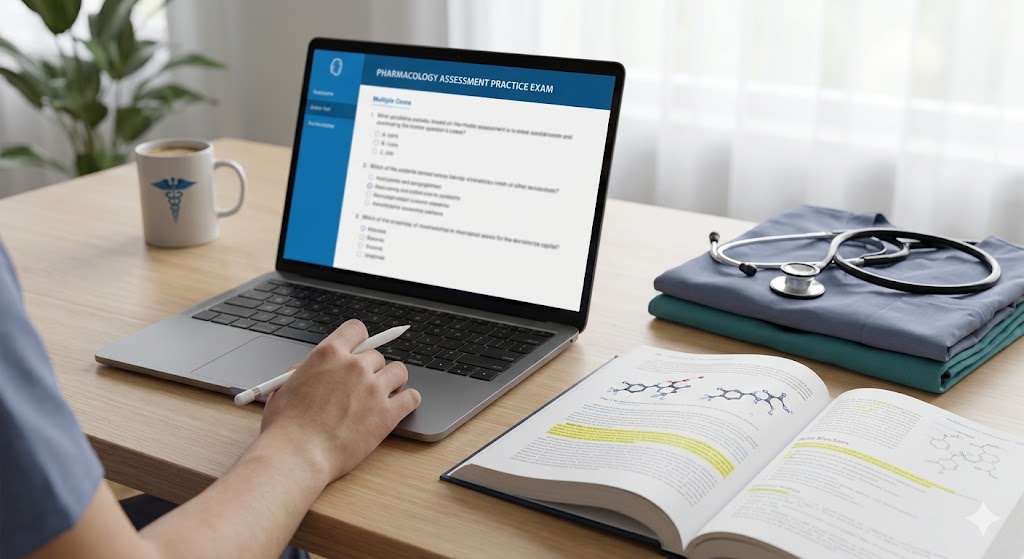
Additional Information
What the Course Entails and Exam Details
This comprehensive assessment covers a vast array of topics essential for modern healthcare practice. Students are expected to master core concepts including pharmacokinetics (absorption, distribution, metabolism, excretion) and pharmacodynamics (drug mechanisms of action).
The curriculum detail encompasses deep dives into major drug classifications, such as those affecting the cardiovascular, respiratory, gastrointestinal, and central nervous systems. Furthermore, significant emphasis is placed on anti-infectives, endocrine medications, and agents affecting the immune system. Beyond specific drug knowledge, the course entails understanding legal and ethical responsibilities, precise dosage calculations, and the critical nursing implications associated with medication therapy.
What to Expect in the Final Exam
The final Pharmacology A & B Assessments typically utilize a standardized, computer-based format. Candidates should expect a significant number of multiple-choice questions designed to test both recall and higher-level application of knowledge through clinical scenarios.
The exam often includes "Select All That Apply" (SATA) questions, ordered response items, and calculations. While the specific number of questions and time limits can vary slightly by the administrating institution or specific version, students are generally allotted approximately one minute per question. A high level of proficiency is required, as the passing score reflects the safety standard necessary for entry-level clinical practice.
How to Study and Exam Centers
Effective preparation requires a structured study plan emphasizing active recall and application. Utilize active learning strategies such as creating detailed drug charts, using spaced-repetition flashcards for side effects, and practicing dosage calculations daily.
The most effective study method is engaging with Pharmacology A & B practice exams, which familiarize you with the question formatting and identify critical knowledge gaps. Focus on understanding the "why" behind nursing implications, rather than simple memorization.
Regarding exam logistics, these assessments are typically administered internally by accredited nursing schools or healthcare education programs. They are usually taken in a proctored environment on campus, though some institutions may utilize secure, remote proctoring services for distance learners. Check with your specific program coordinator for scheduling and location details.
Job Opportunities from the Course
Mastering the content in the Pharmacology A & B assessments is a foundational step toward securing licensure and succeeding in various high-demand healthcare roles.
Achieving proficiency in this area facilitates career paths such as:
Registered Nurse (RN)
Licensed Practical Nurse (LPN) / Licensed Vocational Nurse (LVN)
Nurse Practitioner (NP)
Clinical Nurse Specialist
Pharmacy Technician
Clinical Research Coordinator
Medical Surgical Nurse
Critical Care Nurse
Frequently Asked Questions
Reviews
5.0
Based on 0 reviews
Leave a Review
No reviews yet. Be the first to review!