
Pharmacology Cholinergic Agents Practice Test
$69.00
- Buy to unlock unlimited access to all Quiz questions and Answers in this Quiz.
- After purchase you can print a PDF of the whole quiz at any point. The PDF will contain the questions and the correct answers.
About this Exam
The Pharmacology Cholinergic Agents Practice Test is a crucial assessment tool for students and healthcare professionals-in-training, including those pursuing degrees in pharmacy, nursing, and medicine. This comprehensive test is designed to validate understanding of the autonomic nervous system, specifically the cholinergic division, and the various agents that influence it. This is not a standalone "certification" but rather a specialized sub-module assessment common in broader pharmacology curriculums or part of larger board preparation (like the NAPLEX or NCLEX). The exam is designed for individuals who need to demonstrate mastery of drug classes, mechanisms of action, and clinical applications related to acetylcholine.
Ready to test your knowledge?
Buy Now to Access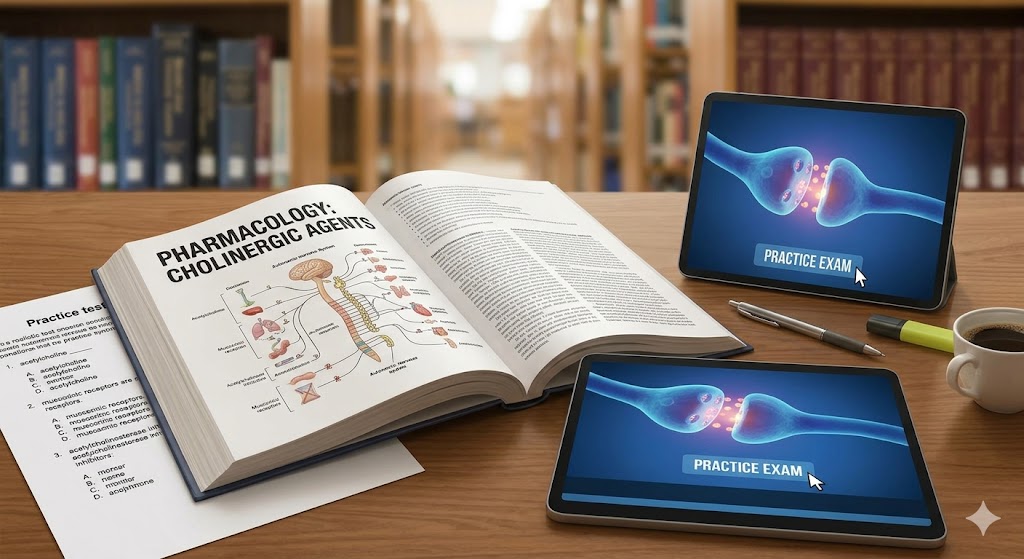
Additional Information
What the Course Entails and Exam Details
This examination focuses on the complex physiology of the parasympathetic nervous system and the drugs that mimic or inhibit its activity.
The core topics typically covered include:
Physiology of the Cholinergic Synapse: Detailed understanding of acetylcholine synthesis, storage, release, receptor binding (muscarinic and nicotinic), and termination of action via acetylcholinesterase.
Direct-Acting Cholinergic Agonists: Mechanisms, effects, and clinical uses of drugs like pilocarpine and bethanechol (e.g., glaucoma, urinary retention).
Indirect-Acting Cholinergic Agonists (Cholinesterase Inhibitors): Reversible and irreversible inhibitors, including their use in treating Myasthenia Gravis, Alzheimer’s disease, and as nerve agents.
Cholinergic Antagonists (Anticholinergics): Mechanisms, therapeutic uses, and adverse effects of muscarinic antagonists (like atropine and scopolamine) and nicotinic antagonists (neuromuscular blockers).
Adverse Effects and Toxicity: Recognizing and managing cholinergic crisis (SLUDGE syndrome) and anticholinergic toxicity.
Clinical Calculations: Basic dosage calculations related to common cholinergic agents.
What to Expect in the Final Exam
While "final" structure depends on the specific institution or board (e.g., your university or the NCSBN), a dedicated Pharmacology Cholinergic Agents Practice Test generally mimics standard professional healthcare exams.
Format: You should expect primarily multiple-choice questions. High-quality practice tests often include "Select All That Apply" (SATA) and matching formats, which are common on boards.
Practical Component: There is typically no hands-on "practical" (like giving an injection) for this pharmacology cognitive test, although clinical scenario "case-based" questions are very common.
Time Limit: A practice test of 50 questions might typically provide 60–75 minutes. For official boards, this section is a timed portion of a multi-hour exam.
Passing Score: For a practice test, you should aim for 80% or higher to demonstrate strong competency. Official passing scores for licensure exams (like NCLEX or NAPLEX) are determined by scaled scoring methods rather than a fixed percentage.
How to Study and Exam Centers
Effective preparation requires a mix of theoretical understanding and active recall.
Study Strategies:
Active Recall with Flashcards: Create detailed flashcards using tools like Anki. Focus on linking the drug name -> class -> mechanism of action -> major clinical use -> key side effects.
Utilize Visual Aids: The cholinergic system is logical. Draw diagrams of the synapse, charting where agonists and antagonists act. Use charts to compare and contrast different drug classes (e.g., reversible vs. irreversible inhibitors).
Focus on 'Prototype' Drugs: Don't memorize every drug. Master the prototype for each class (e.g., atropine for muscarinic antagonists). Once you understand the prototype, you understand the class.
Take Multiple Practice Tests: This is crucial. Use questions from reliable sources to identify gaps in your knowledge and get used to the wording style of board exams.
Where to Take the Exam:
For a standalone practice test, this is usually accessed online via:
Learning Management Systems (LMS): Such as Canvas or Blackboard, provided by your university pharmacology department.
Third-Party Test Prep Providers: Like UWorld, Kaplan, or specialized pharmacology question banks.
For the official licensure exams (where this content is tested), you will take the exam at a professional proctored center:
Pearson VUE: The authorized testing center partner for the NCLEX (nursing) and many other medical board exams.
Prometric: Often used for pharmacy (NAPLEX) and medical licensing.
Job Opportunities from the Course
A strong command of pharmacology, and specifically autonomic agents, is non-negotiable for success in diverse healthcare roles.
Registered Nurse (RN) / Nurse Practitioner (NP): Administering cholinergic and anticholinergic agents safely is a daily task in diverse settings, from critical care (e.g., using atropine for bradycardia) to outpatient management (e.g., Alzheimer's medication).
Licensed Practical Nurse (LPN/LVN): Essential for medication administration and monitoring patients for adverse cholinergic effects.
Pharmacist (PharmD): Expertise is required for verifying orders, counseling patients on side effects, and managing complex drug interactions.
Pharmacy Technician: Understanding the drug classifications ensures accurate medication dispensing.
Anesthesiologist Assistant / CRNA: Master of autonomic agents is vital for managing neuromuscular blockade and reversing its effects.
Physician / Physician Assistant (PA): Critical for prescribing and diagnosing conditions related to the autonomic nervous system.
Medical Pharmacology Researcher: Conducting research on new cholinergic drugs for neurological conditions.
Frequently Asked Questions
Reviews
5.0
Based on 0 reviews
Leave a Review
No reviews yet. Be the first to review!