
Pharmacology Diuretic Agents Practice Test
$69.00
- Buy to unlock unlimited access to all Quiz questions and Answers in this Quiz.
- After purchase you can print a PDF of the whole quiz at any point. The PDF will contain the questions and the correct answers.
About this Exam
The Pharmacology Diuretic Agents Practice Exam is a specialized preparatory tool designed for healthcare students and professionals seeking to master the principles and clinical applications of diuretic medications. This includes students in nursing, pharmacy, pre-medicine, and other allied health programs who must possess a profound understanding of how these drugs affect fluid balance and electrolyte levels. This comprehensive practice test is your bridge from theoretical knowledge to clinical confidence, guiding you through the mechanisms of action, therapeutic indications, major drug interactions, and critical adverse effects of the primary classes of diuretics. Whether you are gearing up for a university final or a critical licensure exam like the NCLEX, NAPLEX, or USMLE, this practice test will sharpen your critical thinking and readiness.
Ready to test your knowledge?
Buy Now to Access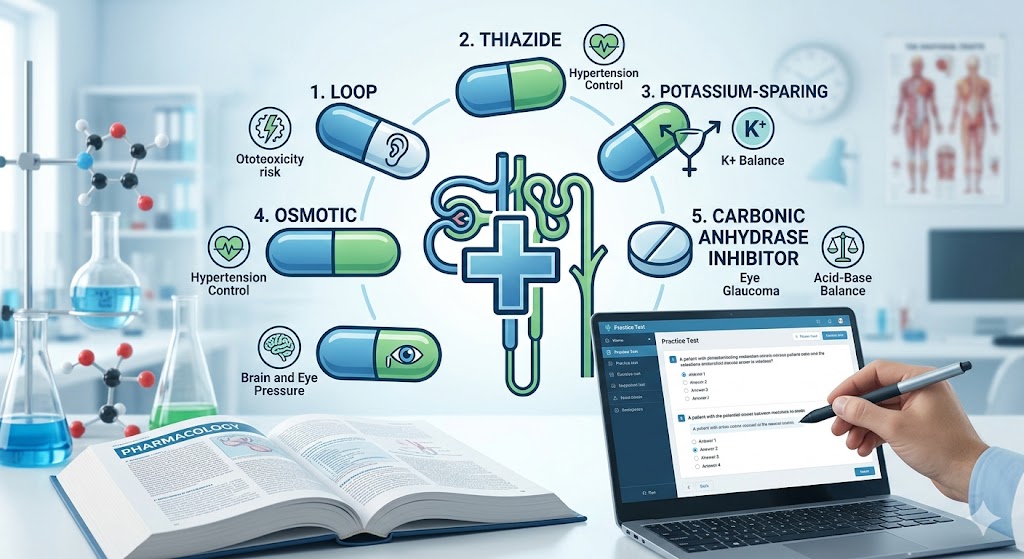
Additional Information
What the Course Entails and Exam Details
This examination covers the complete spectrum of diuretic pharmacology, emphasizing the following core thematic areas:
Taxonomic Classification of Diuretics: Master the five main classes of diuretics: Carbonic Anhydrase Inhibitors, Loop Diuretics, Thiazide and Thiazide-like Diuretics, Potassium-Sparing Diuretics (including Aldosterone Antagonists and Renal Epithelial Sodium Channel Blockers), and Osmotic Diuretics.
Mechanisms of Action: Understand the precise molecular site and process by which each class inhibits solute reabsorption in the nephron, thus promoting urine production.
Key Representative Agents: Recognition of brand and generic names of key drugs, such as Furosemide, Hydrochlorothiazide, Spironolactone, Mannitol, and Acetazolamide.
Clinical Indications: Learn when and why specific diuretics are the treatment of choice for conditions like hypertension, congestive heart failure, acute pulmonary edema, cerebral edema, glaucoma, and certain renal failures.
Adverse Effects and Electrolyte Management: Identify life-threatening and common side effects, with a heavy focus on the management of electrolyte imbalances (hypokalemia, hyperkalemia, hyponatremia, etc.), acid-base shifts, and ototoxicity.
What to Expect in the Final Exam
While the exact nature of your specific final exam may vary, most pharmacology and professional licensure examinations adhere to a standardized format. The final exam typically consists of a set of randomized, peer-reviewed Multiple-Choice Questions (MCQs), often using clinical case scenarios. These case-based questions assess not just factual recall, but your ability to apply pharmacological principles to patient care. For instance, you might be asked to select the appropriate diuretic for a heart failure patient with preexisting renal dysfunction or to prioritize nursing interventions for a patient exhibiting signs of loop-diuretic-induced ototoxicity.
Expect a defined time limit, commonly averaging one to two minutes per question. A passing score is usually set by the individual institution or board, often ranging from 70% to 80% for course completion, with higher standards for licensure.
How to Study and Exam Centers
Effective study strategies are crucial for mastering diuretic pharmacology. Start by creating visual charts that correlate each diuretic class with its site of action in the nephron, its mechanism, and its primary therapeutic and side effects. For name recognition, which is a common stumbling block, create generic-to-brand name flashcards. Always prioritize understanding why a specific drug causes an electrolyte shift; do not just memorize the change. Draw out the nephron and label where each drug works to solidify the physiological context. Utilize this comprehensive practice exam iteratively to identify your specific weak points, and study the detailed rationales for both correct and incorrect answers.
For information on scheduling your final official exam, you must coordinate with your institution or the relevant licensing board. Official exams are often proctored. You might take them at university-approved testing centers, through an online portal using integrated proctoring software, or at authorized global testing organizations such as Pearson VUE, which are standard for many professional certifications.
Job Opportunities from the Course
A strong grasp of diuretic agents is essential for any career in the medical or pharmaceutical fields. Success in this area directly translates to high competency in several key job roles, including:
Registered Nurse (RN), specializing in Cardiovascular, Renal, or Critical Care Units
Clinical Pharmacist, in hospital or retail settings
Cardiology Physician Assistant (PA)
Advanced Practice Registered Nurse (APRN), such as a Nurse Practitioner in Acute or Family Care
Pharmaceutical Research Scientist, focusing on cardiovascular drug development
Medical Writer or Educational Content Creator, specialized in Pharmacology
Medical Science Liaison (MSL), specializing in cardiovascular therapies
Frequently Asked Questions
Reviews
5.0
Based on 0 reviews
Leave a Review
No reviews yet. Be the first to review!