
Pharmacy Curriculum Outcomes Assessment (PCOA) Practice Exam
$69.00
- Buy to unlock unlimited access to all Quiz questions and Answers in this Quiz.
- After purchase you can print a PDF of the whole quiz at any point. The PDF will contain the questions and the correct answers.
About this Exam
The Pharmacy Curriculum Outcomes Assessment, better known as the PCOA, is a comprehensive, standardized, summative assessment developed by the National Association of Boards of Pharmacy (NABP). It is not a licensure exam, but a critical tool for colleges and schools of pharmacy across the United States. The PCOA is meticulously designed to measure a pharmacy student's cumulative knowledge and progress as they near the completion of the didactic portion of their Doctor of Pharmacy (PharmD) curriculum, typically in their third professional year (P3). The results provide valuable feedback to both the individual student and their academic institution regarding curricular strength and student preparedness for subsequent clinical rotations and, ultimately, for licensure.
Ready to test your knowledge?
Buy Now to Access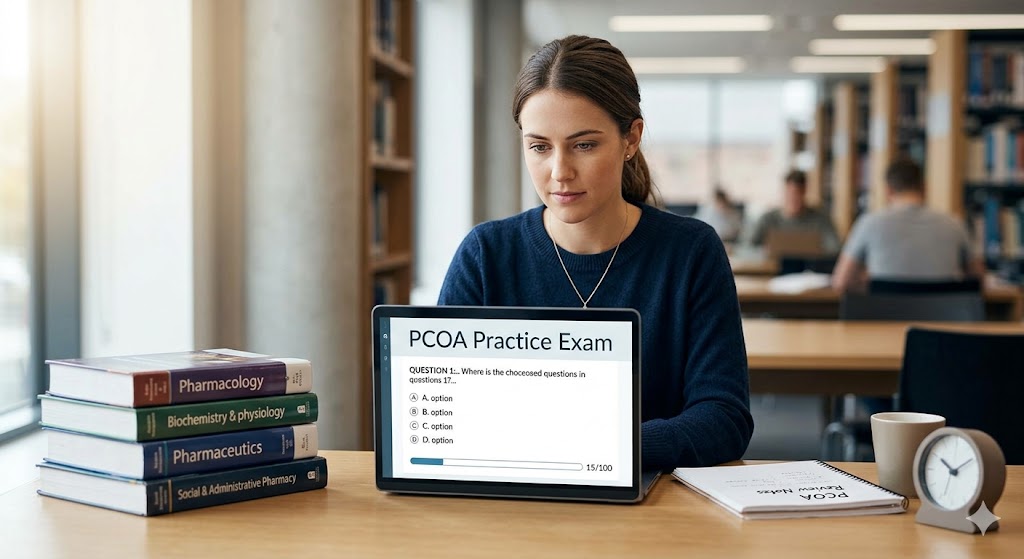
Additional Information
What the Course Entails and Exam Details
The PCOA provides an objective benchmark across four fundamental content areas that form the backbone of a modern pharmacy education. Students are expected to demonstrate proficiency in:
Basic Biomedical Sciences: This covers foundational principles such as physiology, biochemistry, microbiology, and immunology.
Pharmaceutical Sciences: Focuses on the development, delivery, and disposition of drugs, including medicinal chemistry, pharmacology, toxicology, and pharmaceutics.
Social, Behavioral, and Administrative Pharmacy Sciences: Examines the broader context of healthcare delivery, covering topics like pharmacy law, ethics, biostatistics, epidemiology, and pharmacoeconomics.
Clinical Sciences: Assesses practical knowledge and problem-solving skills for patient care, encompassing areas such as pharmacotherapy, medication-use systems, patient assessment, and evidence-based practice.
The PCOA is typically a comprehensive, computer-based exam consisting of multiple-choice questions. It provides individual student reports that detail a total scaled score (ranging from 0 to 700) and specific scores for each of the four content areas. This granular feedback highlights areas of strength and potential weakness for further review.
What to Expect in the Final Exam
Students often find the PCOA to be a high-fidelity experience of a high-stakes, standardized test, mirroring aspects of the future licensure exam, the NAPLEX. The exam is typically administered once during a student's third professional year, with a standard time limit that allows for a thorough assessment of all domains, usually spanning several hours. The format consists of rigorous multiple-choice questions, some of which may utilize modern questioning formats like select-all-that-apply or order-ranking. The number of questions varies, but it is a extensive test. Scoring is based on the number of correct answers, with no penalty for guessing. While some schools may tie results to progression or remedial work, many utilize a low-stakes approach, using the PCOA primarily as a feedback and curriculum assessment tool. Students should confirm their institution’s specific policies.
How to Study and Exam Centers
The key to success on the PCOA lies in early, structured review. Don't think of it as cramming, but rather a final "re-cap" of your didactic journey. Actionable study strategies include:
Content Area Mastery: Revisit course materials and textbooks in the four core content areas. Allocate study time to weaker subjects first.
PCOA Practice Exams: Utilize official or reputable PCOA-specific practice resources. Taking a "PCOA practice exam" is a powerful tool to understand the question style, time management, and areas needing reinforcement. These resources often provide explanations for both correct and incorrect answers.
Collaborative Study: Form small groups to discuss complex topics. Teaching and quizzing peers is an excellent active learning method.
Time Management: Practice timed study sessions to build stamina for the actual multi-hour test.
The PCOA is not taken at public testing centers like Pearson VUE. It is administered directly by the student's accredited college or school of pharmacy. Schools manage all logistics, including scheduling, identifying appropriate physical locations (such as a designated computer lab), and assigning proctors. Therefore, students will not receive an authorization to test at a commercial center; instead, they will take the exam in a familiar academic setting.
Job Opportunities from the Course
Successful completion of the PharmD curriculum, for which the PCOA acts as an important validator of knowledge, unlocks a wide array of prestigious and rewarding career paths. Although the PCOA is not a direct job certification, strong performance can make a student more competitive for key opportunities after graduation, such as PGY1 residencies. A PharmD degree can lead to:
Community Pharmacist: The primary point of care for medication management in a retail setting.
Hospital Pharmacist: Providing advanced pharmaceutical care to inpatients within medical facilities.
Clinical Pharmacist: Working in collaborative healthcare teams to optimize drug therapy in diverse specialties.
Managed Care Pharmacist: Assessing the value of new medications and managing prescription benefits.
Pharmaceutical Industry Pharmacist: Contributing to roles in drug research, development, medical affairs, safety, or regulation.
Public Health Pharmacist: Developing and implementing medication-related public health initiatives for the government or NGOs.
Academic Pharmacist: Teaching and conducting research at a college of pharmacy, shaping future generations.
Specialty Pharmacist: Specializing in areas such as oncology, infectious disease, or nuclear pharmacy.
Compounding Pharmacist: Creating customized medication formulations for individual patient needs.
Regulatory Affairs Specialist: Ensuring products meet strict legal and safety standards.
Residency Trained Pharmacist: Specializing further through PGY1 and PGY2 residencies to access more complex clinical, administrative, or research roles.
Frequently Asked Questions
Reviews
5.0
Based on 0 reviews
Leave a Review
No reviews yet. Be the first to review!