
Pharmacy Technician Certification Board (PTCB) Math Practice Exam
$69.00
- Buy to unlock unlimited access to all Quiz questions and Answers in this Quiz.
- After purchase you can print a PDF of the whole quiz at any point. The PDF will contain the questions and the correct answers.
About this Exam
The Pharmacy Technician Certification Board (PTCB) offers the Pharmacy Technician Certification Exam (PTCE), a critical step for individuals aiming to become Certified Pharmacy Technicians (CPhTs). This certification validates an individual's knowledge and skill in pharmacy technician practices, ensuring they are prepared to assist pharmacists effectively and safely. The PTCB Math Practice Exam specifically targets the mathematical calculations crucial for pharmacy operations, providing candidates with a focused tool to master this essential component of the PTCE. This exam is designed for aspiring pharmacy technicians seeking to build confidence and proficiency in pharmacy math, a key area that often challenges test-takers.
Ready to test your knowledge?
Buy Now to Access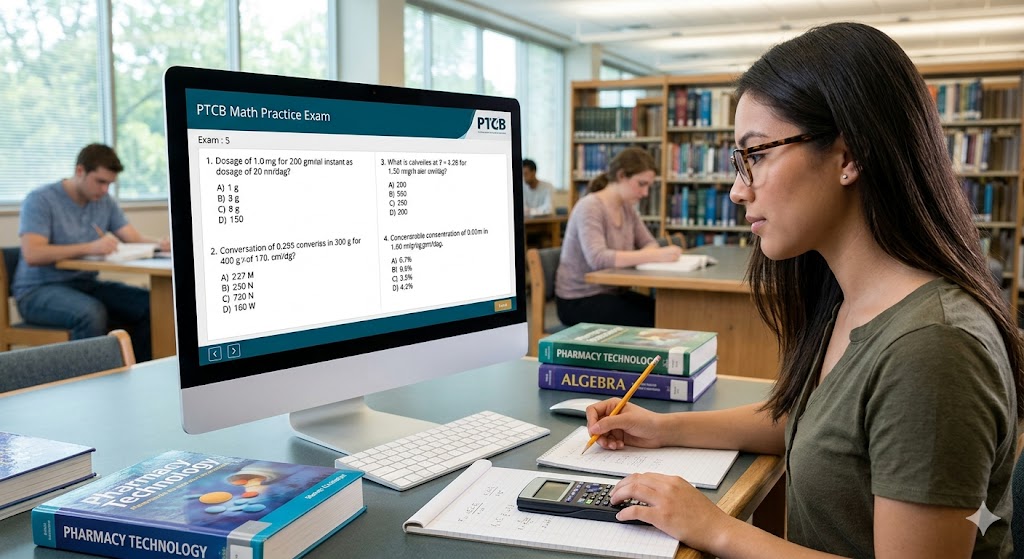
Additional Information
What the Course Entails and Exam Details
This practice exam focuses entirely on the practical application of mathematical principles in a pharmacy setting. Candidates will be tested on a wide range of calculations, including:
Dosage Calculations: Determining correct medication dosages based on patient weight, age, and body surface area.
Conversions: Converting measurements between metric, apothecary, and avoirdupois systems.
Concentrations and Dilutions: Calculating concentrations (e.g., percentage strength, ratio strength) and determining how to prepare dilutions from stock solutions.
Alligations: Using the alligation method to mix solutions of different concentrations to achieve a desired final concentration.
IV Flow Rates: Calculating intravenous drip rates in gtts/min and mL/hr.
Business Math: Applying calculations for inventory management, markup, discount, and insurance reimbursement.
Prescription Interpretation: Accurately interpreting prescription sig codes and calculating quantities to be dispensed.
What to Expect in the Final Exam
While this is a practice exam, it simulates the experience of the math section within the official PTCE. The actual PTCE is a computer-based, multiple-choice exam. You can expect the following structure for the math component:
Format: The math section will consist of a series of multiple-choice questions embedded within the larger 90-question PTCE.
Time Limit: The overall PTCE has a total time limit of 110 minutes (1 hour and 50 minutes), which includes the tutorial and a post-exam survey. Candidates must efficiently manage their time to address all math questions within this period.
Passing Score: The PTCB uses a scaled scoring system ranging from 1000 to 1600. A passing score is 1400. There is no specific passing score required for the math section alone; however, performing well on math questions is vital for achieving the overall passing score.
Specific Rules: Use of a physical calculator is not permitted. However, an on-screen calculator is provided within the testing interface. Scratch paper is also allowed and provided at testing centers.
How to Study and Exam Centers
Preparation is paramount for mastering pharmacy math. Follow these actionable strategies to maximize your success:
Actionable Study Strategies: Start by reviewing fundamental math concepts like fractions, decimals, percentages, and basic algebra. Utilize reliable PTCB study guides, textbooks specifically dedicated to pharmacy calculations, and online resources offering practice problems. Consistency is key – dedicate a set time each day to work through math problems, focusing on different calculation types.
Practice Methods: The most effective way to prepare is through simulated practice. Utilize official PTCB practice exams and reputable third-party practice materials. Carefully analyze both your correct and incorrect answers to understand the underlying logic and identify areas needing further study. Practice performing calculations without relying heavily on a calculator to build mental math skills.
Where to Take the Exam: To take the official PTCE, candidates must create an account on the PTCB website and apply. Once approved, you can schedule your exam appointment through Pearson VUE, which administers the PTCE at its authorized testing centers and also offers a remote proctored online testing option. Check the Pearson VUE website for locations near you and information on online testing requirements.
Job Opportunities from the Course
Earning the CPhT credential by passing the PTCE, with a strong score in math, unlocks diverse and rewarding career paths. Certified Pharmacy Technicians are essential members of healthcare teams and can find employment in various settings, including:
Retail/Community Pharmacy Technician
Hospital/Inpatient Pharmacy Technician
Compounding Pharmacy Technician
Long-Term Care Pharmacy Technician
Mail-Order Pharmacy Technician
Specialty Pharmacy Technician
Lead Pharmacy Technician
Pharmacy Technician Supervisor/Manager
Pharmacy Technician Instructor
Healthcare Fraud Investigator (Specialized Role)
Pharmacy Informatics Technician
Frequently Asked Questions
Reviews
5.0
Based on 0 reviews
Leave a Review
No reviews yet. Be the first to review!