
Pharmacy Technician Law and Safety Practice Test
$69.00
- Buy to unlock unlimited access to all Quiz questions and Answers in this Quiz.
- After purchase you can print a PDF of the whole quiz at any point. The PDF will contain the questions and the correct answers.
About this Exam
Embarking on a career as a certified pharmacy technician requires a deep understanding of the legal framework and critical safety protocols that govern this vital healthcare field.
This [Pharmacy Technician Law and Safety Practice Test] is specifically designed for aspiring pharmacy technicians preparing for the national certification exams, such as the PTCE or ExCPT.
It offers a comprehensive way to test your knowledge, boost your confidence, and identify areas that need further study.
This practice test ensures you are well-versed in the essential regulations and safety standards that ensure patient well-being.
Ready to test your knowledge?
Buy Now to Access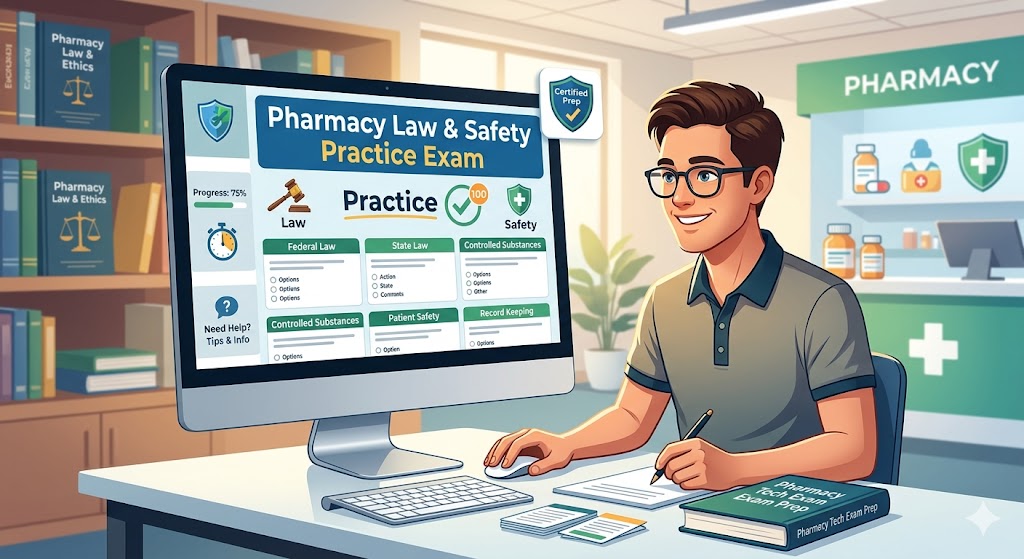
Additional Information
What the Course Entails and Exam Details
While not a full course in itself, a high-quality Law and Safety Practice Test simulates the rigorous scope of these domains in the major certification exams.
The key areas covered include:
Federal & State Regulations: Grasping the intricate network of federal and state laws that dictate pharmacy operations, including the Controlled Substances Act, FDA regulations, and state-specific board of pharmacy rules.
Controlled Substances Management: Navigating the strict protocols for ordering, storing, dispensing, and documenting scheduled medications.
Ethical Principles: Understanding and applying standard ethical principles to patient care, confidentiality (HIPAA), and professional conduct.
Patient Safety & Quality Assurance: Implementing strategies to prevent medication errors, including understanding tall man lettering, look-alike/sound-alike drugs, and proper prescription processing.
Calculations & Accuracy: Although focused on safety, a foundational level of mathematical accuracy for common pharmacy calculations is often integrated.
Record Keeping & Documentation: Mastering the importance of meticulous record-keeping for legal compliance and patient care continuity.
What to Expect in the Final Exam
When you move from practice to the actual certification exams (such as the PTCE administered by PTCB or the ExCPT by NHA), you can expect a demanding and structured evaluation.
The format is typically:
Computer-Based, Multiple-Choice Questions: You will answer a significant number of multiple-choice questions within specific time frames.
Domain-Specific Weighing: Both PTCE and ExCPT have distinct domains, with Pharmacy Law and Medication/Patient Safety being critical components that often carry substantial weight.
Passing Score: Requirements vary between exams and are typically based on scaled scores. For the PTCE, it's usually a scaled score of 1400. For ExCPT, a common scaled score threshold is 390. You should always check the official exam provider's website for the most current information.
Time Limits: You will be allocated a specific amount of time, generally around 2 hours, to complete the entire exam.
Strict Security & Rules: Testing centers have strict rules, requiring valid identification and forbidding outside materials, including specific types of calculators or electronic devices.
How to Study and Exam Centers
Effective preparation is the key to success. Here’s how to approach your study journey:
Utilize Comprehensive Practice Tests: Engage with numerous practice tests like this one to familiarize yourself with the question style, time constraints, and content distribution. This will build stamina and confidence.
Study the Official Content Outlines: Thoroughly review the detailed content blueprints provided by the official exam boards (PTCB and NHA). This tells you exactly what you need to know.
Review Key Reference Materials: Use recommended textbooks, online courses, flashcards, and review guides that focus specifically on pharmacy law, federal regulations, and patient safety protocols.
Focus on Calculation Accuracy: Practice common pharmacy calculations consistently, paying close attention to safety checks and units of measurement.
Exam Centers: The national certification exams (PTCE/ExCPT) are administered at secure, authorized testing locations. The most common center provider is Pearson VUE, with locations across the country. The ExCPT is also administered through PSI testing centers and sometimes via schools or other authorized centers. When registering, you will be able to select a convenient testing center and date. Always confirm the exact location and requirements upon booking your exam.
Job Opportunities from the Course
Becoming a Certified Pharmacy Technician (CPhT) through successful exam completion unlocks a range of rewarding career paths and job opportunities:
Retail Pharmacy Technician: Provide essential services in a community setting, interacting directly with patients and processing prescriptions.
Hospital Pharmacy Technician: Work within a fast-paced clinical environment, preparing complex medication orders and working alongside other healthcare professionals.
Certified Pharmacy Technician (CPhT): This is the fundamental, most common designation, often required or preferred by employers.
Lead Pharmacy Technician: With experience, you can advance to a leadership role, managing a team of technicians and overseeing key aspects of the pharmacy operation.
Compounding Pharmacy Technician: Specialize in preparing customized medications, which requires precise knowledge of safety and compounding techniques.
IV Room Technician (Sterile Compounding): Work with intravenous medications, ensuring sterile conditions and adherence to stringent safety protocols.
Long-Term Care/Home Infusion Technician: Prepare and deliver medications for patients in specialized care settings.
Pharmaceutical Representative or Sales Support: Use your knowledge to support pharmaceutical products or services.
Frequently Asked Questions
Reviews
5.0
Based on 0 reviews
Leave a Review
No reviews yet. Be the first to review!