
PHILSCA Aircraft Construction, Repair, and Maintenance (ACRM) Practice Exam
$69.00
- Buy to unlock unlimited access to all Quiz questions and Answers in this Quiz.
- After purchase you can print a PDF of the whole quiz at any point. The PDF will contain the questions and the correct answers.
About this Exam
The PHILSCA Aircraft Construction, Repair, and Maintenance (ACRM) Practice Exam is a essential preparation tool for students enrolled in, or aspiring to enter, the Philippine State College of Aeronautics' (PHILSCA) ladderized programs in Aircraft Maintenance Technology. This comprehensive assessment focuses on the core principles and technical skills required to construct, inspect, repair, and maintain aircraft structures, ensuring airworthiness and safety. It is designed for students who are serious about pursuing a career as a certified aircraft mechanic or technician specializing in airframe and structural systems. This exam simulates the final evaluation for the ACRM module, testing both theoretical knowledge and practical understanding.
Ready to test your knowledge?
Buy Now to Access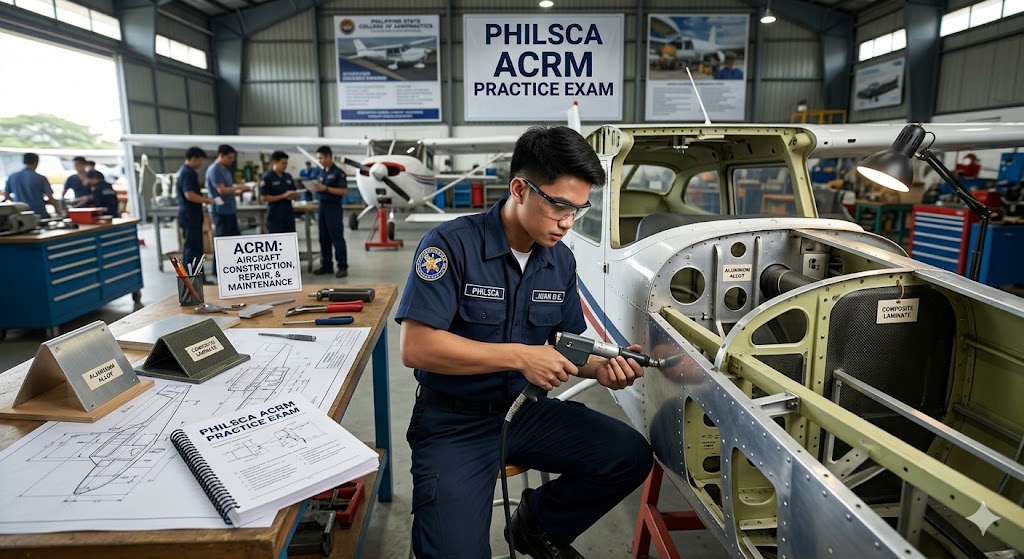
Additional Information
What the Course Entails and Exam Details
Outline the core topics, syllabus, or skills covered.
The PHILSCA ACRM curriculum and its corresponding exam are built around international standards for aircraft maintenance, specifically focusing on the airframe. Key areas of study and assessment include:
Aircraft Structures: Detailed understanding of fuselage, wing, and empennage construction for both fixed-wing and rotary-wing aircraft.
Structural Materials: properties and identification of aluminum alloys, stainless steel, titanium, and advanced composites (fiberglass, carbon fiber, Kevlar).
Fasteners and Riveting: Classification, selection, installation, and inspection of all types of aircraft fasteners, including standard rivets, blind rivets, and specialized bolts.
Sheet Metal Repair: Techniques for layout, bending, cutting, forming, and patching metal structures, adhering to specific repair schemes and tolerances.
Composite Repair: Procedures for damage inspection, material preparation, curing, and testing of composite components, including sandwich structures.
Aircraft Assembly and Rigging: Principles of aligning and joining structural components, including symmetry checks and control surface balancing.
Inspection and NDT: Non-Destructive Testing methods like visual, dye penetrant, and ultrasonic inspection for detecting hidden damage and corrosion.
Technical Documentation: Using illustrated parts catalogs (IPC), structural repair manuals (SRM), and maintaining accurate maintenance logs.
What to Expect in the Final Exam
Detail the exam format (multiple choice, practical, etc.), passing score requirements, time limits, and any specific rules.
The final evaluation for the PHILSCA ACRM module typically consists of two distinct parts to ensure a holistic measure of a student's competency.
The Written Component: This is a rigorous exam with approximately 100 to 150 multiple-choice questions designed to test a student's grasp of theory, regulations, and standard procedures. Topics range from structural mechanics and metallurgy to specific repair methods outlined in the SRM. The time limit is generally three hours. A passing score of 75% or higher is typically required.
The Practical Component (Skill Assessment): Students must demonstrate their hands-on proficiency in a controlled workshop environment. This part requires the successful completion of several assigned tasks, which may include:
Performing a standardized rivet layout and installation.
Executing a flush sheet metal patch repair on a test panel.
Identifying common types of structural damage and corrosion.
Creating a composite test specimen to specification. Students are graded on accuracy, adherence to safety protocols, and proper tool usage. All practical tasks must be completed satisfactorily to pass.
How to Study and Exam Centers
Provide actionable study strategies and practice methods. Explain where and how to take the exam (e.g., online portals, Pearson VUE, specific physical testing centers or authorized schools).
Successfully navigating the PHILSCA ACRM exam requires a blend of focused study and hands-on practice.
Master the SRM: The Structural Repair Manual is your primary reference. Know how to navigate it and find specific repair data for different aircraft types and materials.
Review Official Handbooks: Study the FAA-H-8083 series (specifically Airframe Volumes 1 and 2), which serve as foundational texts for aviation maintenance globally.
Utilize Practice Exams: Regularly taking full-length practice exams, such as this one, helps identify weak areas and familiarizes you with the question format.
Group Study: Engage with peers to discuss complex concepts, troubleshoot problems, and practice hands-on skills in a supportive environment.
Exam Centers: The final ACRM module exam, as a key part of your PHILSCA course grade, is administered at your specific PHILSCA campus testing facility (e.g., Villamor, Basa Air Base, Fernando Air Base, or Mactan). It is a scheduled, proctored exam taken as the culmination of your course. Successful completion of this exam, along with the other modules in your program, will lead to the granting of your Associate or Bachelor of Science degree in Aircraft Maintenance Technology, making you eligible to take the Civil Aviation Authority of the Philippines (CAAP) licensure exam.
Job Opportunities from the Course
Create a clear list or table showing the specific job titles and career paths this certification unlocks.
Graduating from the PHILSCA ACRM course and passing the corresponding exams opens a wide range of career opportunities in the aviation industry, both in the Philippines and internationally.
Aircraft Mechanic (Airframe Specialization): General maintenance and repair of the aircraft body and all structural systems.
Aircraft Structural Technician: Specialized in deep-level structural repairs and modifications.
Composite Repair Technician: Focused entirely on maintaining advanced composite structures on modern aircraft.
Sheet Metal Mechanic (Aviation): Precision cutting, forming, and joining of aircraft metal parts.
Maintenance, Repair, and Overhaul (MRO) Inspector: Inspecting structural work to ensure compliance with CAAP and manufacturer standards.
Aircraft Assembler: Working in manufacturing, putting together new aircraft structures.
Technical Representative (Aviation Structural Systems): Working for manufacturers to provide on-site technical support to airlines and MROs.
Frequently Asked Questions
Reviews
5.0
Based on 0 reviews
Leave a Review
No reviews yet. Be the first to review!