
Phlebotomy Requisition Form Practice Test
$69.00
- Buy to unlock unlimited access to all Quiz questions and Answers in this Quiz.
- After purchase you can print a PDF of the whole quiz at any point. The PDF will contain the questions and the correct answers.
About this Exam
The Phlebotomy Requisition Form Practice Exam is a vital training tool designed for students enrolled in phlebotomy technician programs and healthcare professionals aiming for certification. This specialized assessment focuses specifically on one of the most critical pre-analytical steps in the laboratory process: the accurate interpretation and completion of medical requisition forms. Mastery of these forms is essential to ensure patient safety, prevent diagnostic errors, and facilitate proper billing, making this practice exam an indispensable resource for anyone pursuing a career in blood collection.
Ready to test your knowledge?
Buy Now to Access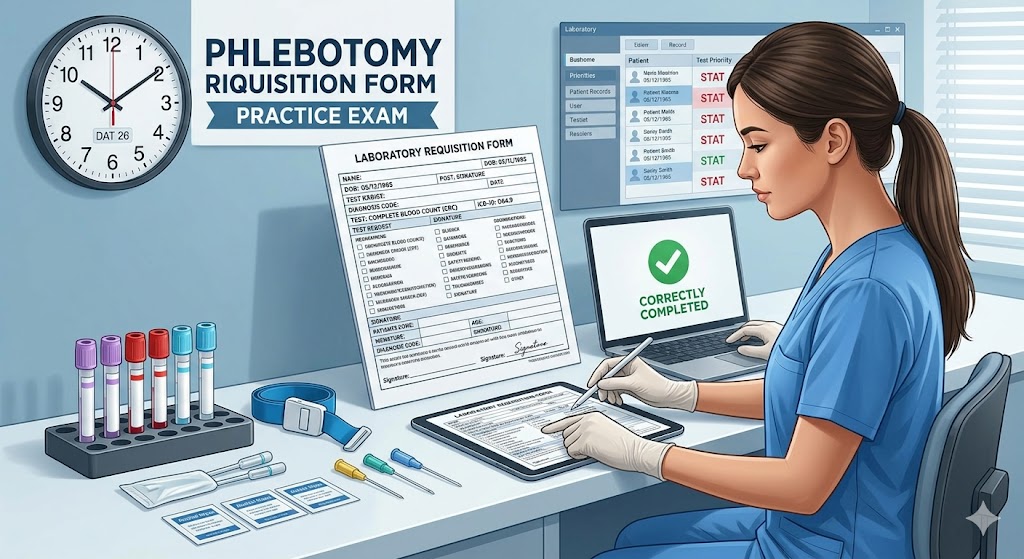
Additional Information
What the Course Entails and Exam Details
This practice exam is not a standalone certification course but rather a comprehension tool. It simulates the types of scenarios phlebotomists encounter daily, focusing on administrative accuracy.
The core topics covered within the practice scenarios include:
Patient Identification: Verifying full name, date of birth, unique identification numbers, and contact details.
Physician and Facility Information: Identifying the ordering physician, their NPI number, and the facility requesting the tests.
Test Selection and Medical Coding: Understanding how to correlate specific test orders (e.g., CBC, BMP, lipid panel) with their corresponding ICD-10 diagnosis codes.
Specimen Priority: Distinguishing between different priority levels such as STAT, routine, and timed draws.
Required Fields: Recognizing mandatory fields on a standard form to avoid rejection.
Labeling Integrity: Matching the information on the requisition form exactly with the labels applied to the collected sample tubes.
As a practice tool, this exam usually features:
Format: A series of multiple-choice questions based on sample cases or fill-in-the-blank simulations of paper or electronic forms.
Time Limit: Often untimed, allowing for thorough review and learning, though some advanced simulations may include a timer to mimic real-world efficiency.
Scoring: Immediate feedback and detailed explanations for correct and incorrect answers.
What to Expect in the Final Exam
While the "Phlebotomy Requisition Form Practice Exam" is a preparatory tool, the actual skill is tested within comprehensive national certification exams. The final exams administered by major organizations, such as the National Healthcareer Association (NHA) for the Certified Phlebotomy Technician (CPT) or the American Society for Clinical Pathology (ASCP) for the Phlebotomy Technician (PBT), include a significant portion dedicated to pre-analytical processes.
You can typically expect the final certification exam to include:
Format: 100 to 120 multiple-choice questions.
Requisition Testing: Requisition form scenarios may account for 15% to 25% of the total questions within the "Patient Preparation" or "Processing" domains.
Passing Score: A set scaled score, often 390 or higher on a scale of 0-500.
Time Limit: Approximately 2 hours.
The final exam will not ask you to manually fill out a form, but rather to evaluate a presented scenario. You will need to identify errors, determine the next correct administrative action, or select the proper ICD-10 code association based on a simulated clinical requisition.
How to Study and Exam Centers
Preparation for requisition form mastery requires a blend of administrative logic and medical terminology knowledge.
Effective Study Strategies:
Review Sample Forms: Collect empty requisition forms from different local hospitals or national labs to familiarize yourself with varying layouts.
Memorize Key Fields: Flashcard the 12 to 15 standard components of a compliant requisition.
Practice Medical Coding Basics: Learn to navigate basic ICD-10 coding books or online portals, specifically relating common diagnoses to lab tests.
Utilize Simulations: Engage repeatedly with online practice platforms, such as those provided by the NHA or ASCP, which offer specialized pre-analytical practice modules.
Taking the Final Exam:
Since this practice exam prepares you for national certification, you will take your final exam through official channels, not a generic online site.
Testing Centers: Major exams are administered at Pearson VUE or PSI physical testing centers, which offer secure, proctored environments.
Online Portals: Some certifying bodies, like the NHA, allow candidates to take the exam remotely via live online proctoring, provided specific hardware and environment requirements are met.
Authorized Schools: Many phlebotomy training programs are authorized testing sites, enabling students to take the final certification exam immediately upon course completion.
Job Opportunities from the Course
Mastery of the phlebotomy requisition form is not a skill meant for a standalone job but is a requisite for virtually every position involving specimen collection and processing. Securing a full national phlebotomy certification (e.g., CPT or PBT) by demonstrating proficiency in this area unlocks the following career paths:
Phlebotomy Technician
Certified Phlebotomist
Medical Laboratory Assistant
Specimen Processor
Laboratory Assistant
Plasma Center Technician
Traveling Phlebotomist
Donor Phlebotomy Technician
Frequently Asked Questions
Reviews
5.0
Based on 0 reviews
Leave a Review
No reviews yet. Be the first to review!