
Phoenix Standard Operating Procedures (SOPs) Volume 2 Practice Test
$69.00
- Buy to unlock unlimited access to all Quiz questions and Answers in this Quiz.
- After purchase you can print a PDF of the whole quiz at any point. The PDF will contain the questions and the correct answers.
About this Exam
The Phoenix Standard Operating Procedures (SOPs) Volume 2 Practice Test is an essential tool for fire service professionals aimed at mastering the official command and operational procedures of the Phoenix Regional Fire Department.
Specifically focused on the department's standard operating procedures for incident command and fireground operations, this practice test serves as a crucial preparation step for promotional exams and operational readiness within the department.
This program is meticulously designed for current and aspiring firefighters, company officers, and command staff who require an in-depth understanding of the specific protocols used to manage emergencies in the Phoenix metropolitan area.
Ready to test your knowledge?
Buy Now to Access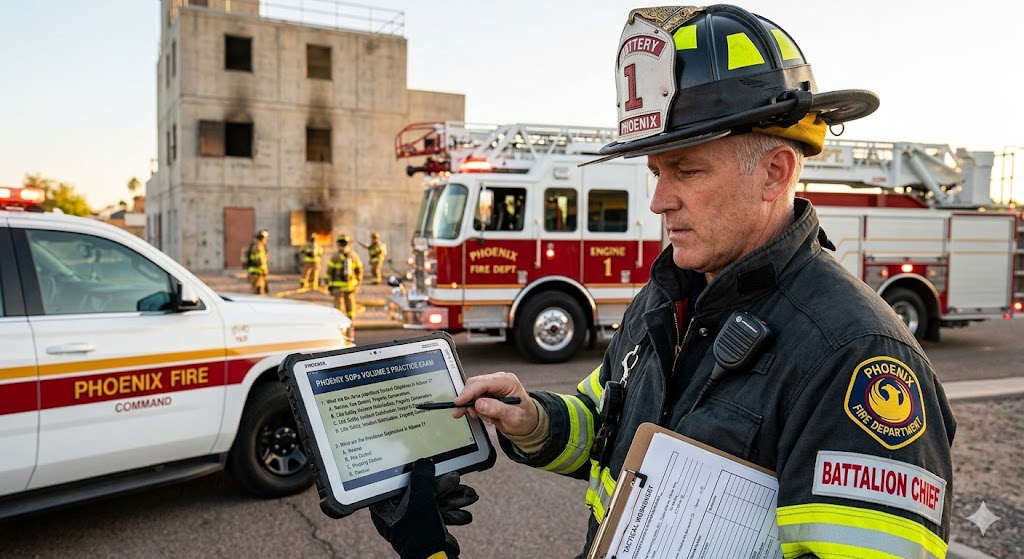
Additional Information
What the Course Entails and Exam Details
This course and practice test provide a comprehensive review of critical tactical and strategic knowledge derived directly from the Phoenix Regional Fire Department’s SOP Manual, specifically Volume 2.
Key focus areas include the fundamental Functions of Command and the precise Tactical Objectives (Rescue, Fire Control, Property Conservation) expected of an Incident Commander.
Participants will gain proficiency in establishing and maintaining an effective Incident Command System (ICS), implementing various command modes (such as Mobile Command and Stationary Command Post), and understanding the intricacies of command transfer procedures.
The curriculum also covers critical decision-making processes on the fireground, including strategic size-up, resource management, company assignments, and multi-agency coordination.
In addition, it integrates important aspects of exceptional customer service (using the CALSSRC acronym) and personnel safety on the scene.
What to Expect in the Final Exam
The final exam on Phoenix SOPs Volume 2 is a rigorous test of a candidate's knowledge and practical application of standard departmental procedures in various emergency scenarios.
Students should expect a challenging multiple-choice format designed to assess not only recall but also critical thinking and decision-making on the fireground.
The exam typically consists of a predetermined number of questions, ranging from 50 to 100, which must be completed within a set time limit, often around 90 to 120 minutes.
To succeed, candidates must achieve a passing score, which is typically a minimum of 70-80%, reflecting a high degree of operational knowledge.
The questions will require students to apply proper Phoenix SOPs to complex scenarios, including multi-company operations, large-scale incidents, and unique rescue situations.
How to Study and Exam Centers
Effective preparation for this exam requires a multi-faceted approach. First and foremost, you must dedicate significant time to a thorough, section-by-section study of the official Phoenix SOPs Volume 2 manual itself.
Do not just read the text; actively memorize the Functions of Command, the prioritized Tactical Objectives, and all critical procedural timelines and terminology.
Using a practice test like this is vital to understanding the exam's structure and finding areas of weakness.
Create flashcards for all key terms and mnemonics.
Form study groups with colleagues to discuss complex tactical scenarios and practice implementing the Incident Command System.
The official exam is administered internally by the Phoenix Fire Department and its authorized partners. Candidates will take the test at specific locations, including:
The Phoenix Fire Department Training Academy.
Regional fire department training facilities within the Phoenix Regional automatic aid system.
Through an internal departmental secure online testing portal.
Be sure to confirm the exact location, time, and registration requirements with your department’s training division.
Job Opportunities from the Course
Mastery of the Phoenix SOPs Volume 2 is a foundational requirement for numerous key roles and promotional paths within the fire service, particularly within the Phoenix region. Successful completion of this exam directly benefits and unlocks positions such as:
Company Officer (Captain, Lieutenant)
Battalion Chief
Incident Commander
Command Staff Officer
Training Academy Instructor
Departmental Safety Officer
Regional Training Coordinator
Developing and demonstrating this advanced knowledge significantly enhances career progression opportunities and is a testament to operational excellence and leadership potential.
Frequently Asked Questions
Reviews
5.0
Based on 0 reviews
Leave a Review
No reviews yet. Be the first to review!