
PHS 7.1 – Basic Structure of the Human Body Practice Test
$69.00
- Buy to unlock unlimited access to all Quiz questions and Answers in this Quiz.
- After purchase you can print a PDF of the whole quiz at any point. The PDF will contain the questions and the correct answers.
About this Exam
The PHS 7.1 Basic Structure of the Human Body Practice Test is designed for students enrolled in foundational health science, career and technical education (CTE), or introductory allied health programs. This exam assesses essential knowledge of human anatomy and physiology, focusing on how the body is organized and functions to maintain life. It serves as a vital checkpoint for those preparing for careers in the vast and rewarding field of healthcare. The certification validates a student's grasp of core anatomical concepts, making them better prepared for advanced studies and official licensing exams.
Ready to test your knowledge?
Buy Now to Access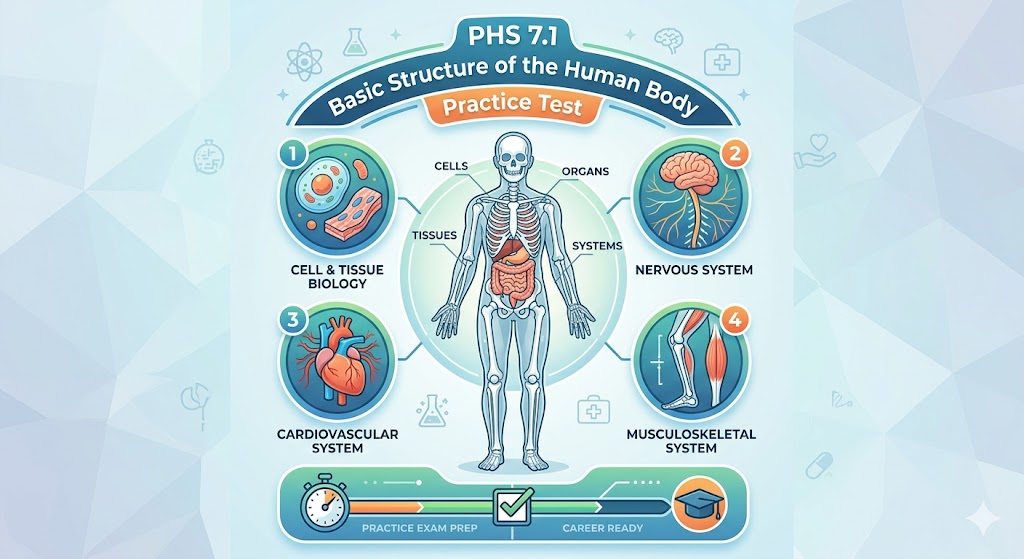
Additional Information
What the Course Entails and Exam Details
This comprehensive course provides a thorough introduction to the fundamental building blocks of human life. Students begin by mastering the "Language of Anatomy," which includes directional terms, body planes, and major cavities. The curriculum then explores Histology, analyzing the four main tissue types: epithelial, connective, muscle, and nervous. From there, the course moves system-by-system, covering the Skeletal, Muscular, Cardiovascular, Respiratory, Digestive, Urinary, Endocrine, Nervous, and Reproductive systems. Beyond simple identification, the course emphasizes the relationship between structure (anatomy) and function (physiology), and explains key physiological concepts like homeostasis, metabolism, and feedback loops.
What to Expect in the Final Exam
The PHS 7.1 exam is typically administered as a multiple-choice digital or written test. While exact specifications can vary by institution or state CTE board, it generally consists of 50 to 100 questions. Students are usually given a strict time limit, often 60 to 90 minutes, to complete the exam. The questions are designed to test not only a student's ability to recall terms and identify structures, but also their understanding of physiological processes and feedback mechanisms. A passing score is frequently set at 70% or 80%. There is typically no practical or hands-on component to this specific written exam, although it may accompany a separate lab assessment.
How to Study and Exam Centers
Preparation for the PHS 7.1 requires a structured approach. Students should create detailed flashcards for anatomical terminology, directional terms, and the specific functions of each body system. Utilizing online interactive anatomy diagrams and virtual dissection tools is highly recommended. Group study sessions are beneficial for teaching concepts to others, which helps reinforce understanding. Finally, taking multiple timed practice exams is crucial for building testing stamina and identifying knowledge gaps. The exam is usually taken within a registered school's computer lab or, in some cases, through authorized physical testing centers that oversee proctored CTE or health science certifications. Students should consult their instructors for specific registration and location details.
Job Opportunities from the Course
While the PHS 7.1 knowledge on its own is a foundational step and often not enough for direct employment, it is an essential requirement for advancing to specific certifications that open numerous career paths. This certification validates that a student has the core knowledge necessary to succeed in higher-level training for roles such as:
Certified Nursing Assistant (CNA)
Medical Assistant (MA)
Emergency Medical Technician (EMT)
Phlebotomy Technician
Patient Care Technician (PCT)
Home Health Aide
Healthcare Administrative Assistant
Admissions Coordinator in a hospital setting
Medical Billing and Coding Specialist
Frequently Asked Questions
Reviews
5.0
Based on 0 reviews
Leave a Review
No reviews yet. Be the first to review!