
Physical Assessment (PA) Lower Extremity (LE) Practice Test
$69.00
- Buy to unlock unlimited access to all Quiz questions and Answers in this Quiz.
- After purchase you can print a PDF of the whole quiz at any point. The PDF will contain the questions and the correct answers.
About this Exam
Mastering the physical assessment of the lower extremities is a critical skill for any healthcare student or professional. This comprehensive practice exam is designed specifically for students in nursing, physical therapy, occupational therapy, and other medical programs. It provides a valuable opportunity to review and reinforce essential skills needed for evaluating the hips, knees, ankles, and feet. This test focuses on key competencies, including patient history collection, visual inspection, palpation for abnormalities, range of motion (ROM) evaluation, and performing special orthopedic tests. By using this practice exam, students can build confidence and prepare effectively for their practical clinical exams and future patient interactions.
Ready to test your knowledge?
Buy Now to Access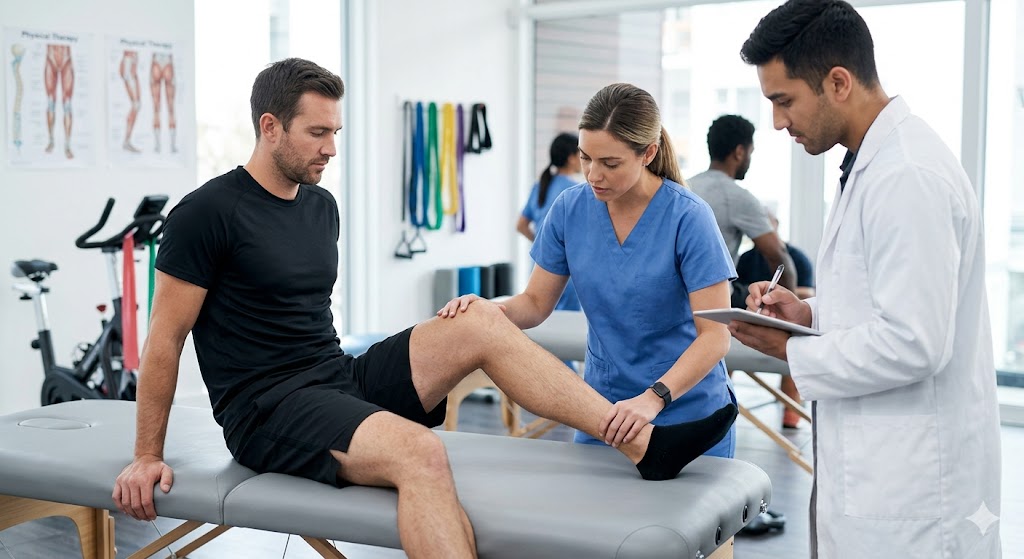
Additional Information
What the Course Entails and Exam Details
While not a formal course itself, this practice exam covers the essential curriculum for lower extremity assessment frequently taught in clinical skills modules. The core competencies covered include:
Relevant Anatomy Review: Briefly identifying key bones, muscles, ligaments, and neurovascular structures of the lower extremity.
Subjective Assessment (History Taking): Understanding specific questions related to lower extremity pain, injury, functional limitations, and mobility.
Objective Assessment Techniques:
Inspection: Observing gait patterns, symmetry, skin condition, swelling, and deformities.
Palpation: Identifying landmarks, assessing temperature, edema, pulses (dorsalis pedis and posterior tibial), and tenderness.
Range of Motion (ROM): Measuring passive and active ROM for the hip, knee, ankle, and foot joints.
Muscle Strength Testing: Assessing major muscle groups using standard grading scales.
Neurological Screening: Checking dermatomes and key reflexes in the lower extremity.
Orthopedic Special Tests: Understanding and interpreting results from common tests (e.g., Lachman's test, Drawer tests, McMurray's test for the knee; Thompson test for the Achilles tendon).
The practice exam typically consists of multiple-choice questions derived from these core areas.
What to Expect in the Final Exam
Since this is a practice exam, it mimics the format often used for academic knowledge assessments, rather than an official certification exam. You should expect:
Format: A varied set of multiple-choice questions focusing on practical scenarios, anatomical identification, the rationale behind specific assessment techniques, and interpretation of common clinical findings.
Content Focus: Scenarios will often ask you to identify the most appropriate assessment step next, determine which orthopedic test to perform based on symptoms, or interpret abnormal findings.
Time Limit: Practice tests usually do not have a strict time limit, allowing you to review each question carefully.
Passing Score: While practice exams don't have an official passing score required for a credential, aim for a score above 80% to demonstrate strong comprehension before your actual practical examinations.
How to Study and Exam Centers
Preparation for this practice test—and your actual clinical skills exam—should be a blend of theoretical knowledge and practical application.
Study Strategies:
Review Textbooks: Use leading physical assessment textbooks (like Bates' Guide to Physical Examination) for detailed steps and rationale.
Utilize Practice Videos: Watch high-quality instructional videos showing correct assessment techniques and special tests.
Flashcards: Create flashcards for anatomical landmarks, ROM norms, and the purpose/procedure of orthopedic special tests.
Hands-on Practice: This is crucial. Partner with a classmate to practice the full assessment flow repeatedly. Practice on family members or friends (with consent) to encounter different variations.
Exam Center Location:
This practice exam is not administered at formal testing centers like Pearson VUE. It is typically accessed online through a learning management system (LMS) provided by your school, a dedicated educational portal, or downloaded as a study resource. You can take this test conveniently from your own computer or mobile device.
Job Opportunities from the Course
While this practice test itself does not grant a certification, mastery of lower extremity physical assessment skills is fundamental for success in numerous healthcare careers:
Registered Nurse (RN): Performs assessments daily on medical-surgical units, in orthopedics, and in home health settings.
Physical Therapist (PT): Uses these assessments as the foundation for diagnosing and treating musculoskeletal conditions.
Occupational Therapist (OT): Evaluates lower extremity function to help patients improve independence in daily activities.
Physician Assistant (PA): Conducts physical exams, including detailed LE assessments, under the supervision of a physician.
Medical Assistant: Performs preliminary patient intake, which may include vital signs and documenting lower extremity concerns.
Orthopedic Technician: Assists orthopedic surgeons with casting, splinting, and initial patient evaluations.
Athletic Trainer: Assesses and manages lower extremity injuries in athletes.
Frequently Asked Questions
Reviews
5.0
Based on 0 reviews
Leave a Review
No reviews yet. Be the first to review!