
Pilates Certification – Anatomy Practice Exam
$69.00
- Buy to unlock unlimited access to all Quiz questions and Answers in this Quiz.
- After purchase you can print a PDF of the whole quiz at any point. The PDF will contain the questions and the correct answers.
About this Exam
This [Pilates Certification – Anatomy Practice Exam] is an essential study tool designed for aspiring Pilates instructors, current fitness professionals seeking to enhance their knowledge, and wellness enthusiasts deep within their teacher training journey. A profound understanding of human anatomy is the foundation of the Pilates method, ensuring instructors can guide clients safely and effectively through controlled, precise movements. This practice exam serves as a comprehensive check of that knowledge, allowing students to gauge their understanding of key anatomical concepts and identify areas needing further review before they face the official certification exam.
Ready to test your knowledge?
Buy Now to Access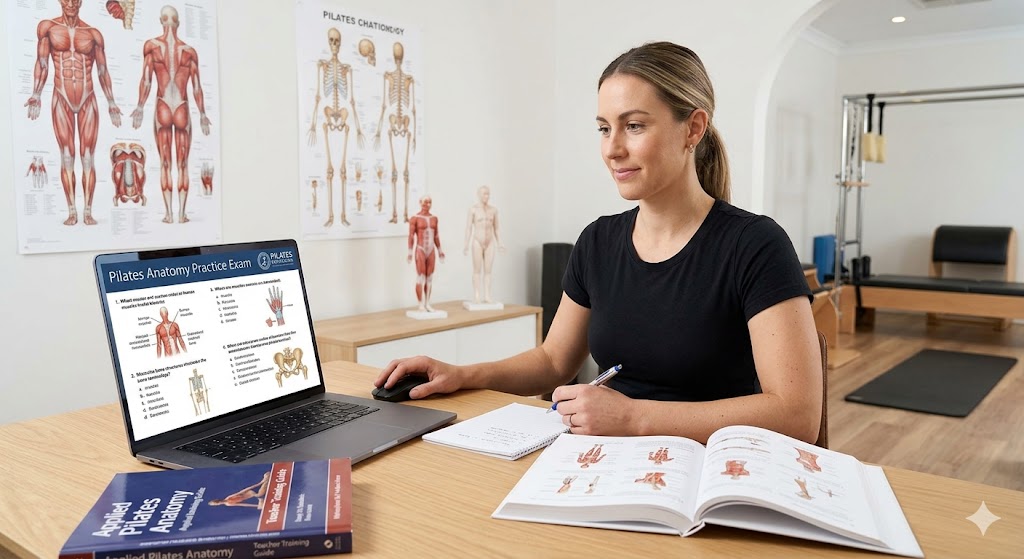
Additional Information
WHAT THE COURSE ENTAILS AND EXAM DETAILS
A standard Pilates anatomy course, which this practice exam prepares you for, typically covers a wide range of essential topics. Students dive deep into the human skeletal system, including the major bones, the structure and function of the spine, and the mechanics of the pelvic and shoulder girdles. Extensive attention is given to the major muscle groups of the body, learning not just their names, but also their origin, insertion, and specific actions during various movements. Understanding joint function, connective tissues like fascia and ligaments, and how the entire body works as an integrated system is paramount. Crucially, the course and subsequent exam emphasize applied anatomy, relating all this knowledge directly to classical and contemporary Pilates exercises, explaining why certain movements are beneficial and how specific muscles are engaged, stabilized, or stretched in each movement.
The exact length, number of questions, and structure of the final official anatomy exam can vary significantly depending on the certifying body (such as PMA, Merrithew, Balanced Body, or others). However, it commonly consists of a substantial number of multiple-choice questions designed to test knowledge of terminology, muscle function, skeletal alignment, and applied anatomy in Pilates scenarios. Some exams may also incorporate illustrative diagrams, short-answer questions, or potentially a small practical component, though the main practical teaching assessment is usually a separate part of the larger certification process.
WHAT TO EXPECT IN THE FINAL EXAM
When you take your final, official Pilates anatomy certification exam, you should expect a challenging and comprehensive assessment that reflects the level of detail covered in your course and this practice tool. The most common format is a proctored, online examination consisting of multiple-choice questions, which may include image-based identification of muscles, bones, and joints. Depending on the certifying body, the exam could also feature short-answer questions, fill-in-the-blank, or case-study-style scenarios requiring the application of anatomical knowledge. You will likely have a fixed time limit, which can range from 60 minutes to over two hours, and a required minimum passing score, often 75% to 80% or higher. Understanding and adhering to all exam rules, including academic integrity and proctoring requirements, is crucial for a successful attempt. Remember, this is not just a test of memory, but of your ability to understand and safely apply anatomical principles in a professional Pilates environment.
HOW TO STUDY AND EXAM CENTERS
Effective preparation is key to success on the official anatomy exam. Here are some actionable study strategies and practice methods:
Utilize Practice Exams: Rigorously use this practice exam and any others available. Go through the questions multiple times, not just to memorize answers, but to understand the reasoning behind the correct choice. Analyze your results to identify your weakest areas.
Flashcards are Crucial: Create detailed flashcards for muscles (including image, name, origin, insertion, action), bones, and anatomical terms. Use them daily for repetitive, active recall.
Applied Learning: When you are not studying with text and diagrams, actively link your anatomy knowledge to physical practice. As you perform or observe a Pilates exercise, identify which muscles are the primary movers, antagonists, and stabilizers, and analyze the joint actions.
Visual Aids: Use anatomy posters, models, 3D apps, and study guides with clear illustrations. Color-coding and labeling diagrams are highly effective.
Form Study Groups: Collaborating with fellow students can provide diverse perspectives and help you talk through complex concepts.
Regarding exam delivery, the official final certification exam is increasingly offered through secure, online portals and proctoring services, allowing you to take it in a controlled environment from home or a designated facility. Many certification bodies also have relationships with physical testing centers and authorized Pilates schools worldwide. Your specific certification provider will give you detailed information on how to register and where you can sit for your final examination. Always verify with your chosen organization for the exact procedure.
JOB OPPORTUNITIES FROM THE COURSE
Passing this anatomy exam is a vital milestone on the path to becoming a certified Pilates instructor. A solid foundation in anatomy opens the door to a rewarding and diverse array of job opportunities within the fitness and wellness industry, including:
Pilates Instructor (Studio/Gym): Leading group classes and private sessions in specialized studios, large gyms, and corporate wellness programs.
Group Fitness Instructor (Pilates Focus): Designing and leading Pilates-inspired group classes in various fitness settings.
Wellness Coach: Integrating Pilates principles with broader wellness coaching to help clients achieve holistic health.
Rehabilitation Specialist (with further training): Assisting clients with recovery and movement improvement under medical guidance.
Special Populations Instructor: Working with clients such as prenatal/postnatal women, seniors, or those with specific injuries or conditions.
Studio Owner: Entrepreneurial instructors can ultimately establish their own dedicated Pilates studio.
Continued Education/Specialization: Mastery of anatomy enables further specialization and advancement within the world of Pilates.
By mastering the anatomical knowledge tested in this practice exam, you are not just preparing to pass a test; you are ensuring your capability as a knowledgeable, safety-conscious, and effective professional ready to make a positive impact on the lives of your future clients.
Frequently Asked Questions
Reviews
5.0
Based on 0 reviews
Leave a Review
No reviews yet. Be the first to review!