
Pilbeam's Mechanical Ventilation Practice Exam
$69.00
- Buy to unlock unlimited access to all Quiz questions and Answers in this Quiz.
- After purchase you can print a PDF of the whole quiz at any point. The PDF will contain the questions and the correct answers.
About this Exam
Mastering mechanical ventilation is a defining step for any respiratory care student and a necessary skill for critical care professionals. Pilbeam's Mechanical Ventilation Practice Exam is your comprehensive tool to prepare for this vital subject, which is often tested at the end of academic courses or as a foundational part of professional certification exams like the NBRC's Therapist Multiple-Choice (TMC) and Clinical Simulation Exam (CSE). This practice test is designed to evaluate your deep understanding of the Jimmy Cairo textbook, ensuring you are ready to apply complex physiological and clinical principles to patient care in a high-stakes environment.
Ready to test your knowledge?
Buy Now to Access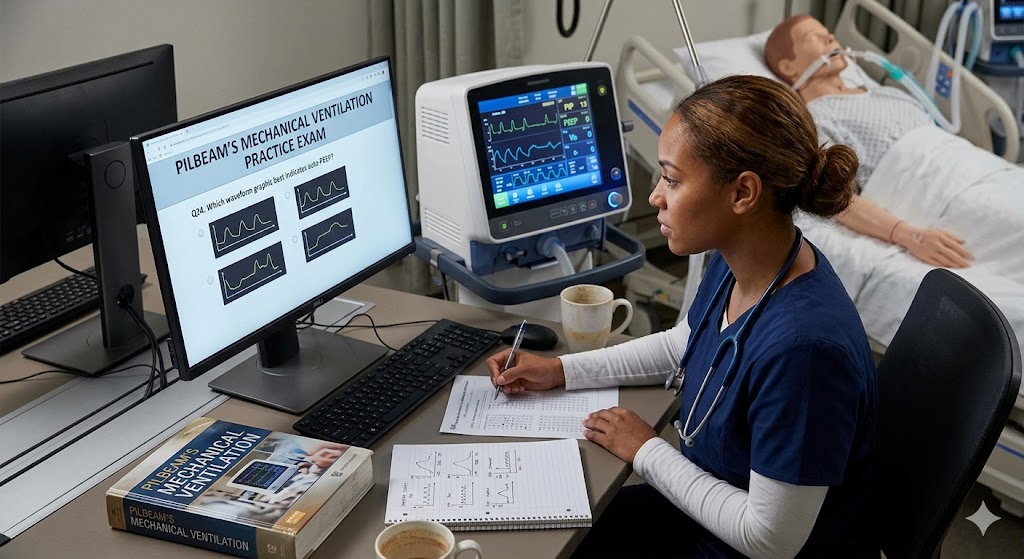
Additional Information
What the Course Entails and Exam Details
This examination is a rigorous assessment of the knowledge presented in "Pilbeam's Mechanical Ventilation: Physiological and Clinical Applications." It focuses heavily on how to operate, monitor, and troubleshoot modern mechanical ventilators, while maintaining the highest standard of patient safety and optimal gas exchange. Key areas of evaluation include:
Physiological Concepts: Understanding normal breathing mechanics vs. positive pressure ventilation and the effects on other body systems.
Ventilator Classification and Operation: Learning the internal workings of ventilators, breath delivery types, and the logic behind control variables (pressure, volume, flow, and time).
Modes of Ventilation: Mastering the differences between full and partial support modes, including A/C, SIMV, PCV, VC, and advanced options.
Initial Setup and Assessment: Calculating starting parameters, interpreting arterial blood gases (ABGs), and assessing initial patient-ventilator interaction.
Ventilator Graphics and Hemodynamics: Analyzing waveform scalars and loops for asynchrony and monitoring cardiac function during ventilation.
Clinical Scenarios and Troubleshooting: Managing complex cases, identifying system leaks, resolving patient distress, and following critical practice guidelines.
Improving Oxygenation and Weaning: Navigating strategies for ARDS and identifying the precise criteria for a successful spontaneous breathing trial and extubation.
What to Expect in the Final Exam
While the exact structure of a final course exam depends on the academic institution, students should prepare for a comprehensive, timed, and invigilated test. This practice exam replicates that pressure and style. For those aiming for professional certification, these concepts are integral to the national exams. Expect a format that tests both recall and, more crucially, critical application through:
Format: A large volume of high-quality multiple-choice questions, many of which are scenario-based and accompanied by ventilator waveforms or clinical data, mirroring NBRC style.
Scoring: A typical passing score for a comprehensive practice exam of this type is usually 70% or 80%. Professional certification requires a higher threshold on specific sections.
Time: The practice exam should be completed within a period comparable to the real test, allowing approximately 60 to 90 seconds per question to build necessary speed and accuracy.
How to Study and Exam Centers
Preparation must be systematic and multi-faceted. Start with the core text, Pilbeam's Mechanical Ventilation, and complement it with the accompanying workbook. Do not just read; actively use case studies and answer every review question. Leverage NBRC Self-Assessment Exams (SAEs) and other focused practice question banks that specialize in mechanical ventilation to understand the unique questioning style. Our comprehensive practice exam provides targeted feedback and explanations for every answer, allowing you to convert every mistake into a learning opportunity.
Regarding location:
Course Finals: If this practice is for a college course, your final exam will be scheduled through your academic institution's official testing centers or via an approved online proctoring service.
NBRC Certification: To earn your CRT or RRT credential, you must register with the NBRC and take the official TMC exam at a designated Pearson VUE testing center. Pearson VUE has locations globally, offering secure computer-based testing.
Job Opportunities from the Course
A strong score on this practice exam, and consequently on the official tests, is a signal to employers that you have the expertise required for high-acuity roles. Mastery of this material is a universal requirement for the following career paths:
Registered Respiratory Therapist (RRT)
Certified Respiratory Therapist (CRT)
Neonatal/Pediatric Specialist (NPS)
Adult Critical Care Specialist (ACCS)
Pulmonary Function Technologist (PFT)
Sleep Disorder Specialist (SDS)
Respiratory Therapy Educator or Professor
Cardiopulmonary Sales or Education Representative for Ventilator Manufacturers
Frequently Asked Questions
Reviews
5.0
Based on 0 reviews
Leave a Review
No reviews yet. Be the first to review!