
Pima JTED Sports Medicine Practice Test
$69.00
- Buy to unlock unlimited access to all Quiz questions and Answers in this Quiz.
- After purchase you can print a PDF of the whole quiz at any point. The PDF will contain the questions and the correct answers.
About this Exam
The Pima JTED Sports Medicine program is a specialized Career and Technical Education (CTE) course offered to high school students in Pima County, Arizona. It provides a foundational understanding of healthcare through the lens of athletic training, rehabilitation, and fitness. This comprehensive program is ideal for aspiring Physical Therapists, Athletic Trainers, Nurses, and Physicians, equipping them with the knowledge and hands-on skills required to prevent, assess, treat, and rehabilitate injuries in physically active populations. The final program exam serves as a capstone, validating their proficiency and readiness for entry-level positions or advanced study.
Ready to test your knowledge?
Buy Now to Access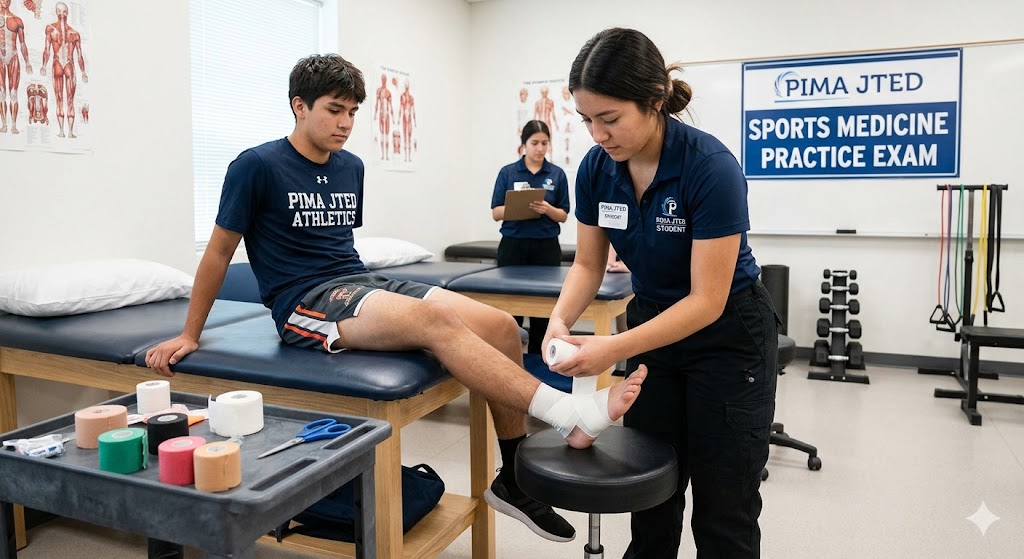
Additional Information
What the Course Entails and Exam Details
The Pima JTED Sports Medicine curriculum combines extensive classroom instruction with intensive practical application. It is designed to prepare students for both immediate workforce entry and seamless transition to post-secondary education. The program covers five core domains, which also form the basis of the final examination:
Human Anatomy & Physiology and Medical Terminology: Mastering the language of healthcare and understanding body systems, particularly the musculoskeletal and nervous systems.
Injury Prevention and Protective Equipment: Learning techniques for strapping, bracing, padding, and assessing the proper fit of protective gear to prevent athletic injuries.
Emergency Care and First Aid: Gaining certifications in American Heart Association (AHA) First Aid, CPR, and AED to respond effectively to acute injuries and medical emergencies.
Clinical Diagnosis and Injury Assessment: developing systematic protocols (e.g., HOPS – History, Observation, Palpation, Special Tests) to evaluate common musculoskeletal conditions and determine a preliminary diagnosis.
Therapeutic Intervention and Rehabilitation: Understanding the principles of progressive exercise, modality use (heat, ice), and designing rehabilitation programs to return individuals safely to activity.
What to Expect in the Final Exam
The Pima JTED Sports Medicine final exam is a critical step to prove a student's competency. It is a dual-component assessment:
Part 1: The Written Examination: This is a comprehensive, timed multiple-choice test. It focuses on theoretical knowledge, testing students on anatomy, medical terminology, physiological principles, emergency action plans, and legal/ethical concepts.
Part 2: The Practical Skills Assessment (OSCE): This is a critical, hand-on component. Students rotate through "stations" where they must perform specific skills in front of evaluators. They might be asked to demonstrate a figure-eight ankle wrap, perform a ligamentous special test, correctly apply a splint, or calculate nutritional needs for an athlete.
Both parts require separate passing scores (typically 70% or higher) for the student to receive their program completion certificate. The entire process often takes an entire school day to complete.
How to Study and Exam Centers
Success on the Pima JTED Sports Medicine exam requires a dedicated, proactive study approach. Students must balance theory with practice.
Study Strategies: Use the Pima JTED-provided curriculum guides and textbook. Create flashcards for medical terms, anatomy, and special tests. Actively participate in class labs and shadowing opportunities to refine your hands-on techniques.
Practice Methods: The most effective practice is simulation. Form study groups to practice injury evaluation scenarios (e.g., "Student A, evaluate a suspected grade 2 ACL tear"). Practice all taping and wrapping skills until they are second nature and meet professional standards for tension and support. Use the Pima JTED practice test materials to familiarize yourself with the question formats.
Exam Centers: The exam is not public. It is only available to students currently enrolled in the Pima JTED Sports Medicine program. It is administered directly at a Pima JTED central campus (like the Pima JTED @ Bridges campus) or, for some programs, at the student's home high school during a scheduled examination window, organized by their instructor.
Job Opportunities from the Course
Successfully completing the Pima JTED Sports Medicine program and passing the final exam unlocks immediate career paths and certifications that are highly valuable for further education.
Physical Therapy Aide
Certified Personal Trainer (CPT) (Ready for industry certification, e.g., NASM, ACE)
Rehabilitation Aide
Athletic Training Student Aide
Fitness Instructor
Exercise Science Technician
Activity Coordinator
Pathway to Bachelor’s/Doctoral programs: The certification provides a significant advantage for admission to undergraduate programs in Athletic Training, Exercise Science, Pre-Physical Therapy, Kinesiology, and Pre-Medical fields.
Frequently Asked Questions
Reviews
5.0
Based on 0 reviews
Leave a Review
No reviews yet. Be the first to review!