
Pima JTED Stagecraft Practice Test
$69.00
- Buy to unlock unlimited access to all Quiz questions and Answers in this Quiz.
- After purchase you can print a PDF of the whole quiz at any point. The PDF will contain the questions and the correct answers.
About this Exam
The Pima JTED Stagecraft program offers a dynamic, creative space for high school students to dive deep into the technical and dramatic principles of live production. This specialized course goes far beyond the performance to teach the intricate skills required for set design, lighting design, sound effects, rigging, scenic painting, and production management. Integrated with professional skills standards, this program prepares young individuals for immediate entry into the workforce, further training, or post-secondary education. The program often includes opportunities for leadership, teamwork, and competition through the Career and Technical Student Organization, SkillsUSA. This practice test is a valuable tool for students to gauge their current understanding and readiness for the high-stakes final assessment that can lead to valuable industry certifications.
Ready to test your knowledge?
Buy Now to Access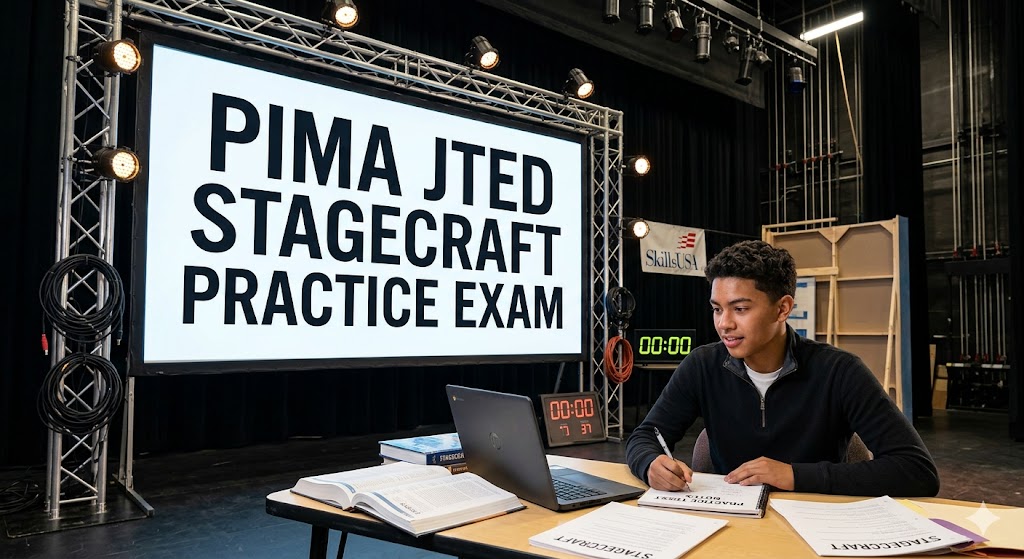
Additional Information
What the Course Entails and Exam Details
A typical comprehensive Stagecraft course will cover a diverse and exciting curriculum. You will gain foundational and advanced knowledge in the following core areas:
Stage Lighting: Design concepts, equipment operation (consoles, instruments, dimmers), safety procedures, and color theory.
Sound Engineering: System setup, microphone placement, mixing, sound effects design, and theatrical acoustics.
Set Construction and Design: Script analysis for scenic needs, ground plans, working drawings, carpentry, scenic painting techniques, and prop construction.
Stage Management & Production: Team communication, scheduling, budget management, safety protocols, and technical direction.
Rigging and Fly Systems: Safe operation and maintenance of rigging equipment, understanding load limits, and knot tying.
Costume & Makeup: Fundamental design, application, and wardrobe management in line with production needs.
Industry Safety: Rigorous emphasis on best safety practices for all aspects of stage operations, tool use, and environmental health.
The final Pima JTED Stagecraft examination typically assesses students through a combination of a written theory component and a practical, hands-on demonstration. The practice test you are preparing with is designed to mirror the topics and question types you will encounter in the written portion and potentially offer guidance on the practical aspects.
What to Expect in the Final Exam
You can expect the comprehensive final exam to be structured to test both your depth of knowledge and your ability to apply it. The assessment is likely to include:
A Written Component: This section often consists of multiple-choice questions, matching exercises, and sometimes short-answer or problem-solving questions. Topics will cover technical terminology, safety procedures, mathematical calculations relevant to set design and sound, historical contexts, and equipment operation principles. Be prepared to recall specific terms, identify equipment parts, and explain key concepts.
A Practical Component: This is where you demonstrate your hands-on mastery. You might be asked to safely rig a light, set up a basic sound system, demonstrate scenic painting techniques, perform a knot tie used in rigging, or solve a simulated technical issue. Your proficiency, safety consciousness, and ability to follow standard procedures are key here.
Time and Passing Score: While the exact details can vary slightly by specific assessment cycle, you can generally expect a time limit of several hours for the total exam (written and practical). The written part might be around 60-90 minutes, and the practical time will depend on the tasks assigned. Passing scores typically range between 70% and 80%, signifying a high level of foundational competence.
Rules and Regulations: Expect strict adhere to exam rules. No unauthorized electronics or materials, prompt arrival, and adherence to all safety protocols, especially in the practical portion, are paramount.
How to Study and Exam Centers
Preparation is the key to success. Here’s a strategic approach to ace your Pima JTED Stagecraft final:
Review Core Materials: Go through your class notes, textbooks, and any official study guides provided by your Pima JTED instructors or program. Pay close attention to vocabulary, safety rules, and procedure flowcharts.
Practice with Mock Exams: Utilizing Pima JTED Stagecraft practice tests is crucial. They are specifically designed to expose you to the types of questions and the format of the exam, helping you to build speed, confidence, and identify weak spots in your knowledge. The search results mentioned the importance of "domain-specific words," so focus on theatrical terminology.
Hands-on Practice: For the practical component, there is no substitute for doing. Seek extra opportunities in your class or on school productions to practice key skills. Rig lights, mix sound, help construct and paint sets. Ensure you understand the "why" behind every safety rule.
Form a Study Group: Collaborating with your peers can be immensely beneficial. Discuss complex concepts, quiz each other, and practice practical tasks together.
Focus on Safety: Make sure you can recall and demonstrate all safety standards without hesitation.
Exam Centers:
Pima JTED assessments are typically conducted at your specific Pima JTED training facility or at one of the associated local high school "satellite" campuses where the programs are offered. Your instructor will provide the exact time, date, and location well in advance. These settings ensure you have access to the necessary equipment for both the written and practical components in a controlled, official environment. In some cases, theoretical portions might be delivered via online portals, but your primary exam center will likely be your Pima JTED location.
Job Opportunities from the Course
A Pima JTED Stagecraft certification opens doors to a variety of exciting, practical career paths and positions in the vibrant entertainment industry:
Lighting Technician: Operates and maintains lighting equipment, executes design.
Sound Engineer/Audio Technician: Sets up, mixes, and manages sound for productions.
Set Carpenter/Scenic Artist: Designs, constructs, and paints theatrical scenery.
Prop Master/Props Artisan: Creates, manages, and maintains all stage props.
Rigging and Fly Crew: Operates the rigging and curtain systems safely.
Wardrobe Assistant/Dresser: Assists with costume changes, maintenance, and organization.
Production Assistant: Provides general support across various technical areas.
Technical Director/Assistant Technical Director: Manages the entire technical operation.
Stage Manager/Assistant Stage Manager: Coordinates and calls production cues.
Set and Exhibit Designer: Designs for theatre, film, and display.
Audio and Video Equipment Technician: Sets up and runs general AV systems.
Frequently Asked Questions
Reviews
5.0
Based on 0 reviews
Leave a Review
No reviews yet. Be the first to review!