
Piney Point Basic Fire Fighting Practice Exam
$69.00
- Buy to unlock unlimited access to all Quiz questions and Answers in this Quiz.
- After purchase you can print a PDF of the whole quiz at any point. The PDF will contain the questions and the correct answers.
About this Exam
Embark on a critical step towards a safe and successful maritime career with our specialized Piney Point Basic Fire Fighting Practice Exam. This comprehensive practice tool is meticulously designed for maritime trainees, new recruits, and seasoned mariners alike who are preparing for their vital Basic Fire Fighting certification.
As a core component of the Standard of Training, Certification and Watchkeeping (STCW) Basic Safety Training, this certification is non-negotiable for working at sea. Our practice exam bridges the gap between study and the final test, offering a realistic, stress-free environment to solidify your knowledge. Whether you are aiming for your first Merchant Mariner Credential or need to refresh your safety skills, this resource empowers you to approach your official exam with confidence, understanding, and readiness. Get prepared to demonstrate your competence in fire prevention and emergency response on board.
Ready to test your knowledge?
Buy Now to Access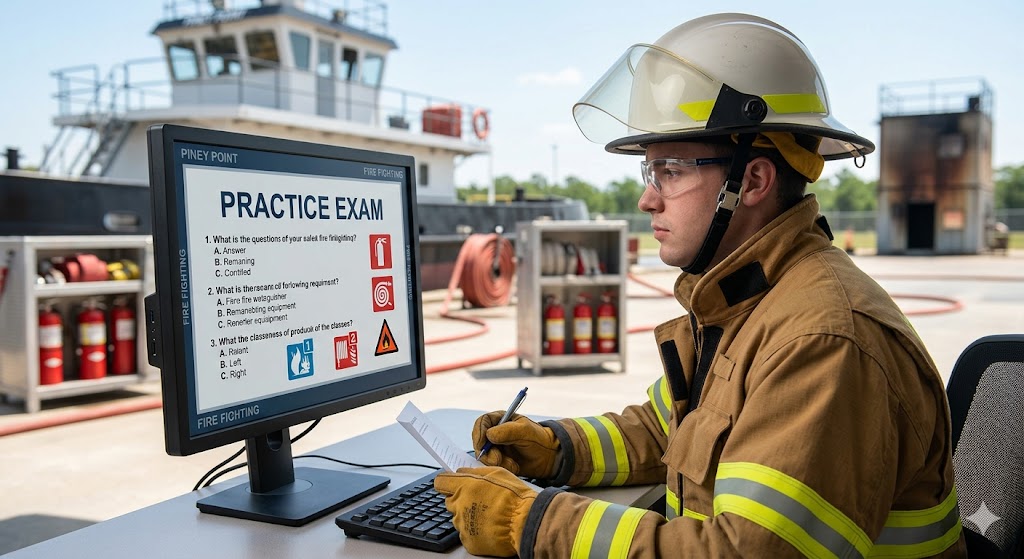
Additional Information
What the Course Entails and Exam Details
The actual Piney Point Basic Fire Fighting course, typically taken at the acclaimed Paul Hall Center, is a blend of intense classroom theory and hands-on practical training. It focuses on equipping you with the fundamental skills required to prevent, detect, and fight different types of fires you might encounter at sea.
Key topics covered in the course include the science of fire, understanding the fire triangle, common fire hazards, and effective fire prevention strategies. You will learn about the various classes of fires and the specific extinguishing agents and equipment best suited for each. Theoretical training also includes crucial safety procedures, the proper use of Personal Protective Equipment (PPE) including Self-Contained Breathing Apparatus (SCBA), communication protocols, and basic team firefighting tactics within a simulated ship environment.
The official exam serves as the ultimate validation of this comprehensive training, designed to test your knowledge retention and practical proficiency in critical, high-pressure situations. Passing both elements is essential for receiving your USCG and STCW approved certificate, proving you are ready to be a safe and valuable member of any vessel's crew.
What to Expect in the Final Exam
The final exam for Basic Fire Fighting is a rigorous assessment consisting of two distinct components: a written knowledge test and a series of practical skills evaluations. To earn your certification, you must demonstrate a deep understanding of the theory in addition to physical competence.
The written portion is typically in a multiple-choice format, designed to test your comprehension of all theoretical concepts, rules, and procedures covered during the course. You can expect questions on fire classes, extinguisher usage, fire alarm systems, safety protocols, and proper PPE protocols. Achieving a passing score, usually within the range of 70% to 80%, is required to pass this element. Strict time limits will be applied to mirror the pressures of the actual test environment.
The practical component is perhaps the most critical. You will be assessed on your ability to apply your knowledge in realistic, controlled scenarios. This involves correctly donning your full bunker gear and SCBA, selecting and operating the appropriate fire extinguishers for different fire types, and demonstrating effective team firefighting techniques using hoses and other suppression equipment, often in live, smoky, and simulated shipboard conditions. You will also be evaluated on your adherence to safety, your communication, and your ability to follow instructions from your instructors, often known as 'burn-field' assessments. Failure to correctly perform essential safety steps can result in an immediate fail for that section. Be prepared for a physically demanding and mentally stimulating day, as this part requires full immersion and exertion. All training and testing must be conducted with a valid photo ID and under strict safety supervision.
How to Study and Exam Centers
Preparing for the Piney Point Basic Fire Fighting exam requires a strategic combination of classroom attention, physical practice, and dedicated self-study. Actionable study methods include:
Reviewing Course Manuals: Thoroughly study the training manuals and materials provided during your course. Pay close attention to definitions, procedures, and safety protocols.
Utilizing Practice Exams: Leverage our [Piney Point Basic Fire Fighting Practice Exam] to familiarize yourself with the type of questions, the multiple-choice format, and the pressure of a timed test. Analyze any incorrect answers to identify and strengthen weak areas.
Flashcards: Create flashcards for critical information such as fire classes, extinguisher types, and specific safety checklists.
Classroom & Practical Engagement: Pay careful attention during all training sessions. Actively participate in the practical exercises, ask questions, and practice your skills repeatedly until they feel instinctive. Physical familiarity with gear and equipment is paramount.
Group Study: Collaborate with your peers. Discussing concepts and quizzing each other can enhance understanding and retention.
The official final exam is a structured component of the full Basic Fire Fighting course, typically taken in person at an authorized and USCG-approved maritime training facility. For those training at the Paul Hall Center in Piney Point, Maryland, this is the Joseph Sacco Fire Fighting and Safety School. The certification is awarded upon successful completion of the course and passing both the written and practical exams. Other authorized maritime schools across the United States, often identified through the Seafarers International Union (SIU) or direct USCG-approved provider lists, also offer these courses and their associated assessments. While practice resources are widely available online and through educational providers, the final, binding certification exam must be completed at an accredited institution that can conduct the necessary practical evaluations safely and formally. Always verify that your training and exam site is currently approved by the appropriate maritime authorities.
Job Opportunities from the Course
A Basic Fire Fighting certification is not just a safety requirement; it's a foundational qualification that opens a wide range of career paths within the dynamic and global maritime industry. Your competence in basic safety, verified by this certification, is a highly valued asset for any shipping company or marine operator. Key job opportunities and career paths this course unlocks include:
Ordinary Seaman (OS): An entry-level deck role that requires all basic STCW certifications, including basic firefighting.
Able Seaman (AB): After gaining experience and further training, you can progress to this essential, higher-level deck role.
Wiper: The corresponding entry-level role in the engine department.
Qualified Member of the Engine Department (QMED): Progression within the engine room, with a variety of technical specializations.
Galley Staff / Cook: All vessel crew members, including those in the steward's department, must possess basic safety training to ensure a secure environment for all.
Fire Patrol: A specific maritime security and safety role often found on cruise ships, responsible for ongoing inspection, maintenance, and first-line response for fire safety equipment.
Safety Officer (further progression): While requiring more advanced training and experience, this certification is a crucial early stepping stone to a career in onboard safety management.
Vessel General Operator / Deckhand (inland/tugboat): Requirements can vary, but basic safety and firefighting competence is a strong asset.
Positions in Port Operations and Marine Terminals: While primarily a seagoing credential, the training is highly relevant and often recognized in related shore-based industrial and safety roles.
Frequently Asked Questions
Reviews
5.0
Based on 0 reviews
Leave a Review
No reviews yet. Be the first to review!