
Pipe Fitting Apprenticeship Practice Test
$69.00
- Buy to unlock unlimited access to all Quiz questions and Answers in this Quiz.
- After purchase you can print a PDF of the whole quiz at any point. The PDF will contain the questions and the correct answers.
About this Exam
The Pipefitter Apprenticeship Practice Exam is a crucial resource designed to help aspiring pipefitters gauge their readiness for the rigorous challenges of a formal apprenticeship program. This practice test is tailor-made for individuals seeking a career in the dynamic field of piping systems, offering an opportunity to assess their knowledge of trade-specific concepts, math applications, and safety practices. It serves as a vital step for students, apprentices, and anyone preparing to launch their journey towards becoming a certified journeyman pipefitter, providing a clear picture of their strengths and areas needing further focus.
Ready to test your knowledge?
Buy Now to Access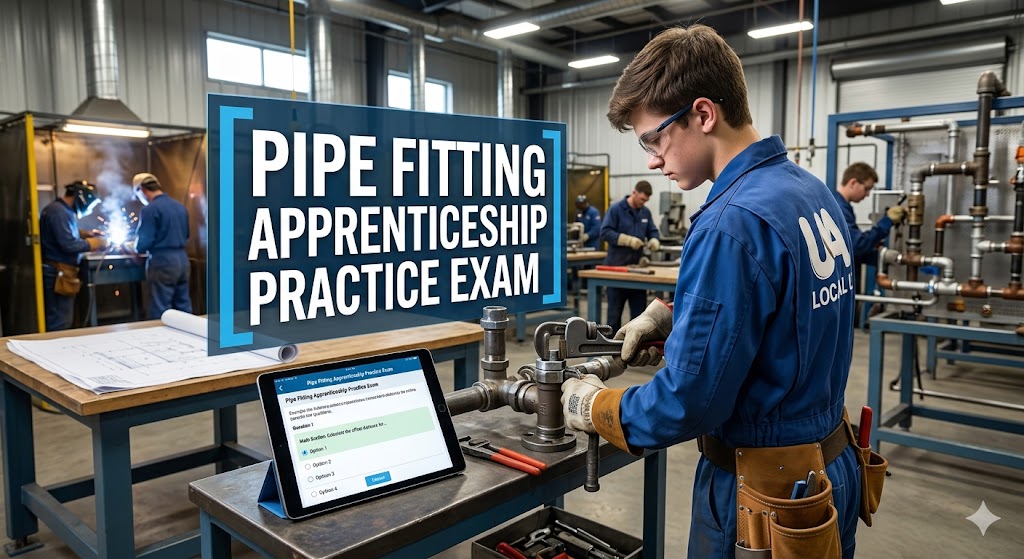
Additional Information
What the Course Entails and Exam Details
While this is a practice exam, it mirrors the key knowledge areas covered in comprehensive pipefitter apprenticeship programs. The actual curriculum combines intense technical classroom instruction with significant paid on-the-job training. Core topics typically include a thorough understanding of blueprint reading and schematic interpretation, safety protocols for hazardous environments, and comprehensive knowledge of pipe materials, including steel, copper, plastic, and high-pressure systems. Students must master calculations involving measurements, volume, and system requirements, alongside practical skills like pipe threading, cutting, welding (GTAW, SMAW), and brazing. The course details how different piping systems operate in diverse settings, from intricate HVAC units to critical industrial process lines and advanced fire protection networks.
What to Expect in the Final Exam
The formal final exam for a pipefitter apprentice program is a comprehensive assessment that often combines both theoretical knowledge and practical skills evaluation. In the final stage of your apprenticeship, you can expect a rigorous multiple-choice test covering theoretical concepts, mathematical formulas, system design, and safety regulations. In many cases, this is followed by a series of practical "hands-on" components, where you must demonstrate proficiency in joining methods, layout accuracy, and trouble-shooting actual piping scenarios. A minimum passing score, typically 70-80% for the theoretical section and successful completion of all practical assessments, is required. The entire final exam process can span several days and includes strict adherence to industry standards and safety practices.
How to Study and Exam Centers
Preparation is key to success on both the practice and the actual final apprenticeship exams. Effective study strategies involve:
Utilizing the provided [Pipe Fitting Apprenticeship Practice Test] to simulate the real exam experience and identify knowledge gaps.
Reviewing study guides, textbooks, and class materials thoroughly.
Creating flashcards for key terms, formulas, and pipe fitting symbols.
Participating in study groups to discuss complex topics.
Practicing math skills specific to pipe fitting.
The actual final exam is typically administered by the organization overseeing your apprenticeship program, which can include local union halls, joint apprenticeship and training committees (JATCs), and potentially at approved technical colleges or designated testing centers. Consult your program instructors and administrators to learn about registration, location details, and the specific exam calendar. For the theoretical component, you may take the exam in a classroom setting or potentially via an authorized, secure online portal, depending on the program's specific procedures.
Job Opportunities from the Course
Upon successful completion of the Pipefitter Apprenticeship Program and passing the final exam, individuals unlock a rewarding career path with numerous job opportunities in diverse industries. Key career avenues include:
Journeyman Pipefitter: A fully qualified professional responsible for installing, maintaining, and repairing piping systems for everything from high-pressure steam and gas to cooling water and advanced manufacturing processes.
Steamfitter: specializing in complex high-pressure piping systems used for steam, oil, and chemical transport.
HVAC Pipefitter: specializing in fitting pipes for heating, ventilation, and air conditioning systems in residential and commercial buildings.
Industrial Pipe Mechanic: focused on installing, repairing, and maintaining complex piping within industrial plants, refineries, and manufacturing facilities.
Supervisory Roles: As you gain experience, opportunities arise to advance into positions such as foreman, project supervisor, or project manager, overseeing projects and crews.
Self-Employment: For some, becoming a licensed pipefitter opens doors to starting their own specialty contracting business.
Frequently Asked Questions
Reviews
5.0
Based on 0 reviews
Leave a Review
No reviews yet. Be the first to review!