
Pipefitting Year One Practice Exam
$69.00
- Buy to unlock unlimited access to all Quiz questions and Answers in this Quiz.
- After purchase you can print a PDF of the whole quiz at any point. The PDF will contain the questions and the correct answers.
About this Exam
The Pipefitting Year One Practice Exam is a crucial stepping stone for aspiring pipefitters and steamfitters beginning their journeyman journey. This comprehensive guide and practice test are specifically designed for first-year apprentices or students enrolled in vocational piping programs. It aims to validate foundational knowledge before trainees advance to more complex system installations and specialized welding techniques.
Ready to test your knowledge?
Buy Now to Access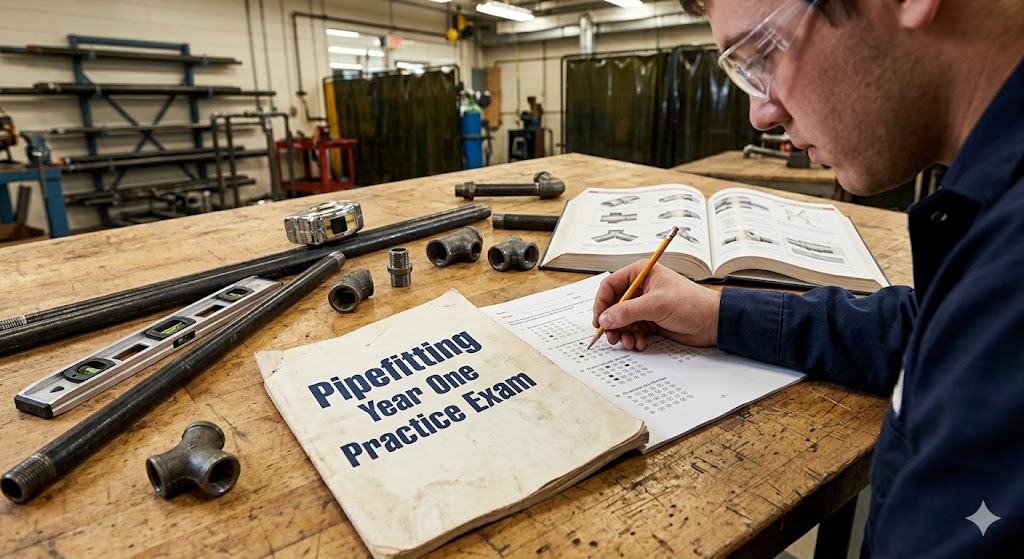
Additional Information
What the Course Entails and Exam Details
This initial level focuses heavily on safety protocols, material identification, and core trade skills. The comprehensive year-one curriculum—and the resulting exam—covers several critical areas:
Safety Standards: Full mastery of OSHA regulations, personal protective equipment (PPE), hazard communication, and safe tool handling is mandatory.
Trade Math: Practical applications of algebra and geometry for calculating pipe lengths, offsets, and rolling offsets.
Blueprint Reading: Understanding symbols, isometric drawings, and specifications commonly used in piping systems.
Materials & Fittings: Identifying various types of pipe (carbon steel, stainless, copper, PVC), fittings, valves, and their appropriate applications.
Tools: Proper use and maintenance of hand and power tools, including pipe cutters, threaders, and reamers.
What to Expect in the Final Exam
The actual final qualification is usually structured as a two-part assessment administered by your training coordinator or local union. First, students must pass a rigorous written, multiple-choice exam that tests theoretical knowledge across all core subjects mentioned above.
Following successful completion of the written portion, apprentices often face a practical, hands-on "shop" exam. In this practical test, you will be required to accurately measure, cut, thread, and assemble a small piping spool according to a provided blueprint, adhering strictly to a tolerance and time limit. A minimum passing score of 70% to 80% is typically required for both sections to advance to the second year.
How to Study and Exam Centers
Preparation is key to succeeding on your Year One exam. Focus your study efforts on these proven strategies:
Review Core Modules: Thoroughly review the level one modules from your curriculum (e.g., NCCER). Pay close attention to review questions and trade terms.
Practice Pipe Math: Do not neglect the math. Repeatedly solve problems involving offsets and takeouts until the calculations become second nature.
Take Practice Exams: Utilize this practice test to simulate the actual exam environment. Focus on timing and identifying weak areas.
Hands-on Review: Spend extra time in the shop practicing your cutting, threading, and layout skills.
Exam Centers: The final certification exam is not typically taken at a public center like Pearson VUE. Instead, these tests are administered at authorized locations, primarily local Union Training Centers (UA), accredited community colleges, or private vocational schools that host registered apprenticeship programs.
Job Opportunities from the Course
Successfully navigating your first year and passing the Pipefitting Year One Practice Exam is the definitive first step into a lucrative career. Upon completing this level, you gain recognized credentials that allow you to work as a productive apprentice. Potential job paths and specialized roles you are now eligible to continue training for include:
Pipefitter Apprentice (Year 2)
Steamfitter Apprentice
Sprinkler Fitter
Industrial Maintenance Technician
HVAC Pipefitter
Gasfitter Apprentice
Frequently Asked Questions
Reviews
5.0
Based on 0 reviews
Leave a Review
No reviews yet. Be the first to review!