
Pittsburgh Institute of Mortuary Science Comprehensive Practice Test
$69.00
- Buy to unlock unlimited access to all Quiz questions and Answers in this Quiz.
- After purchase you can print a PDF of the whole quiz at any point. The PDF will contain the questions and the correct answers.
About this Exam
The Pittsburgh Institute of Mortuary Science Comprehensive Practice Exam is a crucial internal assessment designed to replicate the challenges students will face in their ultimate goal: the National Board Examination (NBE). This comprehensive practice test is tailor-made for students currently enrolled in PIMS programs—whether the campus-based or online Associate Degree in Funeral Service Arts and Sciences, or specialized diploma programs—who are finalizing their academic journey. It serves as a rigorous, synthetic final, ensuring candidates possess the synchronized theoretical knowledge and practical skill set required for licensure and successful entry into the vital, multifaceted field of death care. This is not merely a pass/fail quiz; it is a strategic tool to help you identify strengths and pinpoint areas for final, targeted review before embarking on your professional career.
Ready to test your knowledge?
Buy Now to Access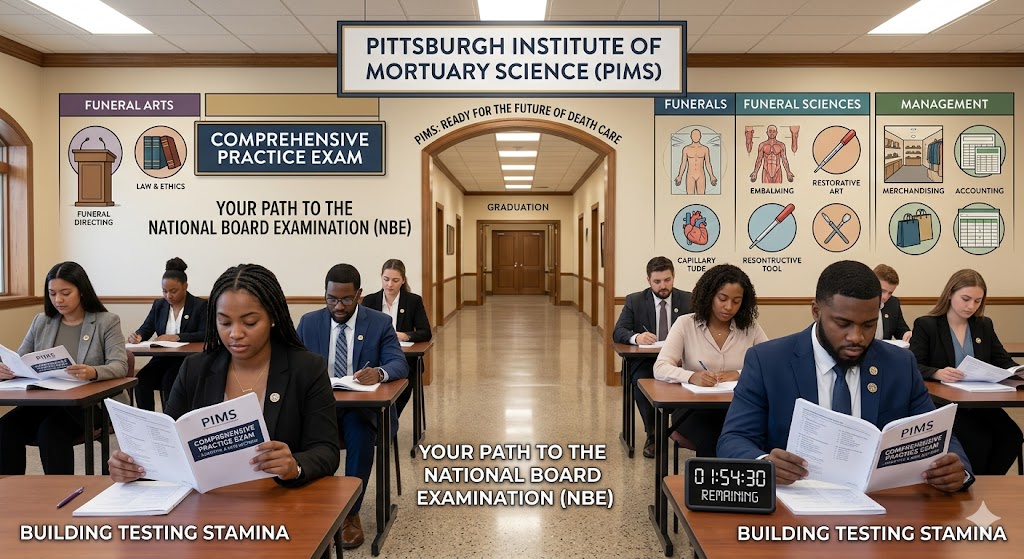
Additional Information
What the Course Entails and Exam Details
As this is a practice examination based on the full PIMS curriculum, it is structured to cover every core domain necessary for a successful modern funeral service professional. The content is broadly divided to mirror the National Board’s two distinct sections: Funeral Service Arts and Funeral Service Sciences. Students must demonstrate proficiency across these critical areas:
Funeral Service Arts:
Funeral Directing: History, sociology, psychology of grief, and the practical aspects of arranging and conducting funeral and memorial services.
Funeral Merchandising: Product knowledge (caskets, urns), selection room design, and pricing strategies.
Funeral Home Management: Operational ethics, accounting, human resources, and business management.
Funeral Service Law and Ethics: Federal, state, and local regulations, contract law, and the ethical principles guiding the profession.
Communications: Both interpersonal, for working with bereaved families, and professional, including marketing.
Funeral Service Sciences:
Embalming: Theory, human anatomy and physiology, pathology, and chemical applications for the preservation and presentation of remains.
Restorative Art: Anatomical reconstruction, cosmetology, and derma-surgery techniques to restore a natural appearance.
Microbiology and Pathology: Study of microorganisms and diseases relevant to public health and the handling of human remains.
Chemistry: Fundamental chemical principles, with a specific focus on embalming chemistry and toxicology.
This practice test ensures that all the rigorous classroom instruction and intensive, hands-on clinical experience (PIMS on-campus students complete over 700 embalmings annually) have been successfully synthesized.
What to Expect in the Final Exam
The Pittsburgh Institute of Mortuary Science Comprehensive Practice Exam is a serious simulation of the National Board Examination. Students should expect a structure that mirrors the real testing environment to reduce anxiety and build confidence.
Format: The primary component of the comprehensive written exam is a lengthy, multiple-choice assessment, closely matching the layout, wording style, and cognitive levels (recall, application, and analysis) of the NBE.
Internal Practical Components: For students in campus programs, the "Comprehensive" designation includes an assessment of practical skills. This might not be part of the multiple-choice test itself, but rather a final clinical sign-off, where instructors evaluate their mastery of embalming and restorative art techniques, ensuring they are ready for the state-level practical requirements.
Timing and Rigor: The written portion is timed, pushing students to manage their pace, just as they will during the real 340-question, dual-section NBE. The goal is to build mental stamina and testing fluency.
Passing Score: While this is a "practice" test, PIMS sets a high internal benchmark. A strong score is not just about moving forward; it is a primary indicator of your readiness to pass the NBE on your first attempt, which PIMS prides itself on (maintaining pass rates consistently above national averages).
How to Study and Exam Centers
Preparation for the PIMS Comprehensive Practice Exam should begin the first day of your program, but intensive review should be focused and strategic.
Actionable Study Strategies:
Systematic Review: Break down the core curriculum. Do not try to learn everything at once. Allocate specific days to Embalming, then Restorative Art, then Funeral Law, etc. Use your PIMS textbooks, comprehensive lecture notes, and provided study guides.
Utilize Official PIMS Practice Questions: Engage with the specific practice sets provided by your instructors. These are designed to highlight the high-frequency topics within the PIMS program.
Simulate Testing Conditions: Take mock multiple-choice sections with a timer. Eliminate distractions. Learn the "feel" of answer endurance.
Peer Study Groups: Mortuary science is a collaborative field. Teaching complex concepts, like the triangle of embalming fluid distribution or the cranial reconstruction landmarks, to classmates is an excellent way to solidify your own understanding.
Identify Weak Points: Use the early parts of your practice exam as a diagnostic tool. Don't waste time on areas you have mastered; ruthlessly focus on your weakest domains.
Exam Centers:
Because this is a Comprehensive Practice Exam internal to the Pittsburgh Institute of Mortuary Science:
On-Campus Students: You will take the exam directly at the PIMS facility in Pittsburgh. It is often scheduled as a mandatory final course requirement before graduation, involving both the written multiple-choice session in a classroom setting and final practical/clinical assessments in the lab.
Online Students: You will access the written comprehensive exam through the PIMS online learning portal. This will be a proctored event, requiring specific technological setups (webcam, secure browser, environmental scan) to ensure academic integrity. Ensure you are familiar with the proctoring requirements well in advance.
Job Opportunities from the Course
A degree or diploma from the Pittsburgh Institute of Mortuary Science is a prestigious credential, and passing the comprehensive requirements unlocks a wide range of careers within the necessary, recession-resistant field of death care. Graduates are prepared for the following professional paths:
Funeral Director
Embalmer (with additional state licensure)
Thanatopractor / Restorative Artist (advanced embalmer)
Crematory Operator / Manager
Funeral Home Owner / Manager (Entrepreneur)
Bereavement Coordinator / Grief Support Specialist
Medical Examiner or Coroner’s Assistant
Organ and Tissue Donation Coordinator
Mortuary Transport and Removal Specialist
Forensic Mortuary Technician
Cemetery Manager / Memorial Park Superintendent
Funeral Product Sales Representative (B2B/Caskets/Chemicals)
Pre-need Funeral Counselor
Eco-Friendly/Green Burial Specialist
Hospice Care Liaison
Frequently Asked Questions
Reviews
5.0
Based on 0 reviews
Leave a Review
No reviews yet. Be the first to review!