
Pivot Point Chemical Texturizing Practice Test
$69.00
- Buy to unlock unlimited access to all Quiz questions and Answers in this Quiz.
- After purchase you can print a PDF of the whole quiz at any point. The PDF will contain the questions and the correct answers.
About this Exam
Mastering chemical texturizing services—including permanent waving, hair relaxing, and curl reformation—is a cornerstone of modern cosmetology.
This Pivot Point Chemical Texturizing Practice Exam is a comprehensive resource designed to evaluate your readiness for official professional licensing exams, such as the NIC or State Board examinations.
This test is tailored for cosmetology students, graduates, and licensed professionals who use the industry-standard Pivot Point curriculum and want to specialize in complex chemical hair services.
Achieving success on this exam demonstrates your mastery of both foundational science and practical application, ensuring you can deliver safe, stunning texture results to diverse clientele.
Ready to test your knowledge?
Buy Now to Access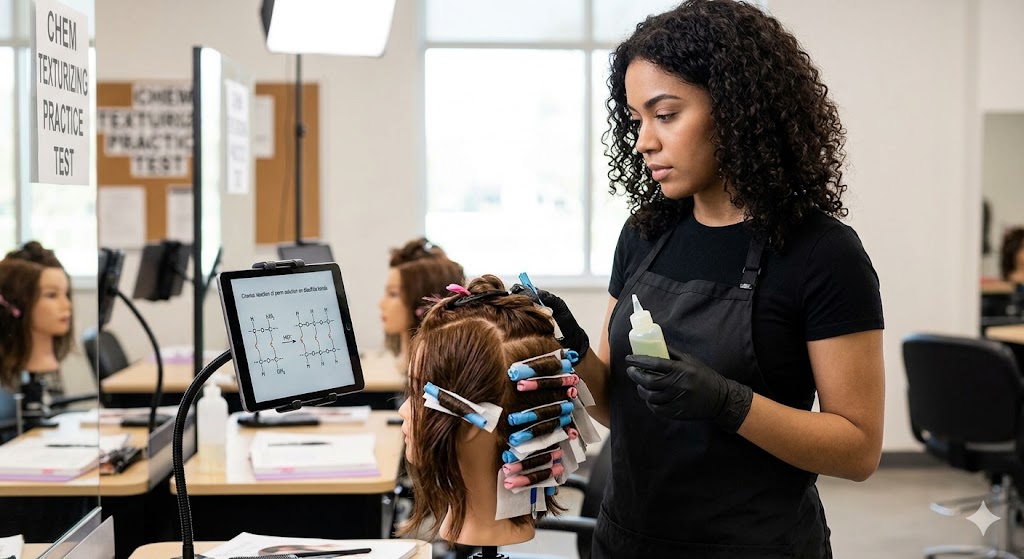
Additional Information
What the Course Entails and Exam Details
The course of study prepares individuals to become expert texturists by combining intensive theory with hands-on practice.
Core learning areas include comprehensive client consultation, identifying different hair types and their specific chemical needs.
Students delve deep into product science, understanding the chemistry behind alkaline and acid permanent waves, thio-based and sodium hydroxide relaxers, and the crucial neutralization processes.
The curriculum emphasizes practical application techniques, including specific wrapping patterns (e.g., standard, weave, spiral) and chemical application sequences.
Safety is paramount, with extensive training in infection control, pH testing, patch testing, and preventing chemical burns or hair damage.
This knowledge forms the foundation of the complex questions found on professional licensing exams, assessing not just recall, but critical thinking in a salon environment.
What to Expect in the Final Exam
While individual state requirements vary, professional chemical texturizing exams typically consist of two distinct but connected components:
1. The Written Theory Examination: This part uses a multiple-choice format, featuring a standard set of questions (often ranging from 60 to 100).
It focuses heavily on the scientific principles of chemistry, hair analysis, safety protocols, regulatory requirements, and standard operating procedures.
Questions are designed to test your understanding of how various chemical relaxers or perm solutions interact with different hair porosities and textures.
A common passing score is 75% or 80%, with a time limit that usually falls between 90 minutes and 2 hours.
2. The Practical Examination: This hands-on section is the defining part of becoming a texture specialist, where you demonstrate your technical skills.
Working on a pre-assigned mannequin head, you are required to perform a specific sequence of chemical texture services within a precise time frame (often 2-3 hours).
This simulation of a real salon service is meticulously graded by multiple proctors on factors including setup, tool selection, the precision of your sectioning, product application technique, safety procedures, cleanup, and infection control.
Your ability to properly manage the timing of services is essential.
How to Study and Exam Centers
Effective study for chemical texturizing requires a balance of knowledge acquisition and practical repetition.
Study Strategies: Use the complete Pivot Point textbooks and educational software as your primary resource.
Consider using the Learn About Beauty (LAB) platform if available.
Create detailed flashcards to memorize chemical types (thio, hydroxide, acid, alkaline), processing times, and crucial safety steps.
The absolute best practice is practical application: practice wrapping and chemical processing steps on multiple mannequins, timing yourself on various patterns.
Take several timed, practice theory tests (like the one this page prepares you for) to build speed and accuracy with multiple-choice questions.
Review incorrect answers in detail to identify knowledge gaps.
Official Exam Centers: It is important to remember that Pivot Point provides the curriculum, not the final licensure.
To take the real official exam for state licensure, you must register through a third-party testing agency or your State Board of Cosmetology.
Most states use large national testing providers such as Pearson VUE, Prometric, or PSI Services, which host exams in secure, professional centers across the country.
Your State Board of Cosmetology website will provide you with the information regarding which official testing service or physical testing center is designated for your region.
Job Opportunities from the Course
A strong understanding of chemical texturizing services, verified by certification and licensure, unlocks specialized roles within the beauty industry.
Becoming a subject matter expert in texture can set you apart in a crowded market. Here are typical job titles:
Licensed Cosmetologist / Stylist
Chemical Texture Specialist
Permanent Wave Artist
Permanent Makeup & Chemical Service Stylist
Salon Texture Director / Lead Stylist
Continuing Education Instructor (Advanced Texturizing)
Beauty Industry Sales Representative (Focus on Chemical Lines)
Product Educator / Platform Artist (for Texture Brands)
Cosmetology School Instructor
Frequently Asked Questions
Reviews
5.0
Based on 0 reviews
Leave a Review
No reviews yet. Be the first to review!