
Pivot Point Chemistry Practice Test
$69.00
- Buy to unlock unlimited access to all Quiz questions and Answers in this Quiz.
- After purchase you can print a PDF of the whole quiz at any point. The PDF will contain the questions and the correct answers.
About this Exam
The Pivot Point Chemistry curriculum is a foundational component of modern beauty education, designed to bridge the gap between scientific principles and practical salon services. This specialized area of study is specifically tailored for aspiring cosmetologists, esthetics students, and nail technicians who need to understand the 'why' behind the products and treatments they use. By mastering the chemical compositions and reactions of hair, skin, and nail products, students ensure client safety, achieve predictable results, and build professional confidence.
Ready to test your knowledge?
Buy Now to Access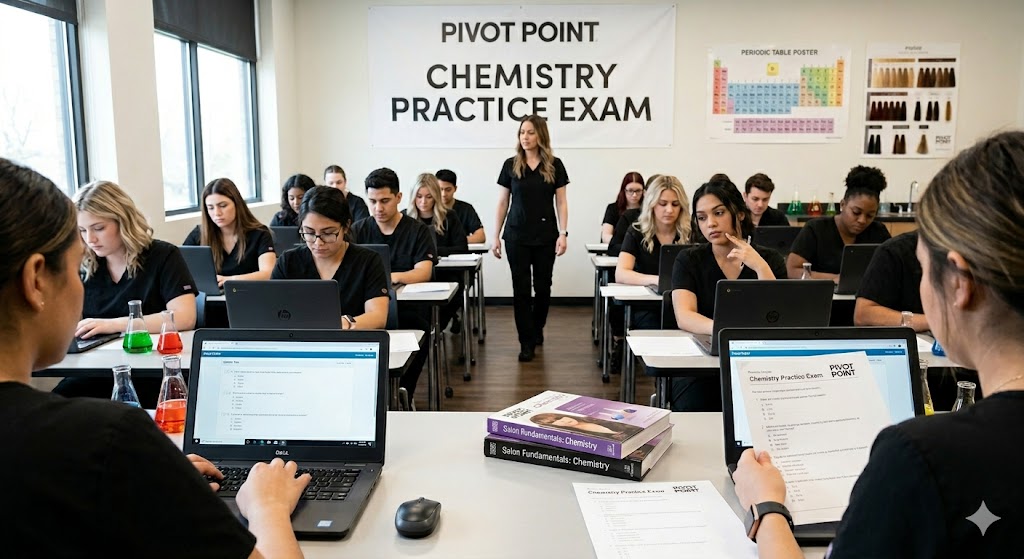
Additional Information
What the Course Entails and Exam Details
This comprehensive course delves into fundamental chemical concepts essential for safe and effective beauty services. Students will explore modules covering basic matter, the complexities of the pH scale and its critical relevance to chemical texture services (perming, relaxing, and coloring), and the chemical composition of cosmetic ingredients. The syllabus also prioritizes safety standards, product chemistry, and understanding how chemical reactions affect the structure of hair and skin. Mastery of these topics ensures professionals can make informed decisions about product selection and application.
What to Expect in the Final Exam
The Pivot Point Chemistry Final Exam is designed to rigorously assess a student's theoretical knowledge and its practical application. Candidates can expect a standardized written test, typically consisting of 50 to 100 multiple-choice questions. This proctored examination must be completed within a specified time limit, often ranging from 60 to 90 minutes. A passing score, usually set by individual state boards or the specific educational institution (often around 75%), is mandatory to proceed in the program or qualify for licensure. Students are advised to understand their specific state board’s unique exam structure and requirements, as small variations may exist.
How to Study and Exam Centers
Preparation for the Pivot Point Chemistry Practice and Final Exam requires a structured, multi-faceted study approach. Students should first immerse themselves in the Pivot Point Fundamentals or Salon Fundamentals textbooks, focusing intently on bold terms, chemical formulas, and pH charts. Utilizing practice tests is highly effective for identifying knowledge gaps and improving time management. Creating digital flashcards for key vocabulary (e.g., oxidation, suspension, alkali) allows for quick revision. Regarding testing, standard Pivot Point tests are usually administered on-site at the accredited beauty school or community college where the student is enrolled. State licensure exams, which include chemistry content, are held at designated testing facilities or state-contracted centers (such as PSI or DL Roope).
Job Opportunities from the Course
A strong command of the chemistry behind beauty services opens numerous doors in the beauty industry. Professionals who excel in this scientific area can leverage their expertise for career advancement and specialization.
Cosmetologist Hair Stylist Licensed Esthetician Medical Aesthetician Nail Technician / Specialist State Board Educator or Examiner Cosmetic Product Sales Representative Beauty Brand Educator / Platform Artist Salon Owner or Manager Chemical Texture Service Specialist Product Development Consultant Makeup Artist (Advanced Applications) Spas and Wellness Center Specialist Distributor Sales Consultant
Frequently Asked Questions
Reviews
5.0
Based on 0 reviews
Leave a Review
No reviews yet. Be the first to review!