
Platinum Airway Practice Test
$69.00
- Buy to unlock unlimited access to all Quiz questions and Answers in this Quiz.
- After purchase you can print a PDF of the whole quiz at any point. The PDF will contain the questions and the correct answers.
About this Exam
The Platinum Airway Practice Test is a comprehensive assessment tool designed specifically for healthcare professionals seeking mastery in advanced airway management techniques. This rigorous certification exam validates critical skills required in emergency medicine, critical care, and anesthesia. It targets practitioners such as Paramedics, Flight Nurses, Respiratory Therapists, and Emergency Physicians who must possess the knowledge and precision to secure difficult airways under high-pressure conditions. Achieving this certification demonstrates a commitment to the highest standards of patient safety and clinical excellence in respiratory emergencies.
Ready to test your knowledge?
Buy Now to Access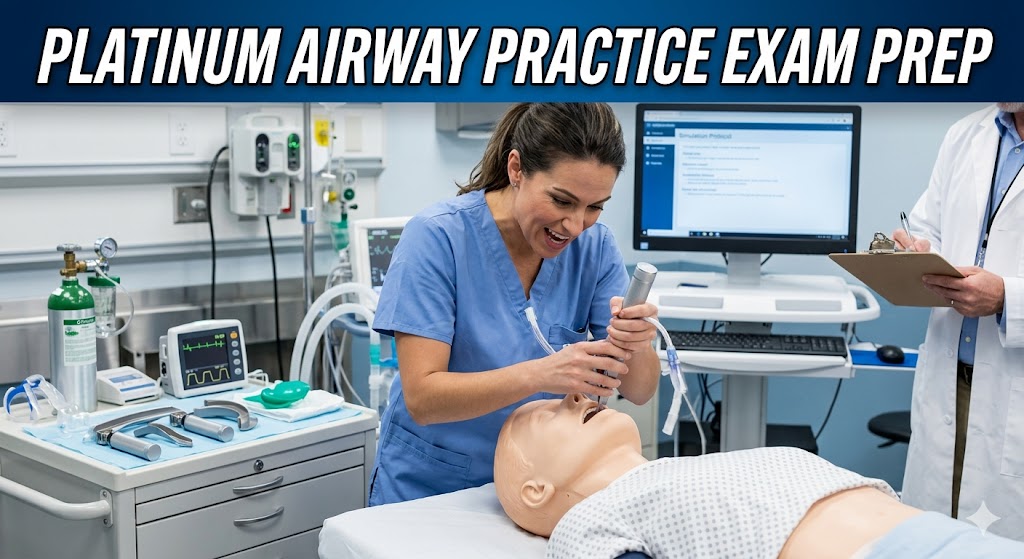
Additional Information
What the Course Entails and Exam Details
The preparatory coursework and the Platinum Airway Practice Test cover a broad spectrum of fundamental and sophisticated airway techniques.
Core areas included in the exam's knowledge base are:
Comprehensive patient assessment and prediction of difficult airways (using tools like the LEMON mnemonic).
Mastery of basic skills: bag-valve-mask (BVM) ventilation, oropharyngeal and nasopharyngeal airway placement.
Advanced techniques, including endotracheal intubation (direct laryngoscopy and video laryngoscopy).
Utilization of supraglottic airway devices (e.g., i-gel, LMA).
Pharmacology of airway management, covering drugs used in Rapid Sequence Intubation (RSI) and post-intubation sedation.
Confirmation techniques for correct tube placement (capnography, auscultation).
Surgical airway management procedures (needle and surgical cricothyrotomy) as a rescue technique.
Ventilation strategies and troubleshooting for ventilated patients.
What to Expect in the Final Exam
The Platinum Airway Practice Test is typically administered as a high-fidelity, multifaceted exam that evaluates both theoretical knowledge and practical proficiency. It goes beyond simple recall to test clinical decision-making.
Candidates can generally expect the following components in the final exam format:
Written Component: A timed, computerized assessment consisting of scenario-based multiple-choice questions. This section focuses on applying guidelines, interpreting data, and selecting appropriate intervention pathways.
Practical Skills Component: This is often the core of the Platinum certification. Candidates are required to demonstrate sequential mastery of advanced procedures on high-fidelity mannequins. Skills testing is rigorously scenario-driven, simulating dynamic and deteriorating patient conditions.
Passing Score: The required passing score is generally high, often set at 80% for the written section and 100% mastery for critical practical skill steps (meaning failure in a "critical fail" step results in failure of that practical scenario).
Time Limits: Strict time limits are applied to individual practical scenarios (e.g., must secure an airway within a specific number of seconds or attempts) and for the completion of the written section.
Specific Rules: Evaluation is performed by certified, independent instructors. Candidates are often required to articulate their steps, interpret monitor data aloud, and maintain strict standard precautions throughout.
How to Study and Exam Centers
Preparation for the Platinum Airway Practice Test requires a dedicated approach that combines focused review with intensive hands-on practice. It is not an exam that can be passed by studying textbook material alone.
Actionable Study Strategies:
Review Authorized Study Materials: Thoroughly study the manual provided by the official training organization sponsoring the course. Focus on protocols, drug dosages, and algorithmic approaches to difficult airways.
Intensive Practical Practice: Utilize high-fidelity simulation labs. Practice every step of advanced techniques until they are seamless. Simulating time constraints and stressful environments is crucial.
Utilize Video Resources: Watch authoritative demonstrations of advanced techniques (e.g., proper positioning, bougie use, surgical airways).
Collaborate and Practice Scenarios: Form study groups to run practice scenarios, with members taking turns as the lead clinician and as dynamic evaluators. Use checklists to simulate real exam evaluation.
Exam Centers:
This certification is typically not offered through standard proctored computer centers (like Pearson VUE). Because it requires specialized simulation equipment and certified evaluators, the final Platinum Airway examination is generally conducted at the conclusion of an authorized, in-person Platinum Airway Management Course.
These courses and exams are held at physical testing centers or authorized training institutions, such as specialized emergency medicine training schools, academic medical centers, or large EMS training academies. Check the official course administrator's website for upcoming course and exam dates.
Job Opportunities from the Course
Earning the Platinum Airway Certification significantly enhances a clinician's credentials and employability in acute and critical care environments. It serves as validation of superior expertise in one of medicine's most critical skill sets.
Specific job titles and career paths this certification helps unlock include:
Critical Care Paramedic / Flight Paramedic
Flight Nurse / Transport Nurse
Advanced Emergency Medical Technician (AEMT) in high-acuity systems
Emergency Room Nurse (RN) with advanced training
Anesthesia Assistant
Critical Care/Intensive Care Unit (ICU) Nurse
Respiratory Therapist (RT) with specialized skills
Physician Assistant (PA) or Nurse Practitioner (NP) specializing in Emergency or Critical Care
Airway Management Instructor
Frequently Asked Questions
Reviews
5.0
Based on 0 reviews
Leave a Review
No reviews yet. Be the first to review!