
PLTW Green Architecture Practice Exam
$69.00
- Buy to unlock unlimited access to all Quiz questions and Answers in this Quiz.
- After purchase you can print a PDF of the whole quiz at any point. The PDF will contain the questions and the correct answers.
About this Exam
The Project Lead The Way (PLTW) Gateway program's "Green Architecture" (GA) unit is an engaging, hands-on module for middle school students, typically in grades 6–8. This unit is specifically designed for young learners interested in STEM, architecture, construction, and environmental sustainability. It introduces them to the fundamental concepts of residential design, architectural systems, and, most importantly, sustainable building practices. Students are challenged to think critically about how the built environment impacts the planet and are empowered to design affordable, sustainable housing solutions using professional 3D architectural software. This course lays a solid foundation for future studies in high school engineering pathways.
Ready to test your knowledge?
Buy Now to Access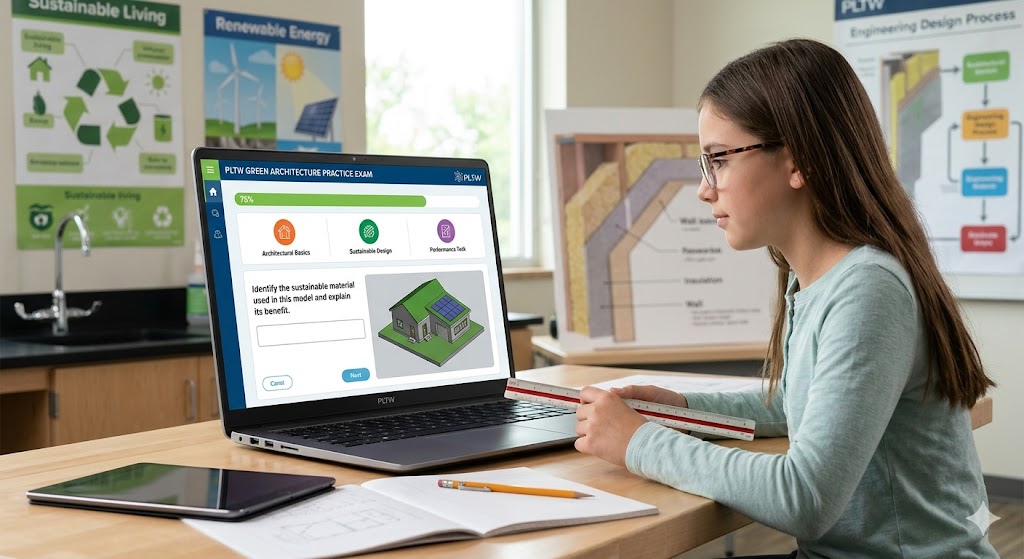
Additional Information
What the Course Entails and Exam Details
The Green Architecture curriculum is structured around three core lessons that blend theoretical knowledge with practical skills.
Key Lessons and Topics Include:
Architectural Basics: Students build foundational skills by learning how to use architectural scales to accurately measure drawings, read, and interpret architectural plans and symbols. They explore the different systems within a home and learn about planning residential spaces while selecting materials that meet budgetary constraints.
Introduction to Sustainable Architecture: This lesson shifts the focus to "going green." Students examine the environmental challenges of resource depletion and environmental degradation. They learn about sustainable architecture's goal of minimizing negative environmental impacts through enhanced efficiency and moderation in materials, energy, and development space, ensuring that present actions do not inhibit future generations.
Architectural Challenge: The final lesson allows students to put their knowledge into action. They utilize advanced software, such as Autodesk Revit (or previously, Autodesk 123D Design), to design a sustainable home, often using creative concepts like repurposed shipping containers. They also engage in physical challenges, such as building wall sections for a framed structure and testing various insulation materials.
What to Expect in the Final Exam
The PLTW Green Architecture End-of-Course (EoC) assessment is a summative evaluation administered online via a secure testing platform.
Exam Format and Style:
Performance-Based: This is not a traditional simple multiple-choice test. The EoC is performance-based, meaning it measures your ability to apply what you have learned to real-world scenarios.
Question Types: You should expect a mix of traditional multiple-choice questions to test your conceptual and foundational knowledge (e.g., definitions, scale reading) and reconstructed response or performance-based items that require you to solve an engineering problem, interpret a CAD model, or explain a design decision.
Scoring: Rather than a simple pass/fail mark, students receive a scaled score ranging from 100 to 600. Based on this score, you will be placed into one of four achievement levels: Novice, Practiced, Accomplished, or Distinguished. Achieving a score in the "Accomplished" or "Distinguished" levels indicates a strong mastery of the course content and can be used to qualify for special opportunities, bolster future college applications, and demonstrate career readiness.
How to Study and Exam Centers
Preparing for the PLTW Green Architecture exam requires a blend of reviewing core concepts and practicing technical skills.
Proven Study Strategies:
Leverage MyPLTW Resources: Your primary study hub should be mypltw.org. Review all course presentations, activity sheets, and vocabulary lists. Pay special attention to the core concepts from each of the three lessons.
Utilize Your Engineering Notebook: Go back through your engineering notebook. This is a crucial tool in PLTW and contains your personal reflections, sketches, dimensioned drawings, and notes from experiments (like the insulation test).
Practice with the Software: Become proficient in the architectural software used in your class (e.g., Autodesk Revit). Know how to create walls, add windows and doors, set up basic floor plans, and utilize dimensioning tools. You may have to interpret or modify a model during the assessment.
Review Mathematics for Architecture: Ensure you are confident in reading an architectural scale, understanding dimensioning standards, and making calculations related to area, volume, and material cost.
Take the PLTW Green Architecture Practice Exam: Utilize high-quality practice exams to familiarize yourself with the question types, digital platform, and time constraints you will encounter. This is one of the most effective ways to identify gaps in your knowledge and reduce test anxiety.
Exam Center Information:
This exam is administered in a standardized classroom setting. You will not go to a commercial testing center. Instead, your authorized PLTW school will set a specific date and time for the assessment, which will be proctored by your teacher or another school official, using a secure exam browser to ensure test integrity.
Job Opportunities from the Course
The knowledge and skills gained in this PLTW Gateway unit provide a foundational understanding that can lead to numerous exciting and in-demand careers in sustainable design and engineering, after continuing your educational journey. This course is a stepping stone to a wide array of future professions.
Potential Career Paths to Explore:
Green Building Architect
Sustainable Design Consultant
CAD Technician (Computer-Aided Design)
Construction Manager
Environmental Engineer
Landscape Architect
Urban Planner
Energy Auditor
LEED Specialist (Leadership in Energy and Environmental Design)
Interior Designer (with a focus on sustainability)
Frequently Asked Questions
Reviews
5.0
Based on 0 reviews
Leave a Review
No reviews yet. Be the first to review!