
PLTW Introduction to Engineering Design (IED) Practice Test
$69.00
- Buy to unlock unlimited access to all Quiz questions and Answers in this Quiz.
- After purchase you can print a PDF of the whole quiz at any point. The PDF will contain the questions and the correct answers.
About this Exam
Are you a high school student with a spark for creation and a curiosity about how the world is built? Project Lead The Way’s (PLTW) "Introduction to Engineering Design" (IED) is your first definitive step into the vast, exciting universe of engineering. This foundation course is meticulously crafted to transform your imaginative ideas into tangible solutions. It's not just about formulas; it’s about a new way of thinking. Students from all backgrounds, whether already engineering-focused or simply looking to develop their creative problem-solving skills, will find immense value. IED uses a hands-on, project-based approach to nurture the "transportable skills"—collaboration, communication, and critical thinking—that are essential for success in any 21st-century career.
Ready to test your knowledge?
Buy Now to Access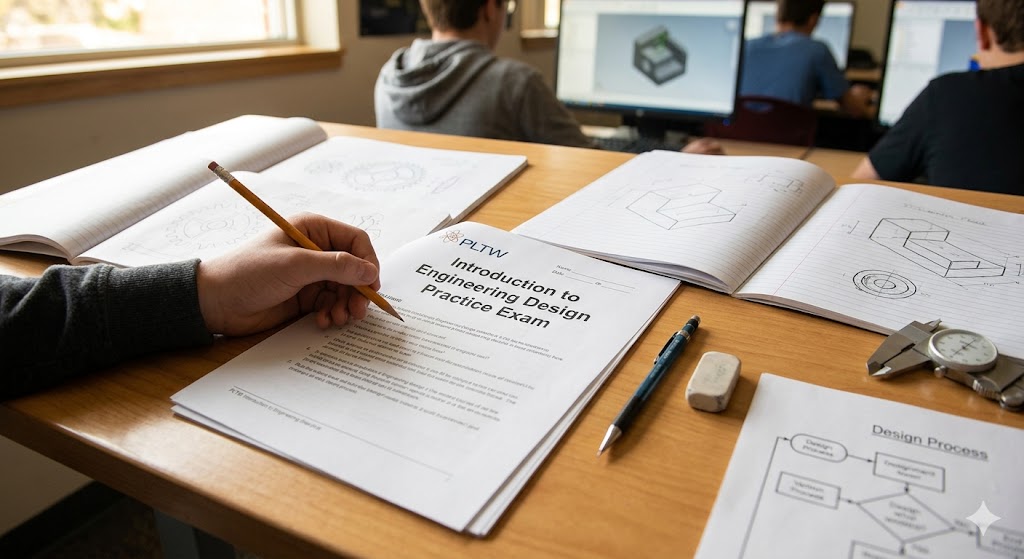
Additional Information
What the Course Entails and Exam Details
The IED curriculum is a dynamic blend of theory and application, providing a holistic overview of the product design lifecycle. The course is structured around key units that act as building blocks for your engineering journey.
Core Topics Covered Include:
The Design Process: Mastering a systematic, multi-step problem-solving strategy, from problem definition to prototyping and evaluation.
Technical Sketching and Drawing: Learning to visually communicate your concepts through isometric, oblique, perspective, and multi-view drawings, using standard line conventions.
Measurement and Statistics: Becoming proficient with tools like dial calipers and applying mathematical concepts like mean, median, mode, and standard deviation to analyze design data.
3D Solid Modeling (CAD): Gaining hands-on experience with industry-standard Computer-Aided Design (CAD) software (such as Autodesk Inventor) to create, analyze, and document virtual prototypes.
Geometry of Design: Applying geometric concepts to solve design challenges and understanding properties like volume and surface area.
Reverse Engineering: Disassembling and analyzing existing products to understand their functionality, design, and manufacturing processes.
Documentation: Learning the critical skill of meticulously documenting every step of the design process in an engineering notebook and creating working drawings.
The final culmination of this journey is the PLTW IED End-of-Course (EOC) Exam, which serves as a powerful validation of the knowledge and skills you’ve acquired throughout the year.
What to Expect in the Final Exam
Knowing the landscape is half the battle. The PLTW IED EOC exam is a comprehensive assessment designed to measure your understanding of the course learning outcomes.
Key Exam Details:
Format: The primary summative component is an online exam, composed almost exclusively of high-quality multiple-choice questions. These questions don't just ask for facts; they require you to apply your engineering mindset to scenarios and problems.
Structure: The exam is typically divided into two distinct parts:
Part 1: Focuses on multiple-choice questions that cover a broad spectrum of course content, from unit concepts to problem-solving.
Part 2: Also consists of multiple-choice questions, but these tend to be more complex, often requiring the use of a reference material or scenario.
Time Limit: Both parts are strictly timed, ensuring you can demonstrate not only understanding but also fluency with the material. Specific time limits can vary slightly but expect around 40-50 minutes per part.
Scoring and College Credit: A significant advantage of the PLTW framework is the opportunity to earn college credit. Students who achieve a strong score on the EOC exam (often a 6 or higher on a 9-point scale) and maintain a high grade in the course can apply for credit at a number of partner universities, giving them a head start in their higher education.
Allowed Resources: During the exam, you will have access to a specific PLTW-provided formula sheet. You are generally allowed to use a handheld calculator (subject to school and proctor rules), or you can utilize an on-screen calculator provided within the exam interface. No other outside notes, notebooks, or internet resources are permitted.
How to Study and Exam Centers
Your journey to a top score requires strategy. Cramming is not an option; consistent application is the key.
Actionable Study Strategies:
Embrace the PLTW Framework: The best resource is the curriculum itself. Log in to your MYPLTW account and meticulously review all unit presentations, activities, and key term glossaries. The exam is directly aligned with this content.
Practice Technical Sketching: Don't just look at drawings; create them. Practice converting a 3D object into orthographic and isometric views, paying close attention to line conventions (hidden, construction, object lines).
Master Measurement Tools: Re-familiarize yourself with reading a rule and, more importantly, a dial caliper. Find online simulation tools to test your accuracy and speed.
Review the Design Process: Be able to recall all six steps of the design process in order and, crucially, understand what activities happen at each stage. Practice writing clear problem and design statements.
Utilize Practice Questions: Seek out validated PLTW IED practice tests and review guides. Focus on understanding why a correct answer is right and why the distractors are wrong. This is the goal of our practice exam.
Where to Take the Exam:
The PLTW IED End-of-Course exam is administered in a secure, proctored environment directly within authorized PLTW schools. This is typically done during the final weeks of the course within a dedicated classroom or computer lab. Ask your IED instructor for specific dates, times, and logistical details.
Job Opportunities from the Course
The skills you build in IED are the foundation for dozens of high-demand, high-paying career paths. This course is not just a high school class; it is the starting point of your professional portfolio.
While many students use IED as a springboard for further engineering study in college (such as Mechanical, Civil, or Electrical Engineering), the course also prepares you for immediate entry-level and technician roles in the design and manufacturing sectors.
Direct and Related Career Paths:
CAD Designer: Creating detailed 2D and 3D technical drawings and models of products, parts, and buildings using CAD software.
Mechanical Designer: Specializing in the design and development of mechanical systems, machines, and components.
Junior Engineer / Engineering Assistant: Providing essential support to engineering teams, including testing, data analysis, and documentation.
Product Designer: Focusing on the user experience, aesthetics, and functionality of a consumer or industrial product.
Manufacturing Technician: Overseeing and optimizing the processes and equipment used in a manufacturing facility.
Drafter: Converting designs into technical drawings and blueprints for production.
This is your moment to shine. Good luck as you prepare to launch your engineering career with the PLTW Introduction to Engineering Design Practice Exam.
Frequently Asked Questions
Reviews
5.0
Based on 0 reviews
Leave a Review
No reviews yet. Be the first to review!