
PLTW Principles of Engineering (POE) Practice Exam
$69.00
- Buy to unlock unlimited access to all Quiz questions and Answers in this Quiz.
- After purchase you can print a PDF of the whole quiz at any point. The PDF will contain the questions and the correct answers.
About this Exam
The Project Lead The Way (PLTW) Principles of Engineering (POE) course is a cornerstone of high school engineering education. Designed for students in grades 10-12, it is a demanding but highly rewarding curriculum that provides a hands-on introduction to the multifaceted world of engineering. The end-of-course (EoC) exam, for which this practice exam prepares you, is a cumulative assessment that measures your mastery of fundamental engineering concepts and your ability to apply them to real-world problems. Successfully completing the POE course and its exam demonstrates a strong foundation in STEM principles and a readiness for more advanced engineering studies. It is ideal for students exploring future careers in engineering, technology, or computer science.
Ready to test your knowledge?
Buy Now to Access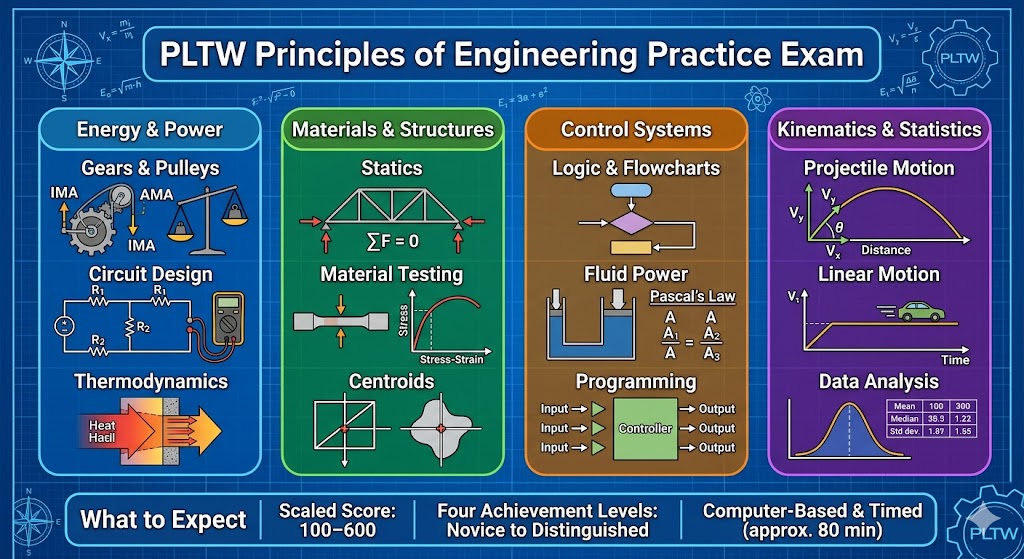
Additional Information
What the Course Entails and Exam Details
The PLTW POE course is a deep dive into the practical application of math, science, and technology. You will learn to use the same tools and processes as professional engineers. The comprehensive exam covers four primary content areas, or "Units," which form the syllabus for your preparation:
Unit 1: Energy and Power
This unit explores the fundamental concepts of mechanisms and thermodynamics. You will master simple machines, gears, pulleys, and sprocket systems, calculating mechanical advantage, work, and power. It also covers energy sources (renewable and non-renewable), energy transfer, circuit design, and electricity (Ohm's law, series and parallel circuits).
Unit 2: Materials and Structures
Here, you will focus on the properties and uses of different materials and the forces that act upon structures. Topics include static equilibrium, determining centroid locations, and calculating the internal and external forces within a truss system. You will also perform material testing and analysis, including non-destructive testing and mass property calculations.
Unit 3: Control Systems and Automation
This unit introduces you to the logic and systems that power modern automation. You will learn to design, build, and program control systems using software and hardware, applying flowcharts and logical reasoning. Key concepts include open and closed-loop systems, sensor integration, and fluid power, including both pneumatic and hydraulic systems and applications of Pascal's Law.
Unit 4: Kinematics and Statistics
You will learn to analyze and predict motion in this final unit. Topics include projectile motion, displacement, speed, velocity, and acceleration. You will also learn to collect and interpret statistical data, applying probability to solve problems and use statistics in the engineering design process.
The cumulative exam at the end of the course will test your ability to synthesize knowledge from all four units, requiring a combination of mathematical calculations, problem-solving, and theoretical understanding.
What to Expect in the Final Exam
The PLTW POE End-of-Course Assessment is a robust, computer-based exam designed to simulate an engineering challenge environment. It is critical to understand its structure and evaluation methods:
Format: The exam consists of multiple-choice questions, which can be further categorized. Some questions are discrete, testing specific knowledge. Others are context-based and presented as "item sets" or scenarios, where you will be given a problem, diagram, or data set and asked several related questions to assess your deeper analytical skills.
Evaluation: Rather than a simple "pass/fail" based on raw score percentage, PLTW uses a scaled score that ranges from 100 to 600. This scaled score provides a common measure across different versions of the test. Based on your scaled score, you will be assigned one of four achievement levels: Novice, Practiced, Accomplished, or Distinguished.
Achievement Benchmarks: PLTW does not set a single, universal passing score. Individual states, school districts, and sometimes colleges use these achievement levels to define proficiency, award credit, or determine a student's readiness for next-level coursework. Your goal should be to achieve an "Accomplished" or "Distinguished" level to maximize future opportunities.
Time and Tools: The exam is timed, typically taking 80 minutes, although this can vary by academic year and specific administration protocols. You will be permitted to use an approved scientific or graphing calculator, and you will be provided with a reference sheet containing formulas and constant values. Being extremely familiar with this reference sheet is a huge advantage.
How to Study and Exam Centers
Preparing for the PLTW POE EoC exam requires a structured and consistent approach. Here are actionable strategies to ensure your success:
Step 1: Deep Review of the Formula Sheet
The PLTW POE formula sheet is your single most important tool. Do not wait until the day of the exam to read it. Practice using every single formula to solve problems from your coursework. Know the context for each formula and what variable each symbol represents.
Step 2: Solve Calculation Problems
A large portion of the exam involves math. Practice solving problems daily. Focus on mechanical advantage, electricity, thermodynamics, projectile motion, and static equilibrium. The more problems you solve, the more intuitive and faster your calculations will become.
Step 3: Master the Design Process
Be ready to answer questions about the steps of the Engineering Design Process. You should understand the goals of each stage—from "Define Problem" to "Present Solution"—and be able to identify what step a hypothetical engineer is currently performing in a scenario.
Step 4: Use Practice Questions
The best preparation is using questions that mimic the format of the final exam. Practice identifying key information in a problem statement and ignoring irrelevant data. Work on context-based scenario questions to practice multi-step reasoning.
Step 5: Review Vocabulary and Concepts
Review your notes for all four units. Pay special attention to unique terminology (e.g., "statically determinate," "closed-loop," "non-destructive"). Create a glossary of key terms to review weekly.
Exam Centers and Registration:
The PLTW POE End-of-Course assessment is administered by your school. It is not an exam you register for independently at a private testing center. Authorized PLTW schools deliver the exam in a proctored, secure, computer-based environment, using a dedicated testing platform (such as Kite Educator Portal). Consult your PLTW teacher for the specific scheduling and details for your exam administration.
Job Opportunities from the Course
While a high school certificate alone does not unlock professional-level engineering jobs, completing the PLTW POE course and earning a high achievement level on the EoC assessment provides a definitive advantage in the job market for entry-level and preparatory positions. It demonstrates you possess crucial "transportable skills," like problem-solving, collaboration, and critical thinking, which employers in every field highly value.
Direct Entry-Level Paths and Internships:
Engineering Intern (High School or Summer): A perfect role to gain exposure to professional design, manufacturing, or testing.
Draftsperson (Trainee or Junior): Using basic CAD and technical drawing skills you began to develop.
CAD Technician (Entry-Level): Focus on creating detailed engineering models and drawings.
Engineering Technician (Assistant): Supporting full engineers by setting up tests, collecting data, and building prototypes.
Automation Specialist (Intern): Assisting in the setup, troubleshooting, and programming of basic robotic and control systems.
Long-Term Career Development:
Completion of this course is primarily a foundational step for further education. It is designed to lead to:
Engineering Technology (A.S. or B.S.): Direct pathway to roles like field service technician, manufacturing technician, or quality control inspector.
Engineering Degrees (B.S.): Critical preparation for specialization in mechanical, electrical, civil, civil, architectural, or aerospace engineering.
Frequently Asked Questions
Reviews
5.0
Based on 0 reviews
Leave a Review
No reviews yet. Be the first to review!