
PMMI Fluid Power Practice Test
$69.00
- Buy to unlock unlimited access to all Quiz questions and Answers in this Quiz.
- After purchase you can print a PDF of the whole quiz at any point. The PDF will contain the questions and the correct answers.
About this Exam
The PMMI Fluid Power Certification validates an individual's mastery of the critical principles, components, and systems that utilize compressed fluids (liquids or gases) to transmit power. This prestigious credential, offered by the Packaging Machinery Manufacturers Institute (PMMI), is specifically designed for industrial maintenance technicians, machine operators, engineers, and plant personnel who install, maintain, and troubleshoot pneumatic and hydraulic systems in modern manufacturing environments, particularly in the packaging and processing industries. It serves as a strong indicator of technical proficiency to employers looking for skilled fluid power professionals.
Ready to test your knowledge?
Buy Now to Access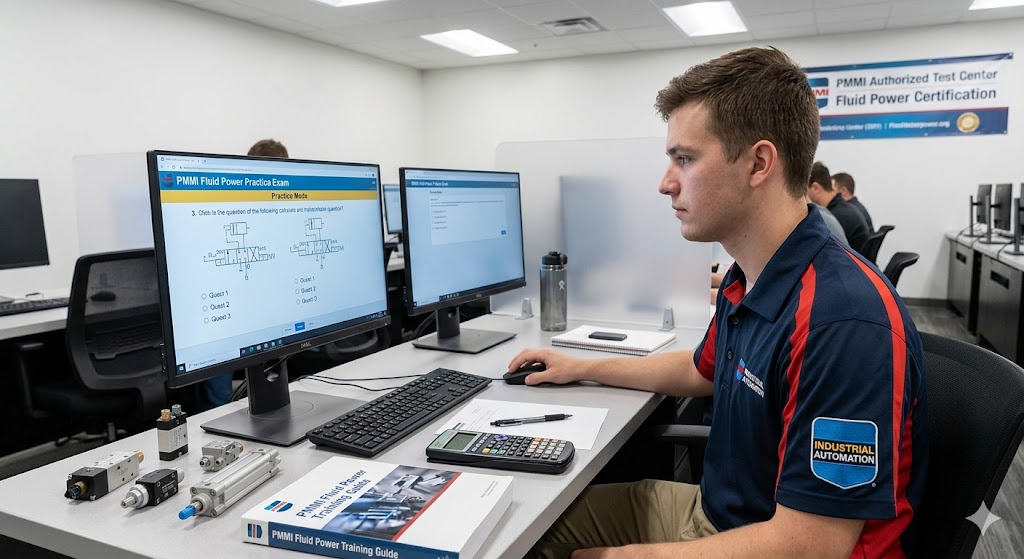
Additional Information
What the Course Entails and Exam Details
The corresponding training course (often offered through PMMI-partnered schools or institutions) and the final certification exam cover a comprehensive range of topics. Key areas include:
Fundamental Principles: Fluid mechanics, pressure, flow rate, and power calculations (e.g., Pascal's Law, Boyle's Law).
Pneumatic Systems: Compressed air generation, preparation, storage, and distribution. Design and function of components like compressors, actuators, valves, regulators, and piping. Interpreting pneumatic schematics.
Hydraulic Systems: Hydraulic principles, fluid properties, pumps, reservoirs, filters, heat exchangers, valves, cylinders, motors, and hydraulic circuits. Reading hydraulic schematics.
Troubleshooting and Maintenance: Diagnostic techniques, preventive maintenance procedures, safely handling components, and identifying system faults in both pneumatic and hydraulic setups.
Safety Standards: OSHA and other relevant safety regulations for working with pressurized systems, lockout/tagout (LOTO) procedures, and PPE requirements.
Applications: Integration of fluid power in automated machinery, particularly packaging equipment.
What to Expect in the Final Exam
The PMMI Fluid Power Certification is typically a computer-based, standardized examination.
Format: The exam consists of multiple-choice questions designed to test theoretical knowledge and its practical application in real-world scenarios.
Passing Score: While specific passing thresholds can vary slightly between testing administrations or partner programs, they generally require demonstrating strong technical comprehension, often in the 70% to 80% range. It is crucial to check with your testing administrator for the exact score needed.
Time Limit: Candidates are given a specific timeframe to complete the test, usually around 60 to 90 minutes. This rigorous format ensures that candidates have ready-state knowledge.
Specific Rules: Candidates should bring valid identification. Access to external materials is usually prohibited.
How to Study and Exam Centers
Preparation is key to success on the PMMI Fluid Power exam. Follow these actionable strategies:
Utilize Practice Tests: This is often cited as one of the most effective methods. Utilize available practice exams to understand the question structure, difficulty level, and identify areas needing further study. Practice exams help manage time and reduce anxiety.
Leverage PMMI Materials: Access the official PMMI Mechatronics Certification curriculum and training guides if possible, or materials provided by their affiliated educational institutions.
Review Textbooks: Study leading fluid power textbooks covering both pneumatics and hydraulics.
Hands-on Experience: Whenever possible, reinforce theoretical knowledge with practical experience in maintaining, building, or troubleshooting actual fluid power circuits.
Form Study Groups: Collaborating with peers can expose you to different perspectives and troubleshooting methods.
The exam is not typically taken at generic Pearson VUE centers. Instead, it is administered primarily through PMMI-partnered community colleges, technical schools, and designated training centers that have adopted the PMMI Mechatronics curriculum. The exam may be proctored in a computer lab setting within these institutions. Online, proctored testing may also be available through specific portals associated with these certified partners. Contact your local technical college or PMMI directly for authorized testing locations.
Job Opportunities from the Course
Earning the PMMI Fluid Power Certification significantly boosts your credibility and opens doors to diverse, technical career paths in automated manufacturing. Specific job titles and roles include:
Packaging Machine Technician: Specializing in the maintenance and repair of fluid power systems on packaging lines.
Automation Technician: Focuses on maintaining complex machinery where hydraulics and pneumatics are integrated with control systems.
Industrial Maintenance Technician: A core role in factories requiring broad proficiency in multiple skills, including fluid power.
Fluid Power Specialist: A targeted role dedicated to designing, troubleshooting, or upgrading pneumatic and hydraulic equipment.
Field Service Engineer: Traveling to customer sites to install or repair manufacturing equipment.
Production Supervisor/Team Lead: A step toward leadership, where understanding the technical aspects of the line's equipment is vital.
Maintenance Planner: Creating maintenance schedules based on technical requirements, including for critical fluid power systems.
Facility Engineer: Managing the overall plant infrastructure, where pneumatic or large-scale hydraulic systems may be present.
Frequently Asked Questions
Reviews
5.0
Based on 0 reviews
Leave a Review
No reviews yet. Be the first to review!