
POB Business Practice Test
$69.00
- Buy to unlock unlimited access to all Quiz questions and Answers in this Quiz.
- After purchase you can print a PDF of the whole quiz at any point. The PDF will contain the questions and the correct answers.
About this Exam
The CSEC Principles of Business (POB) examination is a cornerstone of business education for secondary school students across the Caribbean, typically targeted at those in their fourth and fifth forms. This introductory course is designed to equip students with a comprehensive understanding of the fundamental principles and practices governing the dynamic world of business. It serves as a vital first step for aspiring entrepreneurs, accountants, marketers, managers, and anyone interested in how organizations function and interact within a regional and global economy.
Ready to test your knowledge?
Buy Now to Access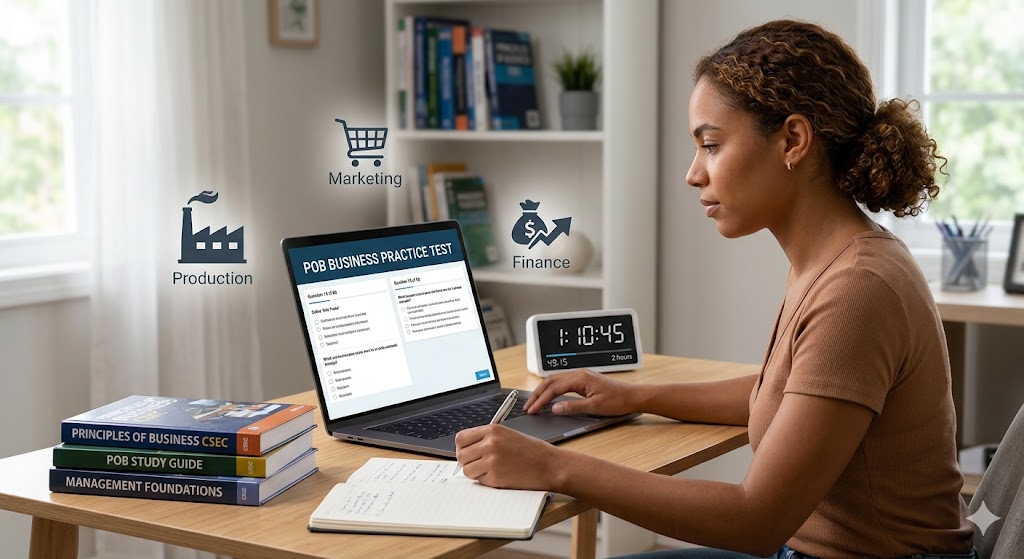
Additional Information
What the Course Entails and Exam Details
The CSEC POB syllabus is meticulous, ensuring students cover a broad range of critical business functions and environmental factors. The course is structured into three main 'Profile Dimensions,' which are then broken down into ten specific sections.
The core topics you will master include:
Profile 1: Organizational Principles:
The Nature of Business
Internal Organizational Environment
Establishing a Business
Legal Aspects of Business
Profile 2: Production, Marketing and Finance:
Production
Marketing
Business Finance
Profile 3: The Business Environment:
The Role of Government in an Economy
Social Accounting and Global Trade
Regional and Global Business Environment
The official examination, administered by the Caribbean Examinations Council (CXC), consists of a combination of assessment methods to evaluate your theoretical knowledge, application, and analytical skills. The primary components are:
Paper 1 (Multiple Choice): This is a 1-hour and 15-minute exam consisting of 60 multiple-choice questions that cover all three profile dimensions. It contributes 30% to your final grade.
Paper 2 (Structured Essay): A 2-hour paper divided into two sections. You are required to answer a total of five questions out of seven, focusing on specific syllabus
sections. This paper makes up 50% of your total marks.
What to Expect in the Final Exam
On exam day, you should arrive mentally prepared for a rigorous but fair assessment. The format requires speed for Paper 1 and thoughtful structuring for Paper 2. In Paper 1, expect questions ranging from definitions of basic terms like "bartering" and "entrepreneurship" to more complex, application-based scenarios involving business structures, market economic systems, and international trade.
For Paper 2, you must select questions strategically, as it accounts for half of your total grade. Be prepared to "define," "explain," "compare," and "outline" business concepts with clear, relevant examples, ideally drawing from the Caribbean context. For example, you might need to explain the roles of an entrepreneur, compare the advantages of a sole trader to a partnership, or discuss the government's role in regulating local business.
In addition to the formal exam papers, in-school candidates must complete a School-Based Assessment (SBA), which is a project worth 20%. Private candidates will take an alternate Paper 3/2, which is a 1-hour case study exam, also worth 20%.
How to Study and Exam Centers
A strategic approach to studying is crucial for success. Begin by thoroughly understanding the CXC syllabus. Make a study plan that covers every section, paying attention to the specific objectives. Actionable methods include:
Mastering the Terminology: Use flashcards to learn definitions. A strong grasp of the specific business verbs is essential for answering questions effectively.
Practicing Past Papers: This is perhaps the single most important activity. Practice timed Paper 1 to improve your speed and accuracy. For Paper 2, write out full essay responses to multiple questions, then check them against the official CXC marking schemes. Focus on structure and time management.
SBA Excellence: For in-school candidates, dedicate time to producing a high-quality SBA. It is a guaranteed way to boost your overall percentage before you even enter the exam room. Consult closely with your teacher.
For the final official examination, students in recognized schools are registered automatically. Private candidates must register with their local Ministry of Education or authorized CXC centers. To take practice tests, you can find numerous online platforms, quiz websites, and Caribbean-focused educational portals that offer simulated exams specifically for CSEC POB.
Job Opportunities from the Course
Successfully completing the CSEC Principles of Business course opens the door to numerous entry-level positions and career paths, even before pursuing higher education.
A clear list of job titles and career paths this certification unlocks includes:
Entrepreneur / Small Business Owner
Accounts Clerk / Assistant Accountant
Marketing Assistant / Social Media Coordinator
Administrative Assistant / Office Manager
Human Resource Assistant
Banking Clerk
Customer Service Representative
Inventory Clerk / Logistics Assistant
Data Entry Clerk
Public Relations Assistant
Frequently Asked Questions
Reviews
5.0
Based on 0 reviews
Leave a Review
No reviews yet. Be the first to review!