
Police Academy Case Law Practice Test
$69.00
- Buy to unlock unlimited access to all Quiz questions and Answers in this Quiz.
- After purchase you can print a PDF of the whole quiz at any point. The PDF will contain the questions and the correct answers.
About this Exam
The Police Academy Case Law Practice Exam is a comprehensive study tool designed for aspiring law enforcement officers preparing for their foundational academy exams.
This practice test specifically targets understanding of pivotal U.S. Supreme Court decisions that govern police procedures and the application of constitutional law in real-world scenarios.
It is an invaluable resource for police recruits, criminal justice students, and anyone preparing for a career where a deep knowledge of criminal procedure and established case law is mandatory for field operations.
By simulating the rigor of the actual academy testing environment, this practice exam helps candidates identify knowledge gaps and build critical thinking skills required for legal reasoning.
Ready to test your knowledge?
Buy Now to Access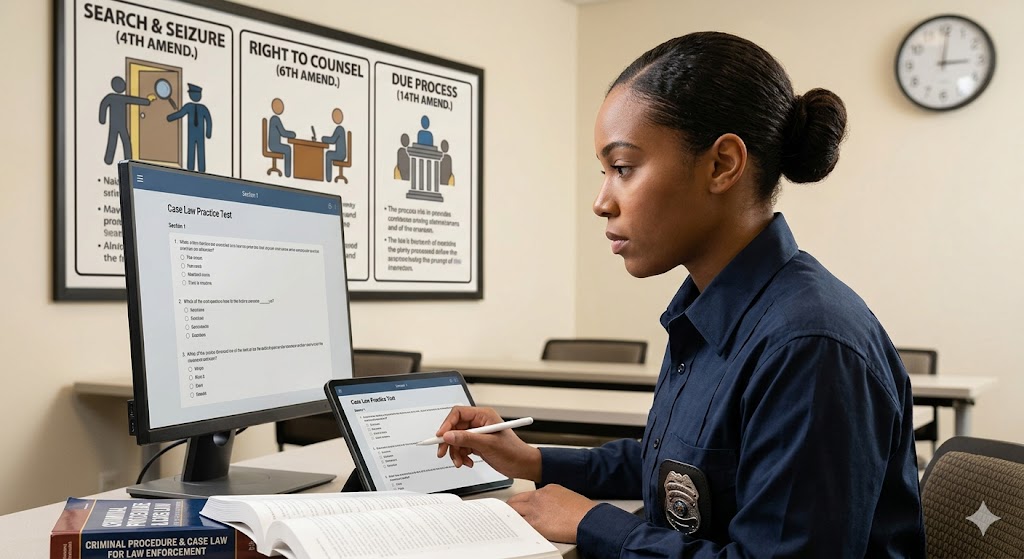
Additional Information
What the Course Entails and Exam Details
This resource is designed as a practice simulation, not a standalone course, but it tests content covered in core police academy curriculum blocks.
The material tested by this practice exam focuses exclusively on established legal precedents.
Candidates can expect to see significant emphasis on the following critical legal areas:
Fourth Amendment Applications: Detailed knowledge of search warrants, exceptions to the warrant requirement (such as exigent circumstances, plain view, and search incident to arrest), and the exclusionary rule.
Fifth Amendment Protections: In-depth understanding of the right against self-incrimination, the Miranda decision, and procedural requirements for custodial interrogations.
Sixth Amendment Rights: The right to counsel, including at which critical stages this right attaches and how it must be honored by law enforcement.
Fourteenth Amendment Due Process: Concepts of fundamental fairness in all police interactions, from stops and frisks to evidence handling and suspect identification.
Other Critical Precedents: Seminal cases related to use of force standards, officer liability, and detainee rights.
What to Expect in the Final Exam
This practice test is structured to mimic the challenge and format of actual police academy exams.
Candidates should expect a rigorous assessment that evaluates their ability to apply legal concepts to specific, hypothetical police scenarios rather than just recalling facts.
The format will be entirely multiple choice, but the questions require analysis, integration of multiple facts, and selecting the best legal answer in complex situations.
A typical actual academy exam on this subject might include 50 to 100 questions.
To pass, recruits usually need a minimum score of 70% to 80%, depending on the specific academy and state's Peace Officer Standards and Training (P.O.S.T.) guidelines.
Timed sessions are standard, requiring recruits to manage their time effectively under pressure to ensure they complete all questions.
How to Study and Exam Centers
Effective preparation is key to success on the actual exam.
Begin by rigorously reviewing your primary academy textbooks and P.O.S.T. study materials.
Focus on creating case summaries for every seminal Supreme Court decision discussed in class, noting the key facts, the central legal issue, and the Court's ultimate holding and rationale.
Use this Police Academy Case Law Practice Exam repeatedly to simulate the testing environment, improve speed, and refine your legal analysis.
For the final, official examination, recruits take the test at their specific authorized Police Academy training facility.
Some P.O.S.T. agencies might utilize secure online proctoring portals or dedicated state testing centers, but for standard police recruits, the testing is integrated into the academy curriculum, and specific scheduling is handled by the academy instructors.
Job Opportunities from the Course
A strong score on your academy case law exams, combined with completion of the entire training program, unlocks various careers in public safety.
Successfully passing this critical legal block is mandatory to move forward and become certified as a law enforcement professional.
Successful graduates can pursue numerous positions, including:
Municipal Police Officer
County Sheriff’s Deputy
State Patrol/Highway Patrol Trooper
Federal Law Enforcement Agent (e.g., FBI, DEA, ATF)
Transit Police Officer
Campus Police Officer (University and College)
Conservation/Park Ranger Officer
Correctional Officer (inบาง jurisdictions requiring P.O.S.T. certification)
Criminal Investigator/Detective (following a period of field experience)
Corporate Security and Private Investigation (where a police background is highly valued)
Frequently Asked Questions
Reviews
5.0
Based on 0 reviews
Leave a Review
No reviews yet. Be the first to review!