
Police Academy – Constitutional Law Practice Test
$69.00
- Buy to unlock unlimited access to all Quiz questions and Answers in this Quiz.
- After purchase you can print a PDF of the whole quiz at any point. The PDF will contain the questions and the correct answers.
About this Exam
The Police Academy Constitutional Law examination is a pivotal component of law enforcement training, serving as the foundational assessment of a recruit's legal competence.
This comprehensive test is designed specifically for recruits currently enrolled in a certified police academy or aspiring officers preparing for enrollment.
It verifies a candidate's thorough understanding of the U.S. Constitution, focusing heavily on how supreme law governs daily law enforcement operations and interaction with the public.
Passing this exam is not merely an academic hurdle; it is a critical demonstration that a future officer possesses the requisite knowledge to uphold individual rights while maintaining public safety and executing their duties within the bounds of the law.
Ready to test your knowledge?
Buy Now to Access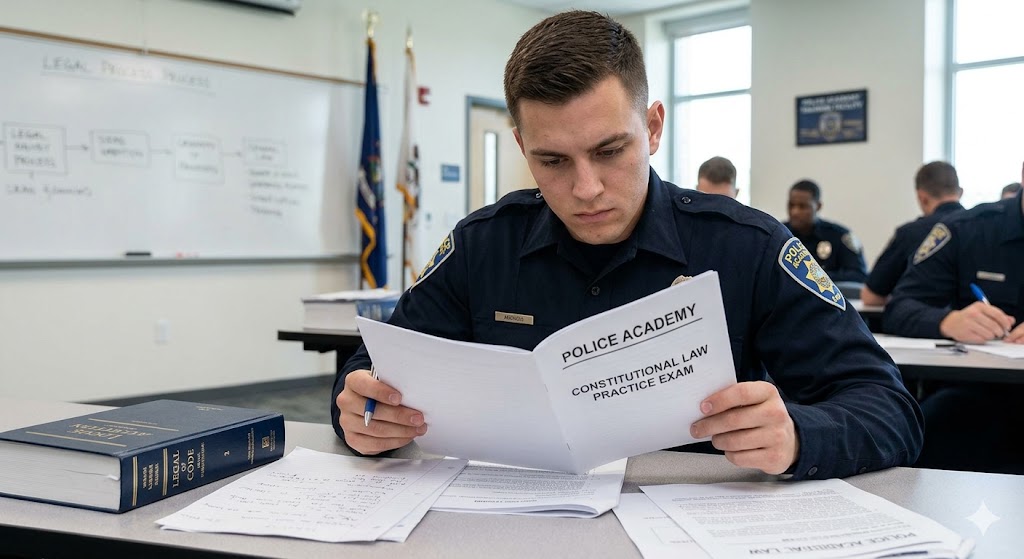
Additional Information
What the Course Entails and Exam Details
The material covered in preparation for this exam is both rigorous and detailed, moving beyond abstract theories to practical applications of jurisprudence.
Recruits must master fundamental legal principles, starting with a deep dive into the Bill of Rights and subsequent amendments critical to criminal procedure.
The core syllabus specifically targets:
The Fourth Amendment: Extensive focus on search and seizure laws, the requirements for warrants, exceptions to the warrant requirement, and the definition of probable cause versus reasonable suspicion.
The Fifth Amendment: Mastering the laws surrounding self-incrimination, the legal definition of "custody" and "interrogation," and the accurate administration of Miranda warnings.
The Sixth Amendment: Understanding a suspect's right to legal counsel, confrontation of witnesses, and the parameters of a speedy and public trial.
The Eighth Amendment: Applying standards regarding bail and the prohibition of cruel and unusual punishment within law enforcement contexts.
The Fourteenth Amendment: Grasping the complexities of due process and equal protection under the law for all citizens.
Additionally, the course demands a thorough knowledge of major landmark U.S. Supreme Court cases that have shaped modern policing procedures and defined the scope of officer authority.
What to Expect in the Final Exam
Candidates should prepare for a challenging, comprehensive final exam that is typically administered in a timed, closed-book format.
The examination structure is heavily weighted towards multiple-choice questions, but these are rarely simple rote-memorization checks.
Instead, the majority of questions are scenario-based, presenting complex, real-world police situations that require the candidate to analyze the facts and apply the correct constitutional principle to determine the lawful course of action.
A high passing score is required, often set at 80% or above by state POST (Peace Officer Standards and Training) commissions, reflecting the critical nature of this knowledge.
The strict time limit, which varies by specific academy, requires candidates to demonstrate not only accuracy but also decisiveness under pressure, mimicking operational realities.
The exam is proctored, usually in a classroom setting at the training facility, under strict academic integrity protocols.
How to Study and Exam Centers
Success on this exam requires dedicated, active study strategies that move beyond passive reading.
We highly recommend creating analytical case briefs for all major Supreme Court decisions covered in class, focusing on the legal reasoning rather than just the outcome.
Develop flashcards for precise legal definitions—such as "probable cause," "exigent circumstances," and "plain view doctrine"—as exact terminology is crucial.
The most effective study method is taking practice tests that simulate the multiple-choice, scenario-based format of the actual exam; this builds familiarity with questioning patterns and sharpens decision-making speed.
Utilize any study guides or review sessions provided by academy instructors, as they often highlight state-specific legal nuances.
Regarding testing locations, this specific exam is not generally administered at public testing centers like Pearson VUE.
It is taken on-site at the authorized police academy or regional law enforcement training facility where the recruit is enrolled, often delivered through a secure, internal state-mandated testing portal.
Job Opportunities from the Course
Mastering Constitutional Law is the gateway to a comprehensive and rewarding career in public service.
This knowledge is not optional; it is required for every certified law enforcement position across the United States.
Upon successful completion of the police academy training and passing this critical legal exam, several career paths become available:
Municipal Police Officer
County Sheriff’s Deputy
State Trooper / Highway Patrol Officer
Transit Police Officer
University or Campus Police Officer
Tribal Police Officer
Wildlife / Conservation Officer (State level)
Furthermore, the foundational expertise established by this course provides the essential knowledge necessary for long-term career advancement into specialized roles, including:
Criminal Investigator / Detective
Legal Liaison Officer
Internal Affairs Investigator
Field Training Officer (FTO)
Frequently Asked Questions
Reviews
5.0
Based on 0 reviews
Leave a Review
No reviews yet. Be the first to review!