
Police Oral Board Practice Exam
$69.00
- Buy to unlock unlimited access to all Quiz questions and Answers in this Quiz.
- After purchase you can print a PDF of the whole quiz at any point. The PDF will contain the questions and the correct answers.
About this Exam
The police oral board is often considered the most critical component of the law enforcement hiring process. This face-to-face interview with high-ranking officers and civilian panel members is designed to assess your judgment, communication skills, ethical core, and ability to think on your feet under pressure. While written exams test your cognitive abilities, the oral board evaluates your character and suitability for the badge.
Our comprehensive Police Oral Board Practice Exam is engineered for aspiring law enforcement officers who have passed their initial testing and are ready to tackle the final hurdle before conditional offer. This simulation is not a traditional written test; rather, it is a dynamic, scenario-based practice module that mimics the high-stakes environment of a real department interview, forcing you to articulate your responses and defend your decisions in real-time.
Ready to test your knowledge?
Buy Now to Access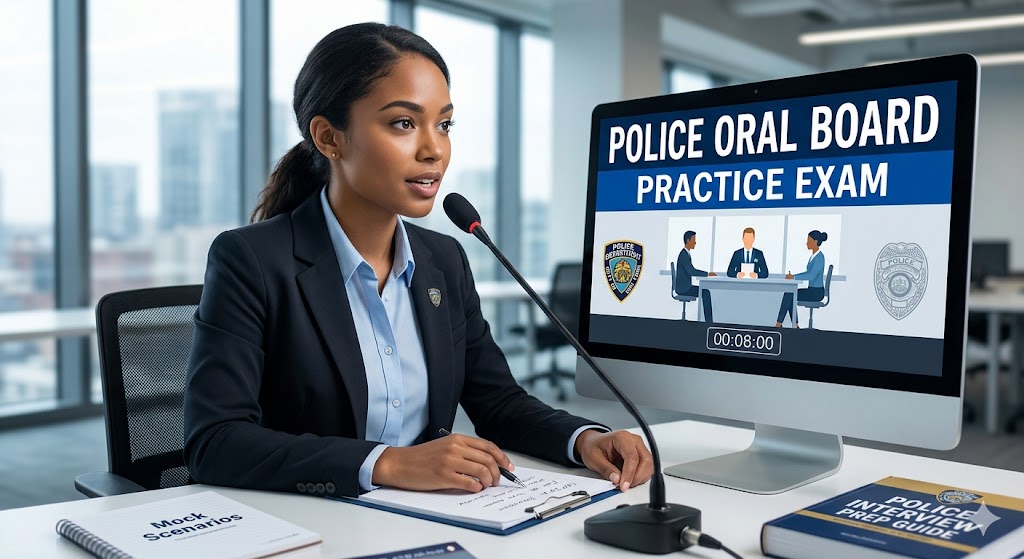
Additional Information
What the Course Entails and Exam Details
This practice experience isn't about memorizing answers; it's about mastering the mindset of a professional police officer. The simulation covers a broad range of core competencies that oral boards universally prioritize.
You will navigate through hundreds of curated behavioral, ethical, and situational questions. The core syllabus includes critical areas such as understanding the police role and mission, demonstrates sound judgment and decisive problem-solving, maintaining integrity and ethical standards, situational leadership, cultural sensitivity and community relations, and stress tolerance and emotional stability.
While standard multiple-choice practice exams are also included to review policy-based scenarios, the centerpiece of this module is the interactive video simulation. In this format, you are presented with a scenario or question by a digital panel member. You must record your response under a countdown timer, forcing you to develop concise, structured, and impactful answers—simulating the actual pressure of the live board.
What to Expect in the Final Exam
When you step into the room for your final police oral board interview, you should expect a structured, professional, and potentially intimidating environment. Typically, the board will consist of three to five members, often a combination of police sergeants, lieutenants, a command staff officer, and sometimes a human resources representative or civilian community member.
The interview typically lasts between 30 to 60 minutes. It is structured around behavioral-based questions ("Tell us about a time when you...") and complex situational scenarios ("You observe your partner taking something from a crime scene; what do you do?"). Unlike a written test, there is no simple percentage score to pass. Agencies use a dynamic scoring matrix to grade you on dimensions such as oral communication, judgment, presence, and honesty. You aren't just competing against a standard; you are competing against the top candidates applying for a limited number of positions.
To succeed, you must communicate with confidence, maintain strong eye contact with all panel members, and structure your responses using proven methods like the STAR technique (Situation, Task, Action, Result) to provide clear, competency-based answers.
How to Study and Exam Centers
Effective preparation for the police oral board requires moving beyond passive reading to active, practical drills. We recommend a three-pronged approach for your study strategy.
First, deep research. Know the department you are applying to inside and out—its mission statement, current challenges, community demographics, and recent news. Structure your answers to reflect that you have done your homework and are genuinely invested in serving that specific community.
Second, use the simulation. Our online practice portal provides the nearest experience to the real thing. Record yourself multiple times. Critically review your recordings to analyze your body language, tone, and the substance of your answers. Practice articulating your 'Why'—why you want to be a police officer and why that specific agency.
Third, mock interviews. Arrange mock interviews with trusted mentors, advisors, or law enforcement professionals. Feedback from real-time, face-to-face interaction is invaluable. You can access the practice simulations online from anywhere, but the actual final oral board interview will be a physical testing center, typically hosted at the police department, a municipal training academy, or a centralized assessment center managed by the hiring agency.
Job Opportunities from the Course
Successfully mastering the skills covered in the Police Oral Board Practice Exam is the definitive key to unlocking a wide array of law enforcement careers. While it is not a certification in itself, it is the crucial gateway performance required to secure appointment in virtually all police agencies across the country.
Candidates who excel in their oral board are positioned for top-tier opportunities as a:
Municipal Police Officer (City Departments)
County Sheriff’s Deputy
State Trooper / Highway Patrol Officer
University Police Officer
Transit Police Officer
Federal Law Enforcement Agent (Various specialized roles)
Park Ranger / Conservation Officer
Frequently Asked Questions
Reviews
5.0
Based on 0 reviews
Leave a Review
No reviews yet. Be the first to review!