
Policies & Procedures for Certified IPC Specialist (CIS), Certified IPC Trainer (CIT) and Master IPC Trainer (MIT) Practice Test
$69.00
- Buy to unlock unlimited access to all Quiz questions and Answers in this Quiz.
- After purchase you can print a PDF of the whole quiz at any point. The PDF will contain the questions and the correct answers.
About this Exam
The [IPC Policies Procedures CIS CIT MIT Practice Exam] is an essential preparatory tool for any individual aiming to obtain or maintain their status as a Certified IPC Specialist (CIS), Certified IPC Trainer (CIT), or Master IPC Trainer (MIT). While IPC’s technical certifications validate your understanding of electronic manufacturing standards, this specific exam validates your comprehensive knowledge of the overarching program governance. It is designed to ensure that all certified personnel are intimately familiar with, and adhere to, the official IPC policies, procedures, and code of ethics that maintain the global integrity of the IPC certification system.
This test is not about technical details, but about operational and ethical understanding, safeguarding the value of your certification and the quality of training provided worldwide. It is a critical component for quality professionals, manufacturing engineers, and dedicated training instructors across the electronics industry.
Ready to test your knowledge?
Buy Now to Access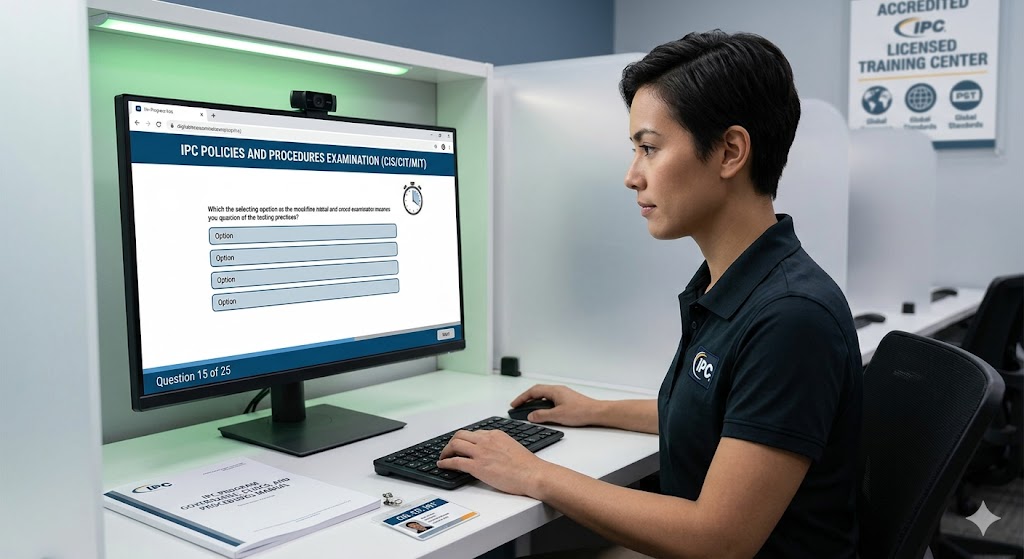
Additional Information
What the Course Entails and Exam Details
This examination focuses exclusively on the non-technical administrative and operational side of the IPC certification program. It does not teach soldering or inspection criteria; instead, it tests your proficiency with the governing documents that dictate how these activities should be proctored, recorded, and maintained. The core syllabus and key focus areas included are:
IPC Certification Program Governance: Understanding the purpose, structure, and value of the global IPC program.
Roles and Responsibilities: Clearly defining the duties and limitations of Certified IPC Specialists (CIS), Certified IPC Trainers (CIT), and Master IPC Trainers (MIT), including authority levels for training and proctoring.
IPC Code of Ethics: Understanding and committing to the ethical standards of professional conduct required for all IPC certificants.
Examination Procedures: Specific rules for scheduling, administering, and proctoring official IPC exams, including remote and paper-based guidelines.
Prerequisites and Applications: Necessary steps and eligibility criteria for individuals seeking each level of certification.
Certification Validity and Renewal: Detailing how long each certification is active and the specific paths for maintaining status through re-certification or continuing education.
Intellectual Property and Copyright: Stringent rules regarding the use and distribution of copyrighted IPC training and examination materials.
Conflict of Interest and Appealing Decisions: Official processes for managing potential conflicts and navigating appeals within the IPC system.
Record-Keeping and Program Reporting: The responsibilities for maintaining accurate training records and reporting results to IPC.
What to Expect in the Final Exam
The final Policies and Procedures exam, often referred to as the "Enhanced Policies and Procedures Exam" for trainers, is a focused, administrative hurdle. It is typically a closed-book, multiple-choice assessment that can be completed either in a proctored training center or via an approved online proctoring system through the IPC EDGE learning platform.
You can anticipate a set number of questions, commonly fewer than technical standard exams, that specifically test your recall and application of the Policies and Procedures. A passing score of at least 80% is strictly required to satisfy this part of the certification process, ensuring a high standard of compliance across the network. The time limit is appropriate for a focused administrative test, often under one hour. Success in this exam, in addition to any relevant technical assessments, is necessary before a final certificate is issued or renewed.
How to Study and Exam Centers
Preparation for the Policies & Procedures exam is uniquely tailored. Your first and most important study resource is the official, current version of the [IPC Policies and Procedures] document. This is not a text to skim; it is a ruleset to memorize and understand. We strongly recommend downloading the PDF from the IPC website or your training center and dedicating significant time to an in-depth review of each section.
To complement your direct study, utilizing a [IPC Policies Procedures CIS CIT MIT Practice Exam] is a highly effective, active-learning strategy. It familiarizes you with the question format, tests your ability to retrieve specific rules under pressure, and immediately highlights any areas where your knowledge is weak.
Regarding taking the official exam, all IPC certification assessments are administered via IPC EDGE, the official learning management system. Your authorized trainer or an IPC Licensed Training Center will schedule your exam, which will be proctored to ensure academic integrity. These centers are located worldwide, ensuring accessible access to authorized testing environments. In certain circumstances and when permitted by current policy, virtual or remote proctoring might also be an available option.
Job Opportunities from the Course
Passing the Policies and Procedures examination is a required component of maintaining valid, active IPC certifications. It does not, in itself, create a new job role. However, it is the fundamental professional validation that allows individuals with technical certifications to function in their designated positions. Without it, your technical certification is not valid. The following are the specific job opportunities that this exam, combined with the corresponding technical certification, unlocks and protects:
Electronic Assembly Technician (Requires CIS)
Quality Inspector (Requires CIS)
Lead Assembly Operator (Requires CIS)
Process Engineer (Requires CIS or CIT)
Quality Manager (Requires CIS or CIT)
IPC Certification Trainer / Educational Instructor (Requires CIT)
Corporate Technical Trainer (Requires CIT)
Training and Development Specialist (Requires CIT)
Master IPC Trainer (Requires MIT status, enabling center governance and CIT training)
IPC Licensed Training Center Director (Requires MIT)
Frequently Asked Questions
Reviews
5.0
Based on 0 reviews
Leave a Review
No reviews yet. Be the first to review!