
Political Science – Citizen Interactions Practice Test
$69.00
- Buy to unlock unlimited access to all Quiz questions and Answers in this Quiz.
- After purchase you can print a PDF of the whole quiz at any point. The PDF will contain the questions and the correct answers.
About this Exam
The [Political Science – Citizen Interactions Practice Test] is a comprehensive diagnostic tool designed to prepare students, aspiring civil servants, and community leaders for rigorous assessments in civic engagement and public service. This practice exam is specifically crafted for individuals who aim to understand the complex dynamics between governing bodies and the public they serve. It goes beyond theoretical knowledge, challenging you to apply core political concepts to practical, real-world scenarios that demand ethical decision-making, effective communication, and strategic problem-solving. This test serves as an essential stepping stone for anyone pursuing a career that requires a deep understanding of democratic participation and a commitment to fostering positive citizen-government relations.
Ready to test your knowledge?
Buy Now to Access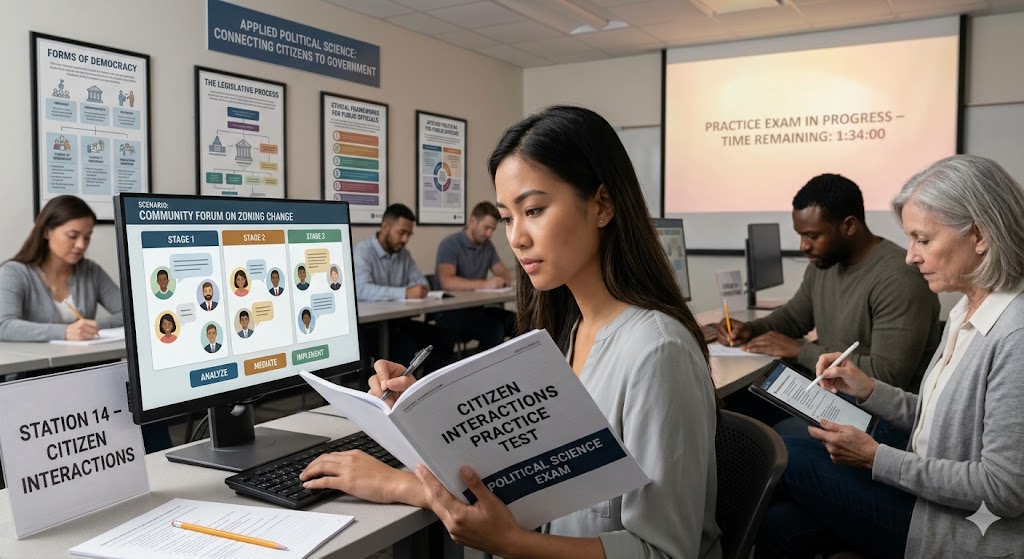
Additional Information
What the Course Entails and Exam Details
This preparation does not rely on a single "course" but rather integrates foundational political science education with applied principles of public administration. The knowledge base covered is extensive, focusing on several key domains.
You will encounter topics that assess your understanding of:
Foundational political concepts, including different forms of democracy, the social contract, and theories of representation.
The legal and constitutional framework governing citizen rights and responsibilities.
The mechanics of public opinion and media, including how information is processed and disseminated in a digital age.
The structure and operation of local, state, and federal government, with an emphasis on citizen-facing departments and service delivery.
Effective communication strategies for diverse populations, including conflict resolution and cross-cultural competence.
Ethical frameworks for public officials and simulated decision-making exercises in resource allocation or public policy implementation.
What to Expect in the Final Exam
The actual certification or academic exam for which this practice test prepares is a multifaceted, high-stakes assessment.
While formats can vary slightly by program, you should generally expect:
Format: A significant portion (60–70%) will be multiple-choice questions designed to test your recall and application of knowledge. The remaining 30–40% will consist of detailed case study analyses and complex, multi-stage problem-solving scenarios.
Case Studies: These often require you to read a scenario involving a community issue (e.g., a zoning dispute, a public health crisis response) and answer multiple questions about the legal, ethical, and strategic path forward.
Passing Score: For most professional certifications or academic versions, a passing score of 70% or 75% is standard.
Time Limit: The final exam is typically timed, offering approximately 2 to 2.5 hours to complete all sections.
Rules: Real exams are generally closed-book, require government-issued identification, and may involve remote proctoring if taken online.
How to Study and Exam Centers
Preparation must be active and varied to ensure success.
Actionable Study Strategies:
Engage with Active Recall: Don't just re-read notes. Use flashcards for key terms, legal precedents, and ethical guidelines.
Analyze Real-World Case Studies: Find public reports on community disputes or policy failures. Analyze them using a political science lens, identifying stakeholders, conflicting values, and potential solutions.
Simulate Interactions: Work with peers to role-play scenarios, such as a contentious city council meeting or a public forum. Practice remaining calm, analytical, and professional.
Use the Practice Test: Use this [Political Science – Citizen Interactions Practice Test] as a true diagnostic. Take it under timed, closed-book conditions to identify areas of weakness before your final exam.
Where to Take the Exam: The actual exam location depends on the specific institution or certifying body:
Online Portals: Many certifications use official, secure proctoring platforms (like ProctorU).
Pearson VUE Testing Centers: This is a common requirement for professional licensing.
University-Specific Centers: If the test is an academic exit exam, it will likely be administered at the university's testing center.
Authorized Schools: Specific professional training programs may have authorization to administer their own exams.
Job Opportunities from the Course
A certification or advanced qualification in Political Science – Citizen Interactions unlocks a diverse array of rewarding career paths across the public, private, and non-profit sectors.
Completing this preparation signals to employers that you possess the analytical skills and practical know-how to manage complex public-facing responsibilities.
Specific job titles and career paths this achievement supports include:
Community Liaison Officer: Bridges the gap between government agencies and community groups.
Public Policy Analyst (Citizen Engagement): Designs and evaluates programs that promote public participation in policymaking.
City Council or Legislative Staffer: Manages constituent services, researches policy, and facilitates community outreach.
Voter Education and Outreach Coordinator: Designs and implements non-partisan campaigns to increase voter registration and turnout.
Non-Profit Program Manager (Civic Engagement): Leads initiatives for organizations focused on advocacy, community organizing, or public education.
Public Affairs Specialist: Manages communication between an organization and government entities or the public.
Ethics and Compliance Officer (Public Sector): Monitors and enforces ethical guidelines within government agencies.
Frequently Asked Questions
Reviews
5.0
Based on 0 reviews
Leave a Review
No reviews yet. Be the first to review!