
Port State Control Examiner Practice Test
$69.00
- Buy to unlock unlimited access to all Quiz questions and Answers in this Quiz.
- After purchase you can print a PDF of the whole quiz at any point. The PDF will contain the questions and the correct answers.
About this Exam
The Port State Control (Examiner) designation is a critical component of international maritime law and safety. Port State Control (PSC) is the process by which national maritime authorities inspect foreign-flagged ships that call at their ports. The role of the examiner, often a Port State Control Officer (PSCO), is to verify that the vessel, its equipment, and its crew comply with major international conventions. These include the International Convention for the Safety of Life at Sea (SOLAS), the International Convention for the Prevention of Pollution from Ships (MARPOL), and the International Convention on Standards of Training, Certification and Watchkeeping for Seafarers (STCW), as well as other instruments like the Maritime Labour Convention (MLC). This exam and its related training are designed for experienced maritime professionals, such as Master Mariners and Chief Engineers, who are looking to transition into a critical regulatory and oversight role, ensuring the safety of lives, property, and the marine environment.
Ready to test your knowledge?
Buy Now to Access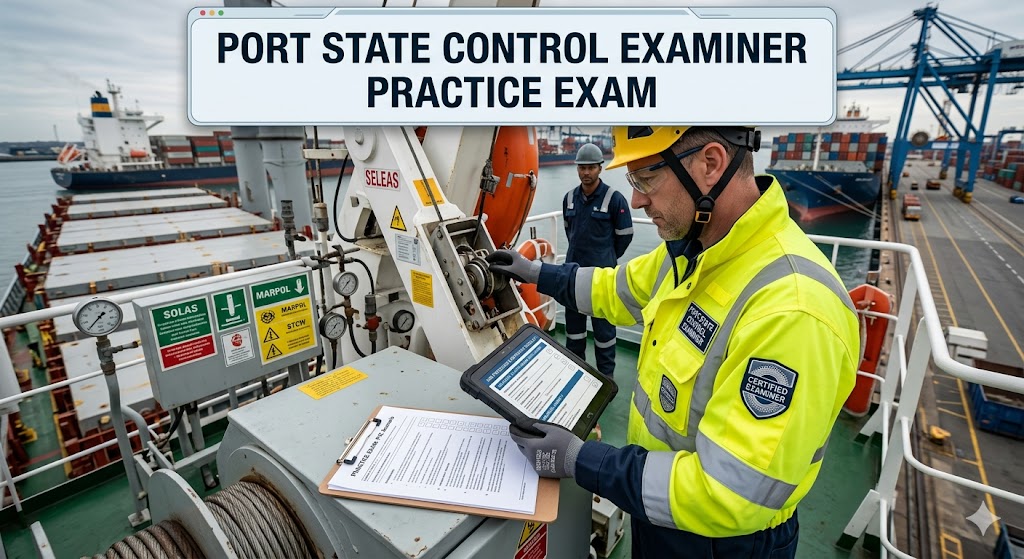
Additional Information
What the Course Entails and Exam Details
To prepare for the final examiner assessment, a candidate must undergo specialized training that aligns with the guidelines set out by the International Maritime Organization (IMO), particularly IMO Model Course 3.26, Port State Control. The course provides a deep dive into both theoretical knowledge and practical application. Candidates must master the entire legal framework of Port State Control, from global United Nations Convention on the Law of the Sea (UNCLOS) principles to regional Memoranda of Understanding (MoUs) like the Paris or Tokyo MoUs. A core focus is the systematic inspection procedure: from pre-boarding preparation and vessel targeting to the conduct of a more detailed inspection of ship structure, machinery, and life-saving and firefighting appliances. The syllabus explicitly covers how to identify, document, and report deficiencies, how to use the standard IMO and MoU PSC forms and checklists, and the serious procedures involved in detaining a vessel found to be substandard. The final exam aims to test a comprehensive understanding of all these critical regulatory and operational areas.
What to Expect in the Final Exam
While the exact format of the final examiner exam can vary slightly depending on the national administration or authorized organization, it is primarily a written assessment designed to test practical scenario analysis and technical knowledge. A typical exam will consist of multiple-choice questions, detailed case study analysis, and short-answer questions. The exam will challenge your ability to apply international regulations to real-world shipboard scenarios, such as interpreting a vessel's stability documents, verifying compliance with a complicated MARPOL Annex, or assessing crew competency during a fire drill. For a national certification, the exam might be proctored in a single, three to four-hour session. A high passing score, often around 70% or 80%, is typically required to demonstrate the level of expertise needed for this regulatory role. For certifications that are part of an extended educational program, like a university diploma, the final assessment may include a series of modular tests and a final comprehensive exam.
How to Study and Exam Centers
Preparation for the Port State Control Examiner test must be rigorous and multi-faceted. Success relies on a mastery of the core IMO conventions and procedural guidelines. Your starting point should be a current edition of the IMO Procedures for Port State Control (e.g., Resolution A.1155(32), and subsequent amendments) and the relevant MoU manuals. We highly recommend enrolling in a dedicated training course that includes a mock exam component. Reviewing a Port State Control Examiner Practice Exam is one of the most effective ways to identify knowledge gaps and get comfortable with the case-study format, which is central to the actual assessment. Focus your study on the most common deficiencies found in the annual reports of major MoUs to understand standard interpretation and application. Where you take the final exam depends on the authority offering it: for official government certification, exams are typically held at national maritime testing centers or authorized marine schools. For professional diplomas, the final test may be administered directly through the accredited online learning portal.
Job Opportunities from the Course
A formal certification or qualification as a Port State Control Examiner is a gold standard in the maritime regulatory and compliance sector. It opens doors to a variety of critical roles within government and private industry. The job titles and career paths available include:
Port State Control Officer (PSCO)
Marine Surveyor (National Flag State or Classification Society)
Flag State Inspector
Maritime Safety Inspector
Marine Accident Investigator
International Maritime Auditor
Maritime Compliance Manager
Marine Superintendent (with a focus on regulatory compliance)
Frequently Asked Questions
Reviews
5.0
Based on 0 reviews
Leave a Review
No reviews yet. Be the first to review!