
Positron Emission Tomography–Computed Tomography (PET/CT) Fusion Practice Exam
$69.00
- Buy to unlock unlimited access to all Quiz questions and Answers in this Quiz.
- After purchase you can print a PDF of the whole quiz at any point. The PDF will contain the questions and the correct answers.
About this Exam
Positron Emission Tomography–Computed Tomography (PET/CT) fusion is an indispensable tool in modern medicine, combining the functional insights of PET with the detailed anatomical context of CT scans. A specialized PET/CT Fusion Practice Exam is an essential preparatory tool for imaging professionals, such as nuclear medicine technologists and radiologists, who seek to validate their advanced knowledge and skill set in this complex modality. This comprehensive practice exam simulates the actual certification process, offering a realistic assessment of your readiness and identifying key areas for refinement. By working through challenging questions and clinical scenarios, candidates can build their confidence and master the dual expertise required to excel in this field and enhance patient care.
Ready to test your knowledge?
Buy Now to Access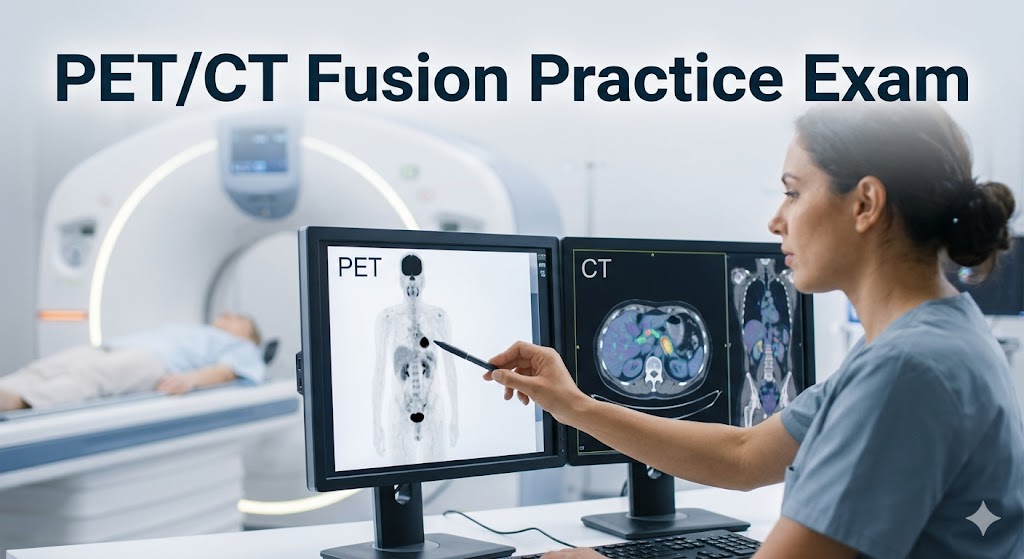
Additional Information
What the Course Entails and Exam Details
The PET/CT Fusion Practice Exam is meticulously designed to cover the breadth of knowledge required for specialized certification. The curriculum and test content typically encompass the following core areas:
PET and CT Physics: Principles of annihilation radiation, positron emission, gamma detectors (scintillation crystals, photomultiplier tubes), CT image formation, Hounsfield units, and image reconstruction algorithms.
Hybrid Imaging Systems: In-depth understanding of PET/CT scanner design, attenuation correction methods (CT-based, radionuclide-based), and quality control procedures for both components and the fused system.
Radiopharmaceuticals: Detailed study of Positron-emitting isotopes, especially Fluorodeoxyglucose (FDG), their production (cyclotrons), biological mechanisms, indications, and appropriate dosage.
Clinical Applications: Protocol selection for oncology, cardiology (myocardial viability), and neurology (dementia, epilepsy), interpreting normal variant uptake, and identifying common pathologies.
Patient Care and Preparation: Understanding patient safety protocols, screening, contraindications, and pre-scan requirements (e.g., dietary restrictions for FDG-PET).
Image Interpretation and Analysis: Mastering fused images, identifying potential artifacts (motion, truncation, metal), quantifying SUV (Standardized Uptake Value), and generating accurate clinical reports.
Radiation Safety: Rigorous adherence to ALARA principles, regulations for radioactive material handling, and CT radiation dose optimization for patients and staff.
What to Expect in the Final Exam
While specific exam bodies may have slight variations, the final certification in PET/CT fusion typically follows a rigorous structure designed to test both theoretical understanding and practical application. Candidates can generally expect:
Multiple-Choice Format: The vast majority of questions are complex multiple-choice, which may include matching, ordering, and image-based scenario analysis.
High-Stakes Testing: The exam is highly timed, often ranging from 1.5 to 3 hours, requiring efficient time management and decisive critical thinking.
Challenging Passing Score: The passing threshold is typically high, often requiring a raw score or scaled score of approximately 75% or greater.
Comprehensive Coverage: The questions are distributed across the core topics, with a significant emphasis on quality control, radiation safety, and cross-sectional anatomy-PET interpretation.
Scenario-Based Questions: Expect to face questions that present real-world clinical data, images, or patient histories, requiring the dynamic application of integrated PET/CT knowledge to make the correct diagnostic or technical decision.
How to Study and Exam Centers
Success on the PET/CT Fusion exam demands a focused and structured approach to study.
Practice, Practice, Practice: Engage in a comprehensive practice exam multiple times. Review all answers, understanding the why behind both correct and incorrect choices. This is the single most effective method for building speed and content mastery.
Textbook Review: Use foundational texts like "The Essential Physics of Medical Imaging" (Bushberg) and dedicated nuclear medicine textbooks (e.g., "Nuclear Medicine and Molecular Imaging" by Mettler and Guiberteau) to master the physics and clinical applications.
Flashcards and Active Recall: Create flashcards for critical formulas, radiopharmaceuticals, quality control steps, and cross-sectional anatomy. Actively test your recall.
Clinical Experience: If possible, gain additional hands-on experience in a PET/CT suite. Observing real scans, participating in QC, and interacting with experts provides invaluable practical context.
Study Groups: Discuss challenging concepts and image interpretations with peers or mentors.
The final certification exam itself is administered by authorized entities. Candidates typically register for the exam through an official board or national registry (such as the Nuclear Medicine Technology Certification Board (NMTCB) or the American Registry of Radiologic Technologists (ARRT) for relevant subspecialty endorsements).
Testing is generally conducted in controlled environments, which include:
Pearson VUE Testing Centers: A major global provider of computer-based testing, where you can schedule and take the exam at a physical location.
Specific School or Hospital Centers: Authorized testing sites at university programs or major healthcare institutions recognized by the certifying body.
Online Portals (Less Common): Occasionally, specific sub-exams may offer proctored online testing, but this is less common for high-stakes clinical certifications and must be confirmed with the primary exam authority.
Job Opportunities from the Course
Achieving specialized certification in PET/CT Fusion significantly expands career horizons and unlocks high-demand positions across a variety of healthcare and research settings. Graduates can pursue roles such as:
PET/CT Technologist: Lead technologist in dedicated PET/CT departments in hospitals and outpatient imaging centers.
Nuclear Medicine Technologist (with PET/CT Focus): A versatile role combining traditional nuclear medicine studies with advanced hybrid imaging.
Radiologic Technologist (PET/CT Specialization): A key imaging position in multi-modality departments, bridging radiography and molecular imaging.
PET/CT Quality Control Specialist: Dedicated role ensuring scanner performance, regulatory compliance, and accuracy.
Clinical Application Specialist (Imaging Vendor): Train other technologists and professionals on new PET/CT systems for a manufacturer.
Research Technologist in Molecular Imaging: Work at universities or research institutions on clinical trials and development.
Imaging Department Manager: Oversee operations, staffing, and technology for an entire imaging division.
PET/CT Educator/Instructor: Teach and mentor students in dedicated training programs.
Frequently Asked Questions
Reviews
5.0
Based on 0 reviews
Leave a Review
No reviews yet. Be the first to review!