
Powers to Arrest and Use of Force Practice Test
$69.00
- Buy to unlock unlimited access to all Quiz questions and Answers in this Quiz.
- After purchase you can print a PDF of the whole quiz at any point. The PDF will contain the questions and the correct answers.
About this Exam
The Powers to Arrest and Use of Force certification is a foundational requirement for individuals seeking employment in the private security industry. This exam validates a candidate's understanding of legal authority, the constraints of private citizenship when making arrests, and the ethical and legal standards governing the application of force. It is designed specifically for aspiring security guards, loss prevention officers, and bodyguards who must balance asset protection with lawful conduct to avoid personal and employer liability.
Ready to test your knowledge?
Buy Now to Access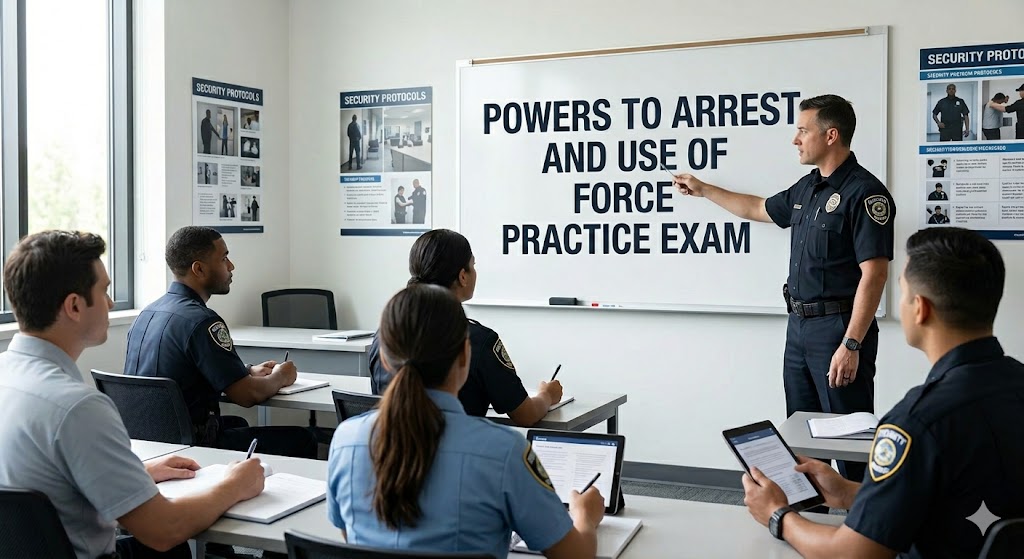
Additional Information
What the Course Entails and Exam Details
The preparatory course focuses heavily on interpreting state-specific penal codes as they apply to private security personnel. Students will learn the critical distinction between private citizens' arrests and peace officers' authorities.
Key syllabus areas include:
Legal Definitions: Understanding felony, misdemeanor, and infraction distinctions.
Arrest Procedures: The step-by-step lawful process of detaining a suspect.
Use of Force Continuum: Analyzing different levels of force and determining the "reasonable and necessary" response to varying threats.
Liability and Ethics: Recognizing the consequences of false imprisonment and excessive force.
What to Expect in the Final Exam
The final examination is designed to test both knowledge retention and situational judgment. It is typically a proctored, computer-based exam, although written formats are still used in some jurisdictions.
Format: Multiple-choice questions, often featuring hypothetical scenarios where the candidate must choose the lawful course of action.
Time Limit: Usually 60 to 90 minutes.
Passing Score: Most jurisdictions require a score of at least 80% to demonstrate competency.
Specific Rules: Candidates must present valid photo identification and are generally prohibited from using open-book references during the test.
How to Study and Exam Centers
Preparation is essential. Effective study strategies include reviewing course materials provided by your training provider, focusing on key terminology and legal constraints. Utilizing practice exams is highly recommended to become familiar with the phrasing of situational questions. Candidates should create flashcards for penal code sections and use-of-force definitions.
The exam is usually administered by state-approved private security training facilities or authorized schools where the course was completed. In some cases, examinations might be available through online portals or specialized testing centers, depending on regional regulations.
Job Opportunities from the Course
Earning this certification is often the primary requisite for securing a variety of positions in the private sector. Potential career paths include:
Contract Security Guard
In-house Security Officer (Retail, Corporate, Hospitality)
Loss Prevention Specialist
Event Security Personnel
Residential Security Agent
Armed Guard (Requires additional certification)
Executive Protection Agent (Bodyguard)
Frequently Asked Questions
Reviews
5.0
Based on 0 reviews
Leave a Review
No reviews yet. Be the first to review!