
Practice TesCISSP Domain 8 – Software Development Securityt
$69.00
- Buy to unlock unlimited access to all Quiz questions and Answers in this Quiz.
- After purchase you can print a PDF of the whole quiz at any point. The PDF will contain the questions and the correct answers.
About this Exam
The Certified Information Systems Security Professional (CISSP) is universally regarded as the gold standard for cybersecurity professionals aiming to prove their senior-level expertise. Administered by ISC2, this comprehensive certification validates a candidate's ability to design, implement, and manage a premier organizational security posture. Domain 8, Software Development Security, is a critical component of this certification, focusing intensely on the application of security principles throughout the entire software development lifecycle (SDLC). It is designed for experienced security practitioners, managers, and executives who need to ensure that applications are resilient against modern threats. Mastering this domain demonstrates your capacity to integrate security proactively, rather than treating it as an afterthought
Ready to test your knowledge?
Buy Now to Access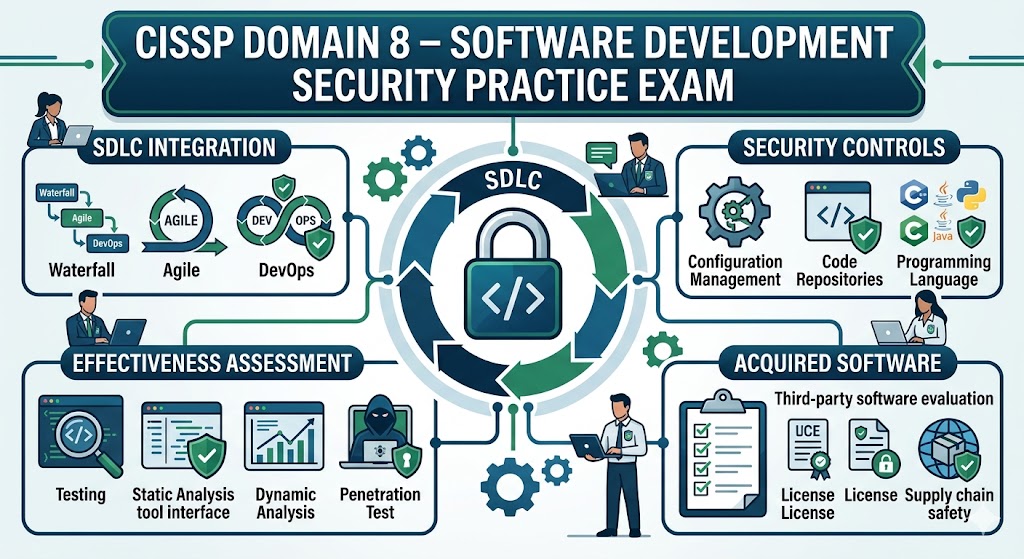
Additional Information
What the Course Entails and Exam Details
CISSP Domain 8 provides a rigorous framework for securing
the ecosystem in which software is created, deployed, and maintained. The core
syllabus encompasses four primary objectives, beginning with understanding and
integrating security into the Software Development Life Cycle (SDLC). This
includes knowledge of various development methodologies, such as Waterfall,
Agile, Scrum, and DevOps, and how to apply security controls at every stage,
from requirements gathering to testing and deployment. Candidates must also
learn to identify and apply security controls in software development
ecosystems, covering tools, repositories, and programming languages. Another
significant focus is assessing the effectiveness of software security,
utilizing methods like static and dynamic analysis, code reviews, and
penetration testing. Finally, the course covers assessing the security impact
of acquired software, which is crucial for managing supply chain risks and
ensuring the integrity of third-party commercial or open-source components.
What to Expect in
the Final Exam
When sitting for the full CISSP exam, which includes Domain
8, candidates in English-speaking regions will typically experience the
Computerized Adaptive Testing (CAT) format. This modern format is highly
efficient, dynamically adjusting the difficulty of questions based on your
previous answers to precisely measure your ability. The exam consists of a
combination of standard multiple-choice questions and advanced innovative
questions, such as drag-and-drop or hotspot scenarios. Under the CAT format, you
will have 3 hours to complete between 100 and 150 questions. For other
languages, a linear format may be used, which takes 6 hours and contains 250
questions. Regardless of the format, you must achieve a scaled score of at
least 700 out of 1000 points to pass. The CISSP exam is strictly closed-book,
and no outside reference materials are permitted.
How to Study and
Exam Centers
Effective preparation for the CISSP, and Domain 8
specifically, requires a structured and multi-faceted study plan. The
foundation of your revision should be the official ISC2 CISSP Study Guide and
the Official CISSP CBK Reference, as these are the authoritative sources for
the exam content. You should complement your reading with reputable practice
exams to familiarize yourself with the unique wording and complexity of the
questions, focusing on understanding the reasoning behind correct answers
rather than just memorizing them. Many candidates find it helpful to create
flashcards for key terms, secure coding standards like OWASP, and SDLC phases.
Joining online study groups or forums can also provide invaluable peer support
and diverse perspectives. When you are ready to certify, you must schedule your
exam through Pearson VUE, which is the exclusive global testing partner for
ISC2. Pearson VUE offers a vast network of secure, professional testing centers
worldwide. Online proctoring is generally not available for the CISSP exam to
maintain its high standard of security.
Job Opportunities from the Course
A CISSP certification is a powerful career catalyst,
recognized globally by employers as a mark of senior leadership and deep
technical competence. The specialized knowledge gained within Domain 8 is
particularly valuable in an era of relentless application-layer attacks, making
professionals who can secure the development process highly sought after. While
the CISSP unlocks many general senior management roles, the Software
Development Security domain directly supports specialized career paths. This expertise
prepares you for a range of critical mid-level to executive positions that
require operationalizing application security within an organization. Some of
the specific job titles this certification can unlock include: Application
Security Engineer, Security Architect, Chief Information Security Officer
(CISO), Software Development Manager, Security Consultant, Information Security
Manager, and Governance, Risk, and Compliance (GRC) Analyst.
Frequently Asked Questions
Reviews
5.0
Based on 0 reviews
Leave a Review
No reviews yet. Be the first to review!