
Praxis Art Content Knowledge (5134) Practice Exam
$69.00
- Buy to unlock unlimited access to all Quiz questions and Answers in this Quiz.
- After purchase you can print a PDF of the whole quiz at any point. The PDF will contain the questions and the correct answers.
About this Exam
The Praxis Art: Content Knowledge (5134) exam is a comprehensive assessment designed for prospective art teachers seeking to teach visual arts at the elementary, middle, and high school levels (K-12). This exam is a critical step in the teacher certification process in many states across the United States. Its purpose is to verify that candidates possess the requisite content knowledge and analytical skills deemed essential for an entry-level art educator. The test evaluates a candidate’s understanding of the historical and theoretical foundations of art, as well as their command over art-making processes, techniques, and safety protocols. The exam ensures that newly certified teachers can effectively create and deliver a rich, well-rounded art curriculum.
Ready to test your knowledge?
Buy Now to Access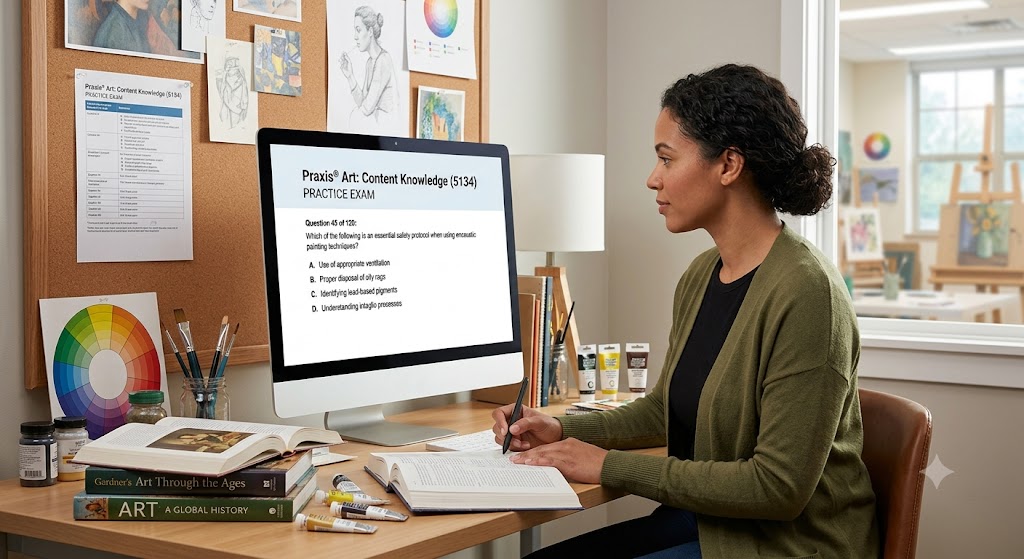
Additional Information
What the Course Entails and Exam Details
This examination is a rigorous evaluation of a candidate's mastery over two primary domains. The course content is divided into the following key areas:
Art Making (64% of the exam): This extensive section assesses your practical knowledge of the creation of art. It covers the understanding of design principles and elements, various multidimensional media, and the application of artistic processes. Topics include drawing, painting, printmaking, sculpture, ceramics, fiber arts, graphic design, photography, and digital art/videography. Crucially, it also examines safety procedures within an art studio, including the identification, safe handling, and storage of hazardous materials, potential health risks, and appropriate ventilation and ventilation practices. You are expected to demonstrate knowledge of tools, techniques, and the appropriate display and presentation of 2D and 3D artwork.
Historical and Theoretical Foundations of Art (36% of the exam): This section tests your analytical and critical skills in interpreting and placing art within its context. It requires a thorough understanding of the Western tradition in art history, comparing and contrasting major styles, periods, and movements from Prehistory to the contemporary era. It also includes the historical and cultural contexts of non-Western art traditions, such as those from Africa, Asia, and the indigenous Americas. You will be tested on your ability to analyze, evaluate, and critique artworks using appropriate art historical and theoretical terminology, understanding concepts like aesthetics, formal analysis, and the influence of cultural perspective on interpretation.
What to Expect in the Final Exam
The Praxis Art Content Knowledge (5134) is a computer-delivered assessment.
Format: The test consists of 120 selected-response questions. These are primarily multiple-choice questions where you select one correct option. However, the exam may also include other types of selected-response formats, such as:
Selecting all correct answers from a list of choices.
Choosing from a drop-down menu.
Clicking on specific parts of a graphic, map, or chart (hot spot questions).
Dragging and dropping answers into target areas.
Time Limit: You are given 2 hours (120 minutes) of actual testing time. This time does not pause, even if you take a short break, so efficient time management is essential.
Passing Score: The qualifying score required to pass is not set by ETS but by each state's licensing agency. Therefore, the passing score varies from state to state. While a typical passing range might be between 155 and 158 on a scaled score of 100-200, you must confirm the specific requirement for the state in which you are seeking licensure.
Rules: There are no scheduled breaks. All responses must be completed during the allocated time. You will receive an official score report after the test window closes, typically within two to three weeks.
How to Study and Exam Centers
Preparation is the key to success. Here are actionable strategies to prepare for the Praxis Art 5134:
Utilize Official Resources: Your first point of contact should be the ETS Praxis website. They provide an official Study Companion, which includes the complete test syllabus, detailed content explanations, sample questions, and test-taking strategies.
Take Practice Exams: Realistic practice is invaluable. ETS offers full-length, interactive practice tests that mimic the actual exam environment. These are essential for gauging your time management and identifying areas where you need further study. Several other reputable educational providers also offer free and paid practice tests.
Review Core Art Concepts: Deepen your knowledge in key areas. For Art Making, review a variety of techniques (e.g., intaglio vs. relief printing) and, critically, safety datasheets and studio safety protocols. For Art History, use comprehensive textbooks and timelines to create comparative tables of major movements, including key artists, works, and characteristics.
Create Flashcards: Flashcards are excellent for memorizing artists, specific artworks, art historical dates, and technical terminology.
Exam Centers
Location: The exam is administered year-round by appointment at a network of authorized testing centers globally, including specific physical sites operated by Prometric. It is also common to take the exam at authorized schools or colleges with testing facilities.
Online Option: Additionally, the Praxis Art Content Knowledge (5134) is available to be taken via at-home testing using an online proctoring service (ProctorU). This option provides flexibility but requires a private room, a reliable computer, and a stable internet connection that meets specific technical requirements.
Registration: All candidates must register for the exam, select their test date, and choose their preferred testing method (testing center or at home) through their official ETS account.
Job Opportunities from the Course
A passing score on the Praxis Art: Content Knowledge (5134) is a direct pathway to state licensure for teaching visual arts, unlocking numerous career opportunities within the education sector. This certification is primarily designed to qualify you for roles such as:
K-12 Visual Arts Teacher
Elementary School Art Teacher
Middle School Art Teacher
High School Art Teacher
Art Specialist
Visual Art Program Coordinator (at a school or district level)
Lead Art Teacher or Fine Arts Department Chair
Museum Educator or Art Gallery Education Coordinator (often, a teaching license is preferred)
Art Instructor in community programs or continuing education.
Frequently Asked Questions
Reviews
5.0
Based on 0 reviews
Leave a Review
No reviews yet. Be the first to review!