
Praxis Family and Consumer Sciences 5123 Practice Test 2026 | Exam Prep Questions
$69.00
- Buy to unlock unlimited access to all Quiz questions and Answers in this Quiz.
- After purchase you can print a PDF of the whole quiz at any point. The PDF will contain the questions and the correct answers.
About this Exam
The Praxis Family and Consumer Sciences (5123) exam is a comprehensive assessment designed for individuals aspiring to become Middle School or High School Family and Consumer Sciences (FCS) teachers.
It is a crucial step in the teaching certification process, ensuring that prospective educators have both the broad subject knowledge and the necessary teaching methodology required to effectively lead an FCS classroom.
The exam content is relevant to individuals with a bachelor's degree program focusing on Family and Consumer Sciences, drawing from the latest national standards for the field.
It represents a gateway for passionate individuals who wish to make a real difference in the lives of young people, teaching vital life skills and preparing students for successful futures.
Ready to test your knowledge?
Buy Now to Access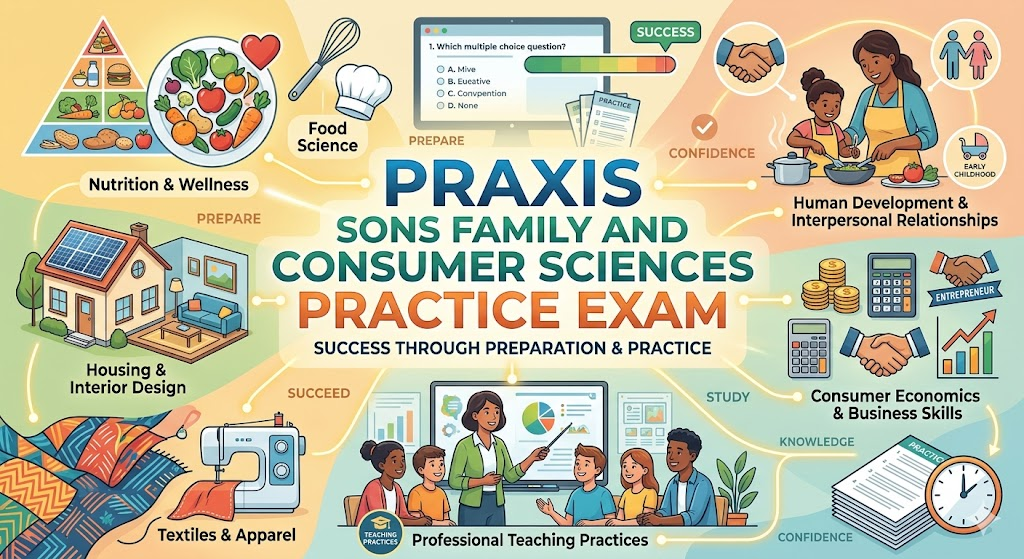
Additional Information
What the Course Entails and Exam Details
While not a "course" you take, the exam syllabus outlines the critical knowledge areas that successful candidates must demonstrate. These areas are vast, reflecting the multifaceted nature of the profession.
The Core Content Areas Covered:
I. Family, Career, and Community Interrelationships (approx. 17%): Focuses on the various influences, trends, and systems that impact these key domains, including the role of community and professional organizations.
II. Wellness, Nutrition, and Food Science (approx. 21%): Explores dietary guidelines, health management, food production, safety and sanitation procedures, and culinary techniques.
III. Human Development and Interpersonal Relationships (approx. 18%): Examines physical, emotional, social, and cognitive growth throughout the lifespan, and principles for positive relationships and parenting.
IV. Housing, Interior Design, Textiles, and Apparel (approx. 12%): Covers principles of design, housing decisions, environmental considerations, types of fibers, and basic apparel construction skills.
V. Business Skills Across Career Pathways (approx. 12%): Includes concepts of financial management, entrepreneurship, managerial skills, leadership, customer service, and human resource management within FCS contexts.
VI. Professional Teaching Practices (approx. 20%): Delves into curriculum development, instructional strategies, assessment methods, and effective laboratory and classroom management.
This diverse range of topics ensures that as a future teacher, you are prepared to cover everything from basic cooking and nutrition to financial literacy and textiles, all while using effective educational practices.
What to Expect in the Final Exam
Knowing what to expect on test day is key to reducing anxiety and performing your best. The exam is structured in a clear, manageable format, and while challenging, it is designed for success.
The Exam Format: The Praxis 5123 exam is a computer-delivered test and consists primarily of selected-response questions. This category includes multiple-choice questions with one correct answer, matching questions, and possibly some that require multiple selections or other interactive formats. The key is that they are not constructed-response or essay questions.
Time Limit: Candidates are generally given approximately 130 minutes (2 hours and 10 minutes) of actual testing time. This is ample but requires good pacing. The entire test session, which includes tutorials and check-in procedures, will last longer.
Passing Score: Each state that uses Praxis exams sets its own passing score requirement. Your raw score (the number of questions you answer correctly) is converted into a scaled score ranging from 100 to 300. It is vital to check your specific state's department of education website or the ETS Praxis website for the precise passing scaled score required for your state and certification level. For reference, a passing scaled score around 153 is a common benchmark, though it varies.
Specific Rules and Fees: As of early 2026, the registration fee for this exam is approximately $130. You are not allowed to bring personal items into the testing area. Remote testing requires a strict, private environment without traffic, a working camera, speaker, and microphone, and a clear surface. For in-person testing, you will be directed to a secure area after check-in.
The exam may contain some "pretest" questions that do not count towards your score. This common practice in standardized testing allows for evaluating new questions and does not affect your result, but it contributes to the overall length of the test.
How to Study and Exam Centers
Effective preparation is your most powerful tool for success, blending focused content review with practical strategy.
Actionable Study Strategies:
Diagnostic Assessment: Begin by taking an official, full-length Praxis Family and Consumer Sciences interactive practice test. Treat this like a real exam to identify your current knowledge level and understand the formatting. This crucial first step reveals your strengths and where you need the most improvement.
Utilize Official Resources: Dive deeply into the official Praxis Study Companion for the 5123 exam. This document details all content categories, provides example questions, and outlines the entire syllabus. It is your ultimate reference for what to study. Consider purchasing official Praxis flashcards for portable, quick reinforcement of key concepts and terminology.
Create a Structured Plan: Use your diagnostic results and the Study Companion to build a personalized study schedule. Allocate dedicated time each week to focus on specific content categories, starting with your weakest areas while regularly reinforcing your strengths. Consistency is key, avoiding last-minute cramming.
Pace Yourself with Practice Tests: In the final weeks, incorporate multiple simulated, full-length timed practice exams. Not only will this help with content recall, but it will also sharpen your time-management and test-taking stamina, reducing anxiety for the actual day. Always review the detailed explanations for every question, understanding both why the correct answer is right and why the other options were wrong.
Review & Refine: Continuously revisit and refine your understanding. Use different learning materials, such as textbook passages, online educational videos, and pedagogical resources for the teaching practices section. Focus not just on memorization but on the application of concepts to real-world classroom situations.
Exam Centers:
The Praxis exam is administered by ETS (Educational Testing Service). You must register through the ETS website, where you can select your desired testing format, location, and date.
Test Location Options: As of 2026, you generally have two main choices:
Authorized In-Person Testing Centers: These are secure facilities, often Prometric test centers or approved universities, dedicated to standardized testing. ETS will provide a list of available locations during the registration process.
Remote Testing (At-Home): The exam can be taken from a private room at your home or other suitable location using a compatible desktop or laptop computer with a working camera, speaker, and microphone. A proctor will observe you and your environment through your webcam.
Remember, proper preparation, positive self-talk, and sufficient rest before the big day will all contribute to your confidence and success.
Job Opportunities from the Course
A certification as a Family and Consumer Sciences teacher opens a wide array of career paths, all focused on supporting individuals, families, and communities. The skills you will teach are universally valuable, and this qualification is highly sought after across various educational and community-based settings.
Specific job titles and career paths this certification unlocks/supports:
Middle School Family and Consumer Sciences Teacher
High School Family and Consumer Sciences Teacher
Career and Technical Education (CTE) Instructor (focusing on FCS pathways)
Vocational Educational Teacher
Curriculum Development Specialist (focusing on FCS or career readiness)
Cooperative Extension Agent/Educator (providing non-formal education to the community)
Consumer Affairs Specialist or Advisor
Child Development Program Coordinator (related roles in early childhood education settings, though additional specific certifications may be required)
Human Services Worker (with a focus on family support and development)
Community Health Educator (within organizations focusing on nutrition and wellness)
FCCLA (Family, Career and Community Leaders of America) Advisor (facilitating student leadership development linked to FCS)
Financial Literacy Educator/Program Coordinator
Nutrition and Wellness Educator (in schools or community programs)
Textile and Apparel Industry Training or Development Roles
Entrepreneur/Self-Employed Consultant in an FCS-related field (using the business skills covered)
The skills and knowledge you gain not only pave the way to a rewarding career in the classroom but also build a diverse foundation applicable across many fields that make a positive impact. Success on this Praxis exam is your first confident step into a world of impactful educational opportunities.
Frequently Asked Questions
Reviews
5.0
Based on 0 reviews
Leave a Review
No reviews yet. Be the first to review!