
Praxis II Pedagogy (5153) Practice Exam
$69.00
- Buy to unlock unlimited access to all Quiz questions and Answers in this Quiz.
- After purchase you can print a PDF of the whole quiz at any point. The PDF will contain the questions and the correct answers.
About this Exam
The Praxis II Pedagogy (5153) exam, officially titled "Pedagogy: Principles of Learning and Teaching," is a cornerstone certification for aspiring educators.
This specific test is designed to measure a candidate's knowledge and understanding of the fundamental principles of learning and teaching that are essential for entry-level teachers in K-12 settings.
It validates that a candidate possesses the pedagogical expertise required to create effective learning environments, plan instruction, assess student progress, and demonstrate professional responsibility.
Individuals who have completed or are nearing completion of a teacher preparation program are the primary candidates for this examination.
Ready to test your knowledge?
Buy Now to Access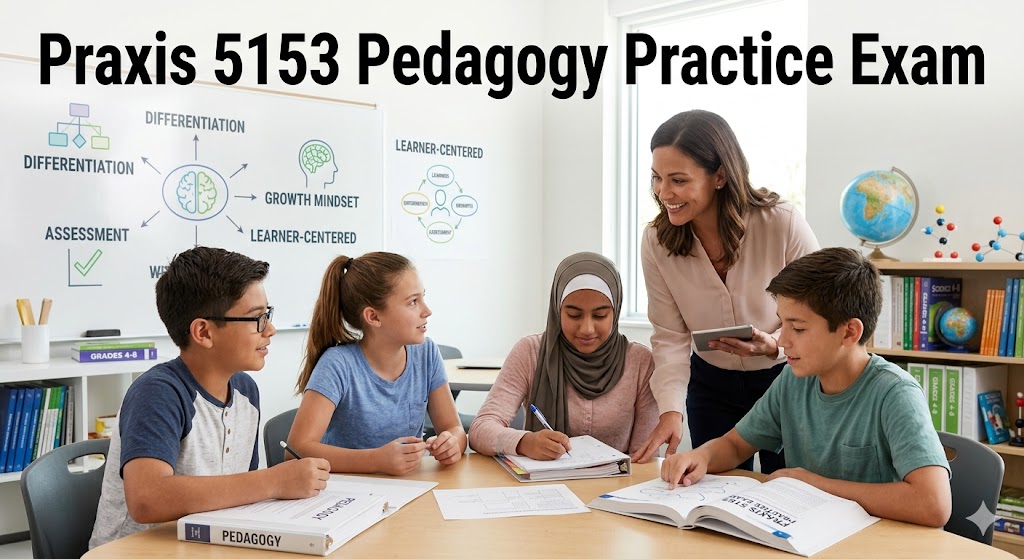
Additional Information
What the Course Entails and Exam Details
This examination does not have a formal "course" associated with it, but rather tests the cumulative knowledge acquired during teacher education programs.
The content aligns with the Interstate Teacher Assessment and Support Consortium (InTASC) Model Core Teaching Standards.
The official study topics generally fall into four main categories:
Students as Learners: This includes understanding student development, the learning process, and factors that influence student learning (e.g., exceptionalities, diversity, prior knowledge).
Instructional Process: Covering instructional planning, a wide range of instructional strategies, the use of resources and technology, and techniques for motivating students.
Assessment: Highlighting the various purposes of assessment (diagnostic, formative, summative), diverse assessment methods, and the appropriate use and interpretation of assessment data to inform instruction.
Professional Development, Leadership, and Community: Focusing on the reflective practitioner, opportunities for professional growth, and effective collaboration with colleagues, parents, and community members.
What to Expect in the Final Exam
The Praxis II Pedagogy (5153) exam is a computer-delivered assessment consisting solely of selected-response questions.
It typically features approximately 100 multiple-choice questions.
Candidates are given a standard testing window of two hours to complete the entire exam.
While passing scores vary by state or licensing agency, the Praxis tests use a scaled scoring system ranging from 100 to 200.
The scaled score required to pass is determined by the state in which you seek licensure, and it is crucial to verify your specific state's requirement before taking the test.
Specific rules, such as those regarding prohibited items in the testing center, must be strictly followed.
How to Study and Exam Centers
Effective preparation is essential, and leveraging the Praxis II Pedagogy (5153) Practice Exam is a highly recommended strategy.
A comprehensive study plan should include:
Reviewing Official Materials: Utilize the ETS (Educational Testing Service) Study Companion and sample questions, which provide exact insight into test content and format.
Taking Practice Tests: Repeatedly utilizing a high-quality Praxis II Pedagogy (5153) Practice Exam allows you to simulate the testing environment, gauge your readiness, identify weak areas, and improve your time management.
Reviewing Pedagogical Concepts: Revisit your coursework and textbooks focusing on developmental psychology, educational psychology, and instructional methods.
Creating Study Guides: Synthesize your learning by creating concise summaries of key principles, theories, and instructional strategies.
The exam is administered internationally by ETS at a network of authorized testing centers, which are typically found at colleges, universities, and professional testing facilities like Prometric centers.
Additionally, online proctoring may be available in some jurisdictions, allowing you to take the exam from a secure location, such as your home.
Job Opportunities from the Course
Successfully passing the Praxis II Pedagogy (5153) exam is a mandatory component for obtaining initial teacher licensure in many states.
Obtaining this certification directly unlocks various career opportunities in the field of education, including:
Certified K-12 Classroom Teacher (across all subject areas, depending on additional content certifications)
Special Education Teacher (often requiring additional specialized certification)
Instructional Coach
Educational Consultant
Curriculum Developer
Adult Education Instructor
Substitute Teacher (often requires licensure even for long-term position
Frequently Asked Questions
Reviews
5.0
Based on 0 reviews
Leave a Review
No reviews yet. Be the first to review!