
Praxis Music Content Knowledge (5113) Practice Test
$69.00
- Buy to unlock unlimited access to all Quiz questions and Answers in this Quiz.
- After purchase you can print a PDF of the whole quiz at any point. The PDF will contain the questions and the correct answers.
About this Exam
The Praxis Music: Content Knowledge (5113) exam is a comprehensive assessment designed to measure the knowledge and skills of individuals seeking certification as music teachers for grades K-12. This test ensures that aspiring educators have a deep understanding of music theory, history, composition, performance, and pedagogy, which are critical for effective instruction in a diverse educational setting. Successful completion of this exam is a key requirement for teacher licensure in many states across the United States.
Ready to test your knowledge?
Buy Now to Access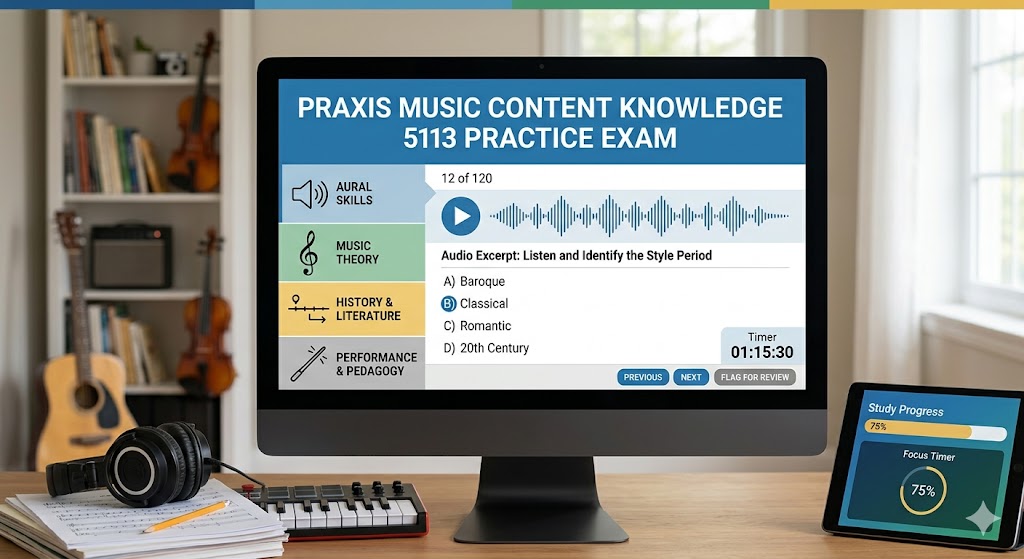
Additional Information
What the Course Entails and Exam Details
This examination covers a broad spectrum of musical concepts and educational principles. While it is a single test, the content is divided into two primary sections, which are further broken down into specific categories.
Section 1: Listening (Aural Skills)
Aural Skills: Involves identifying and analyzing musical elements in audio excerpts, such as melody, harmony, rhythm, timbre, dynamics, and form.
Performance: Includes critical listening to identify performance errors (e.g., pitch, rhythm, intonation, balance, blend) and understanding basic conducting and accompaniment techniques from aural cues.
Music History and Literature: Requires knowledge of significant characteristics of major musical styles, historical periods, and world music from all inhabitable continents. You must be able to link style to the culture of origin.
Theory and Composition: Assesses your ability to apply music theory to aural examples, covering topics like texture, tempo, ranges, chords, and texture.
Section 2: Non-listening
Music History and Literature: Covers the same topics as Section 1, but with questions that do not include audio and incorporate print and electronic sources.
Theory and Composition: Evaluates your understanding of written music analysis and the application of music theory to composition and arranging.
Performance: Focuses on topics that do not require audio, such as score reading, interpretation of notation, strategies for developing a score, concert etiquette, and the relationship between acoustics and performance.
Instruction, Professional Issues, and Technology: This crucial category covers pedagogical approaches, instructional strategies for various settings, integration of educational standards, classroom management, differentiation of instruction, and professional and ethical issues in music education.
What to Expect in the Final Exam
The Praxis Music 5113 exam is a computer-based test that consists of 120 selected-response questions, which are essentially multiple-choice questions.
Time Limit: You will have a total of 2 hours to complete the entire exam. It is divided into an untimed 30-minute tutorial and introductory section, followed by the timed 2-hour test.
Passing Score: The score required to pass is not uniform; it varies from one state to another. Scores are reported on a scaled range from 100 to 200. It is crucial to check with your state's department of education to determine the specific passing score you need.
Specific Rules: On test day, you can expect strict security protocols. If you are taking the test at a testing center, all personal items must be stored, and you will not be allowed to wear headphones for the listening section, as the audio will be played through speakers. Scratch paper will be provided. If you choose to take the exam remotely, you must meet stringent technical requirements, including a working camera, microphone, and speaker, and a private, secure environment, which will be subject to a room scan.
How to Study and Exam Centers
Preparation is key to succeeding on the Praxis Music 5113. Here is a plan of action:
Study Strategies:
Diagnostic Test: Begin your preparation with a Praxis Music Content Knowledge (5113) Practice Test to identify your strengths and weaknesses. This will help you create a targeted study plan.
Study Companions and Guides: Utilize official ETS study materials and other reputable Praxis prep guides. Focus on the core content areas and familiarize yourself with the question types.
Aural Skills Practice: This is a key differentiator. Dedicate significant time to listening exercises. Practice dictation, error detection, and identifying musical styles, periods, and genres.
Review Core Material: Brush up on music theory, analysis, history, literature, pedagogy, and instructional technology.
Use Practice Tests: Regularly take full-length practice exams. This will help you manage your time and improve your stamina for the 2-hour test.
Exam Centers:
You have two primary options for where to take the exam:
Physical Testing Centers: You can take the test at various physical centers, such as Pearson VUE centers, other authorized testing facilities, or specific schools and universities. You will select a location and date during the registration process on the ETS website.
At-Home Testing: ETS offers a remote testing option. If you select this, you must meet all the technical and environment requirements and will be proctored remotely.
Job Opportunities from the Course
Passing the Praxis Music 5113 exam is typically a mandatory step to obtaining licensure to teach music. This certification opens a wide range of career paths within educational systems:
K-12 Music Teacher
General Music Teacher (Elementary/Middle School)
Band Director
Choir Director
Orchestra Director
Vocal Music Teacher
Instrumental Music Teacher
Music Educator for Special Needs
Fine Arts Department Chair or Administrator (with advanced degrees/experience)
Frequently Asked Questions
Reviews
5.0
Based on 0 reviews
Leave a Review
No reviews yet. Be the first to review!